Claude Opus 4.6 to 4.7: What Anthropic actually changed
 Follow Us

AI model upgrades have a habit of sounding more incremental than they really are. Is Claude Opus 4.7 continuing that tradition or is it actually better? According to Anthropic, it doesn’t reinvent what Claude does, but fixes the things that made you distrust it.
 Survey
Also read: Claude Opus 4.7 announced: Three interesting things you should know
The self-doubt is gone
While Opus 4.6 was able but overly cautious in its interpretation of prompts, with many tasks being abandoned partway because of difficulty at agentic processing level, Opus 4.7 interprets prompts very literally (to almost the point of being uncomfortable). Anthropic has cautioned developers that prompts they developed for Opus 4.6 may get unexpected results from Opus 4.7 because it provides very straightforward implementations based on exactly what you’ve asked for versus what you were probably wanting. That’s a feature, not a bug.
With this change, the progress with coding has followed suit- for example, when trying to measure dev teams using the same benchmarks internally, Cursor had a respective 70% completion rate with Opus 4.7 compared to 58% with Opus 4.6. Notion also got 14% better performance with fewer tool errors when performing multi-step workflows. These increases are not just minor improvements, but show that the new model is able to finish what it started.
Vision went from passable to useful
Also read: OpenAI’s Agents SDK 2026 Update: What’s New in Building AI Agents
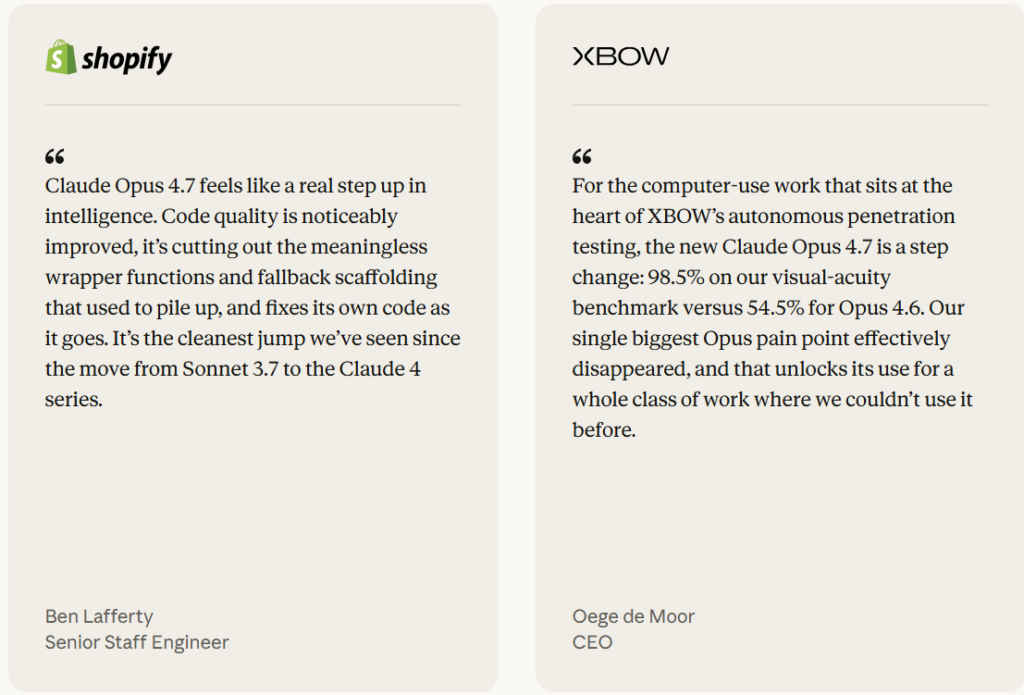
The resolution of images processed by Opus 4.6 was sufficient for general use, but it was unreliable for precise applications. With Opus 4.7, images may now be fully processed up to 3.75 megapixels. This significant increase from 4.6 translates into a substantial increase in the quality of stored images including complicated diagrams, graphic depictions of chemical structures, and complex technical diagrams. According to Oege de Moor, CEO of XBOW, the scores on their internal visual acuity benchmark went from 54.5% on 4.6 to 98.5% on 4.7.
Memory and long-horizon work
While Opus 4.6 started each session fresh (with a minimal number of previous files in memory), Opus 4.7 provides improved multi-session file system-based memories. For users running long agentic workflows, this memory will significantly enhance the user experience.
The tradeoffs are real
It would be dishonest to call 4.7 a pure upgrade with no caveats. he new tokenizer means the same input can map to 1.0 –1.35 times more tokens than before, and higher effort levels generate more output. Costs can creep up. Anthropic acknowledges this and offers mitigation through effort parameters and task budgets, but teams should measure before assuming efficiency gains.
Still, the overall picture is of a model that has grown up. Opus 4.6 was impressive and occasionally unreliable. Opus 4.7 feels like the version Anthropic always meant to ship.
Also read: Claude announces ID verification: What it means for your account and privacy


