Claude Opus 4.7 announced: Three interesting things you should know
 Follow Us

Anthropic’s latest flagship model arrived today, and while the benchmarks are as you would expect with a new model, the devil is in the details. Here’s what actually matters about Claude Opus 4.7.
 Survey
Also read: Claude announces ID verification: What it means for your account and privacy
It finally trusts itself
The main focus of Opus 4.7 is writing code, however it is more than just a way to make your experience quicker. The model not only creates code, but also verifies it and determines if there are logical errors in the design phase. Prior models would quit working on difficult tasks or produce plausible but incorrect results, whereas Opus 4.7 continues to solve those problems.Caitlin Colgrove, co-founder and CTO of HEX stated that “correctly reports when data is missing instead of providing plausible-but-incorrect fallbacks”. This has been a common problem with any AI-based work for a long time.
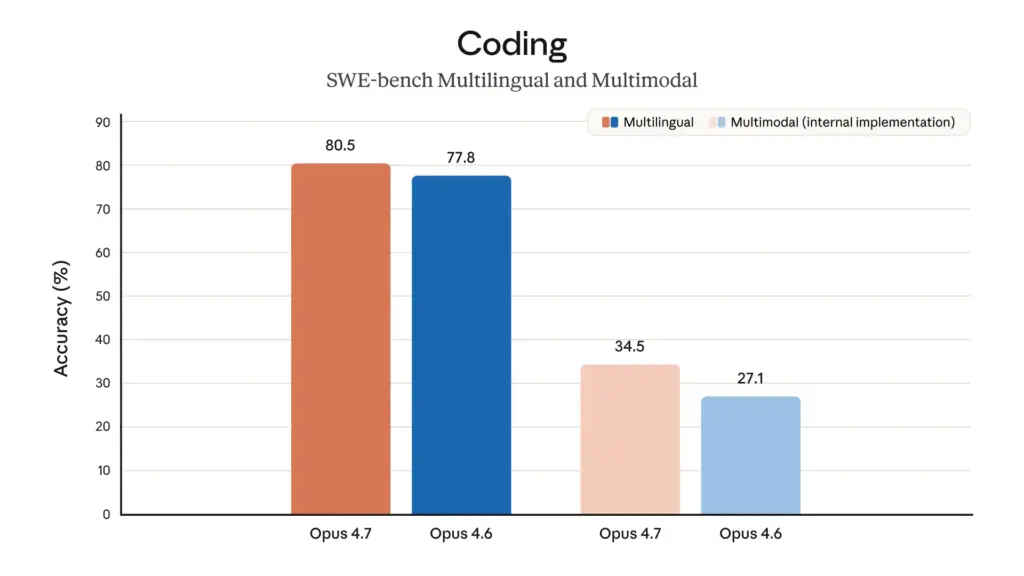
This results in software teams being able to rethink how much supervision agentic actions actually require. Tests have shown the model is already achieving 14% better score than Predecessor models at many companies including: Cursor, Warp, and Notion, and verified that it has successfully completed tasks where previous Claude models couldn’t. The difference between a model producing results compared to a model producing results that customer can ship.
Also read: Apple and Google reportedly hosting deepfake nudity apps, despite breach of policy
It can actually see now
Vision has always been something of an afterthought in language model upgrades, functional, but rarely transformative. Opus 4.7 is a genuine step change. The model now accepts images up to roughly 3.75 megapixels, more than three times the resolution of earlier Claude models. That might sound like a technical footnote, but the practical applications are significant.
For anyone doing computer-use automation, reading dense screenshots or complex technical diagrams is no longer a coin flip. One life sciences company testing the model flagged major improvements in reading chemical structures. Another noted near-perfect visual acuity on benchmarks that Opus 4.6 had scored just above 50% on. The upgrade isn’t cosmetic, it opens up an entire class of multimodal work that simply wasn’t reliable before.
It’s the first model with built-in cyber guardrails
In all of the excitement surrounding launches, it is easy to overlook this one; however, it is something worth noting. Anthropic recently revealed Project Glasswing where they raised a number of serious concerns about the implications of artificial intelligence in regard to cybersecurity. Opus 4.7 is the first time where the training has been specifically done based on these concerns. The company indicates that they experimented with purposely limiting a selection of cyber capabilities throughout the training of this model. In addition, they developed the ability to automatically detect and block requests to the Opus Model related to prohibited or higher risk cyber uses.
For the entire industry, this is a strong signal of what is possible with model-generated content. It is one thing to simply add a content filter; it is considerably different to make decisions regarding the safety of a model at the model level and then to be transparent regarding those decisions and the associated tradeoffs. Security professionals who are legitimately involved, such as penetration testers; red teamers; and vulnerability researchers will be able to apply to a new Cyber Verification Program that will allow them to gain full access to Opus. For all others, they will receive it with purposeful limitations.
Opus 4.7 will be available across Claude’s entire suite of products and through the API at a cost of $5 per million tokens input and $25 for every million tokens output.
Also read: Anthropic uses AI agents for AI alignment breakthrough, but at what cost?


