
Motorola Razr Fold vs Samsung Galaxy Z Fold 7: Price, display, camera, performance, battery and more
 Follow Us
Motorola Razr Fold offers brighter displays, faster charging and a bigger battery.
Samsung Galaxy Z Fold 7 focuses on premium cameras and refined One UI software.
Both foldables feature flagship chips, AI tools and 7 years of updates.
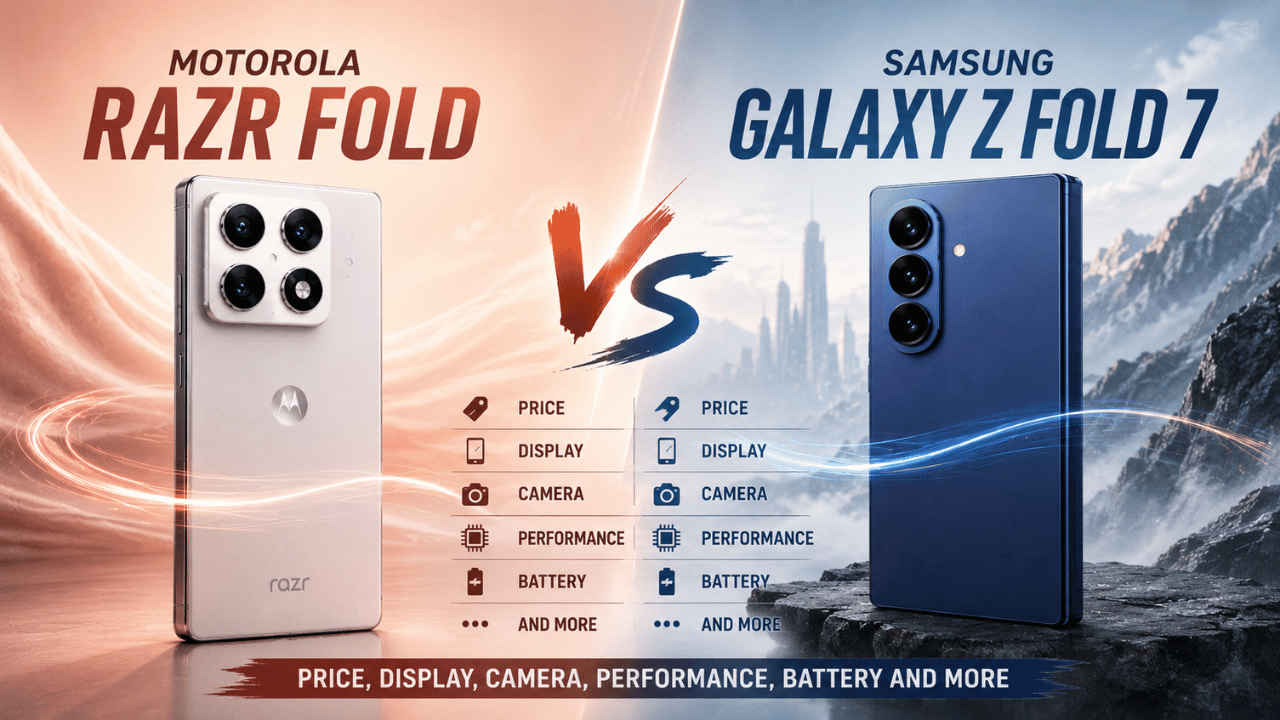

The foldable smartphone segment is heating up with the arrival of the Motorola Razr Fold, and the device is direct competition to Samsung’s Galaxy Z Fold 7. While both the devices bring top-tier specifications, large immersive displays and flagship chipsets, they are built to cater to different audiences. On paper both the foldable smartphones are packed with AI features as well. Motorola focuses on brighter displays, faster charging and a larger battery, while Samsung aims to deliver a refined foldable experience with its powerful camera system and polished One UI software. Here is a detailed spec-based comparison of the Motorola Razr Fold and Samsung Galaxy Z Fold 7.
 Survey
Motorola Razr Fold vs Samsung Galaxy Z Fold 7: Display
The flagship book-style foldable from Motorola comes equipped with an 8.1-inch LTPO pOLED inner display with a 120 Hz refresh rate. The smartphone also supports HDR+, and when used under bright light, the smartphone can reach a peak brightness of 6,200 nits. However, on the exterior, the device houses a 6.6-inch LTPO pOLED panel with a 165Hz refresh rate and 6,000 nits of peak brightness. It also sports Corning Gorilla Glass Ceramic Shield 3 protection to keep the device protected against accidental drops and scratches.
On the other hand, the Samsung Galaxy Z Fold 7 features a slightly smaller 8.0-inch AMOLED main screen with a 120Hz adaptive refresh rate. Under the direct light the smartphone can reach a peak brightness of 2,600 nits. Talking about the outer panel, it houses a 6.5-inch AMOLED panel with 120Hz of adaptive refresh rate.
Samsung Galaxy Z Fold 7 vs Motorola Razr Fold: Performance
The Galaxy Z Fold 7 draws its power from Qualcomm’s Snapdragon 8 Elite. It also comes packed with up to 16GB of RAM and up to 1TB of non-expandable internal storage variants.
The Motorola Razr Fold also comes with a similar setup as it’s backed by the Qualcomm Snapdragon 8 Gen 5 chipset and houses the Adreno 829 GPU. Along with that, it also features 16GB LPDDR5X RAM and 1TB UFS 4.1 internal storage, which is non-expandable.
Motorola Razr Fold vs Samsung Galaxy Z Fold 7: Battery
The Motorola Razr Fold is backed by a 6,000mAh silicon-carbon battery that supports 80W TurboPower wired charging. Not only that but it also supports 50W wireless charging and 5W of reverse wireless charging.
Comparatively, the Samsung Galaxy Z Fold 7 5G features a slightly smaller battery of 4,400mAh with 25W wired, 15W wireless and 4.5W reverse wireless charging support.
Samsung Galaxy Z Fold 7 vs Motorola Razr Fold: Camera
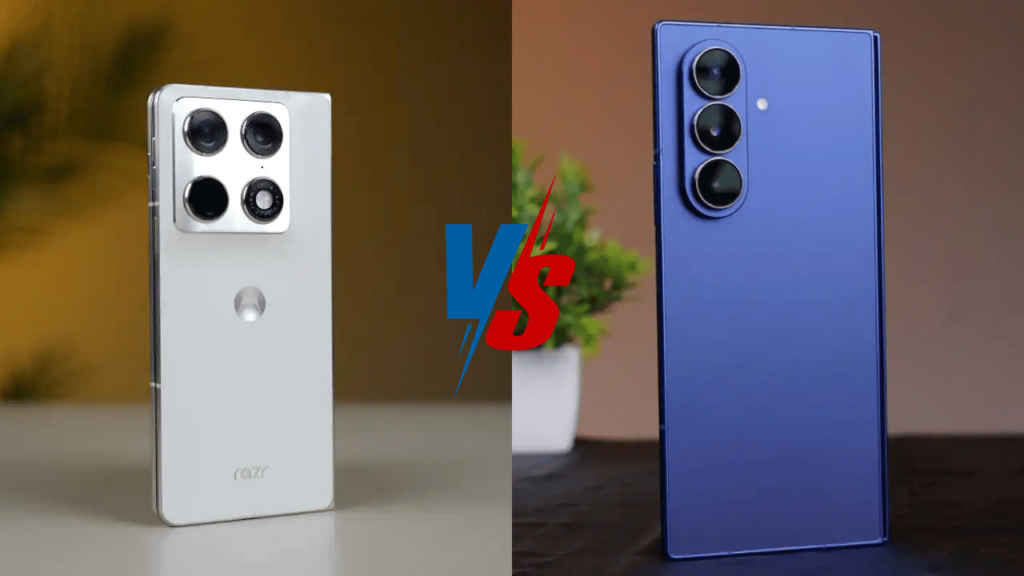
In terms of optics, the Samsung Galaxy Z Fold 7 sports a triple camera setup at the rear end of the device, including a 200MP main lens, a 10MP telephoto sensor and a 12MP ultrawide camera. It also boasts a 10MP front camera on the cover display and a 10MP standard sensor on the inner display for selfies and video calls.
In comparison to that, the Motorola Razr Fold features a triple 50MP camera setup at the back which has a main camera, an ultrawide lens and a telephoto periscope sensor. At the front, it comes with a 50 MP camera that is good for selfies and video calls.
Motorola Razr Fold vs Samsung Galaxy Z Fold 7: Software
On the software front, the Motorola Razr runs on Android 16 and comes with Hello UI AI capabilities. The firm is also providing 7 years of OS and security updates. Similar to that, the Samsung Galaxy Z Fold 7 also runs on the Android 16-based One UI 8. The South Korean tech giant has also promised 7 years of major Android OS upgrades along with security patches.
Motorola Razr Fold vs Samsung Galaxy Z Fold 7: Price
The Motorola Razr Fold launched at Rs 1,59,999, while the Samsung Galaxy Z Fold 7 debuted at Rs 1,74,999.


