
Realme 16 5G review: A budget phone wearing a midrange price tag
 Follow Us

There is a certain pattern you begin to notice when you use enough phones in the sub Rs 35,000 segment. On paper, almost everything looks similar and sorted, as almost each one of them comes with bigger batteries, high refresh rate displays, multiple cameras, and numbers that try to sound impressive. However, the real story begins when you take the phone out of that controlled setup and start living with it. Not testing it just for a few hours, but actually using it as your own phone through the day. That is exactly what I did with the Realme 16 5G, which is priced in India starting at Rs 31,999.
I’ve been using the Realme 16 as my primary device for a few weeks now. I’ve used it for everything. I use it for Instagram, for watching YouTube and OTT, taking voice/video calls, gaming, and clicking photos. Basically, I have used it the way most people would, with no switching back to a secondary phone and no avoiding weak areas, just regular day-to-day usage. While the Realme 16 5G tries hard to present itself as a well-rounded device, the longer I spent with it, the more its compromises began to show in ways that are hard to ignore.
Here’s my full review of the Realme 16 5G.
Realme 16 5G design: Looks that try too hard
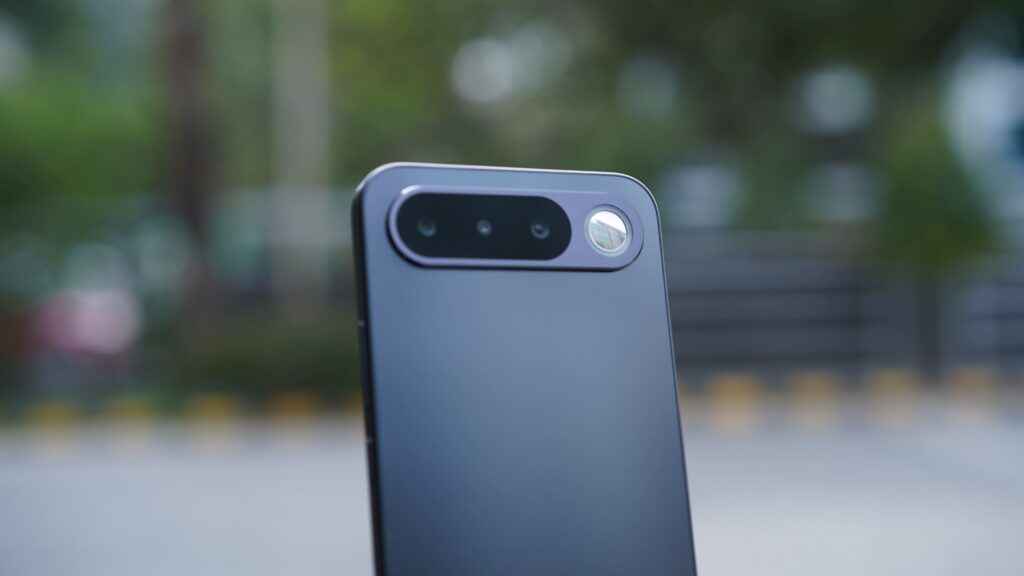
While everything may look good on paper, the first thing you notice when unboxing a device is its design and build, and that was exactly my experience. As soon as I took the Realme 16 out of the box and held it in my hand, it felt light, easy to grip, and not bulky at all. In those first few minutes, it gave me the impression that Realme has done a decent job here, with an intent to deliver a slightly premium feel the moment you pick up the phone.
However, as you continue using the device, small issues begin to surface. The back panel, which appears to be made of polycarbonate with a matte finish, does a good job of resisting fingerprints, which is a plus. It does not pick up smudges easily, and that helps it look clean at a glance. But dust is a completely different story.
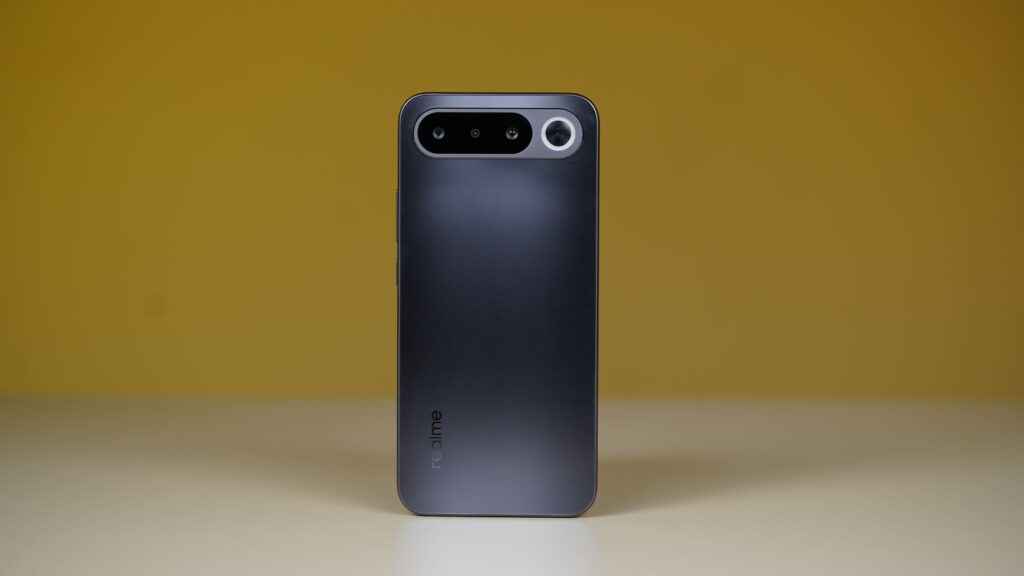
I tested the black variant of the Realme 16, and the area around the camera module is where things start to fall apart. It attracts dust almost instantly, and the dust is quite stubborn. No matter how many times you wipe it, it starts looking messy again within minutes. Over time, this becomes frustrating because the phone never really appears clean, especially around the camera section.
From a durability standpoint, the phone feels decent but not reassuring. The lightweight build helps with comfort, but it does not give that solid confidence you expect at this price. There is no strong sense of toughness here, as the edges and the back panel do not feel like they can handle rough usage without picking up marks over time.
Moreover, the camera module itself presents another problem. There is a noticeable bulge, and when placed on a flat surface, the phone does not sit evenly and tends to wobble. While using a case can fix this, that is not really the point. Without one, the experience feels somewhat unfinished.
On the positive side, the buttons are well done. They are tactile and responsive, which adds a sense of confidence during everyday use.
Realme 16 5G display: Bright and clear
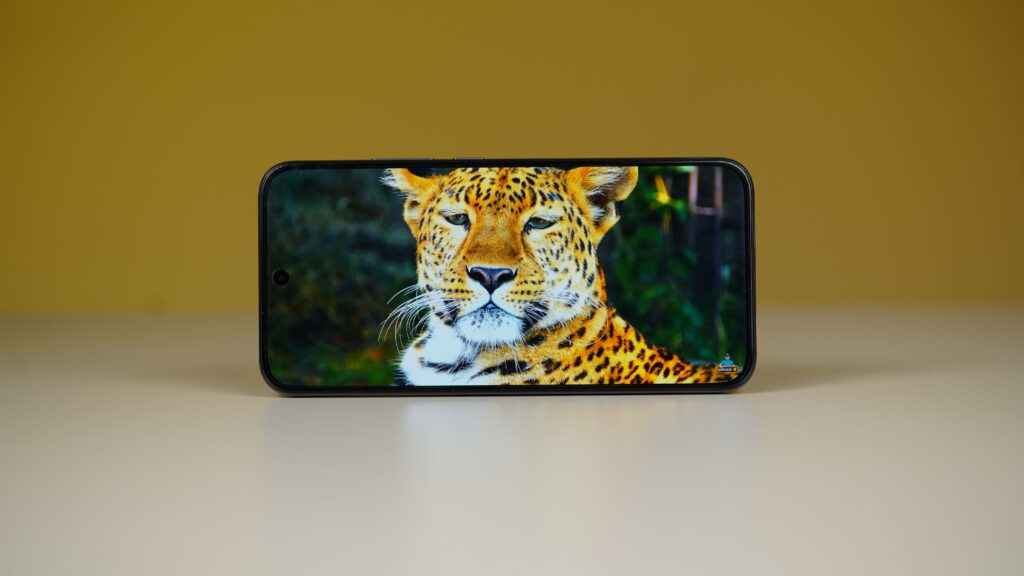
The Realme 16 comes with a 6.57-inch AMOLED display that, at first glance, feels well-balanced and easy to like. It is sharp, smooth and bright enough for most situations. The 120Hz refresh rate keeps scrolling fluid, and animations feel clean without any stutter.
The Realme 16 comes with a claimed peak brightness of 4,200 nits. That said, we all know how peak brightness works. Where it all matters, in our testing, the phone achieved 1,631 nits in High Brightness mode (HBM). The phone is rated to hit 1,400 nits in HBM, so getting this sort of result is actually fantastic, though not the brightest in the segment. However, for what it’s worth, the screen is still good enough for comfortable use under sunlight. The text remains readable, and colours do not wash out easily while using the device outdoors.
I also tested the display using Calman, and the results are quite reassuring. Colours appear accurate and balanced in the Natural mode, which is also the most calibrated mode available in the device. The average DeltaE came out to 1.8, and the maximum DeltaE was 3.6. Whites look clean, Blacks are deep, and the contrast is strong. The measured white luminance was around 592 cd/m², while black luminance stayed close to zero, which helps with that punchy look.
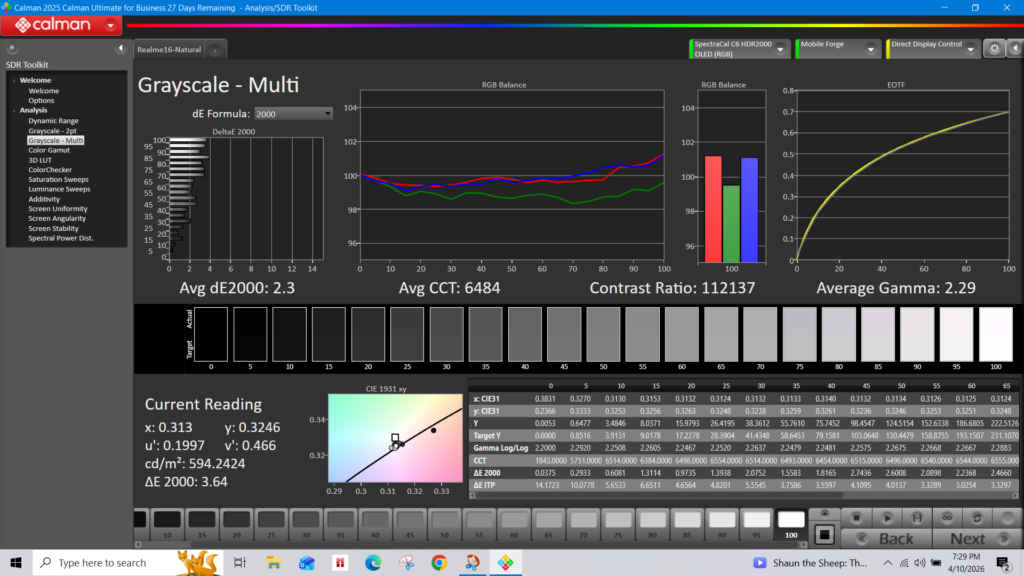
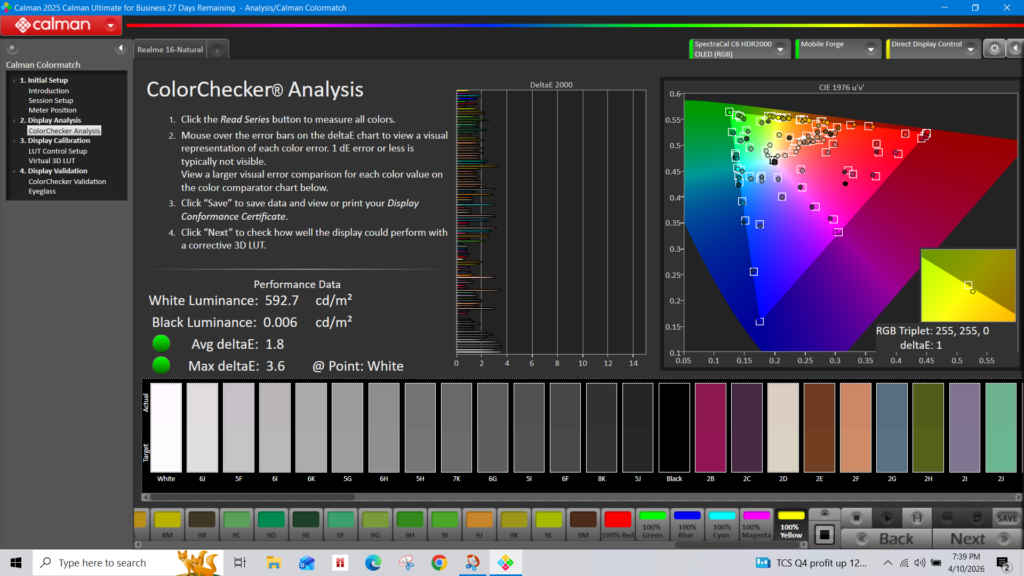
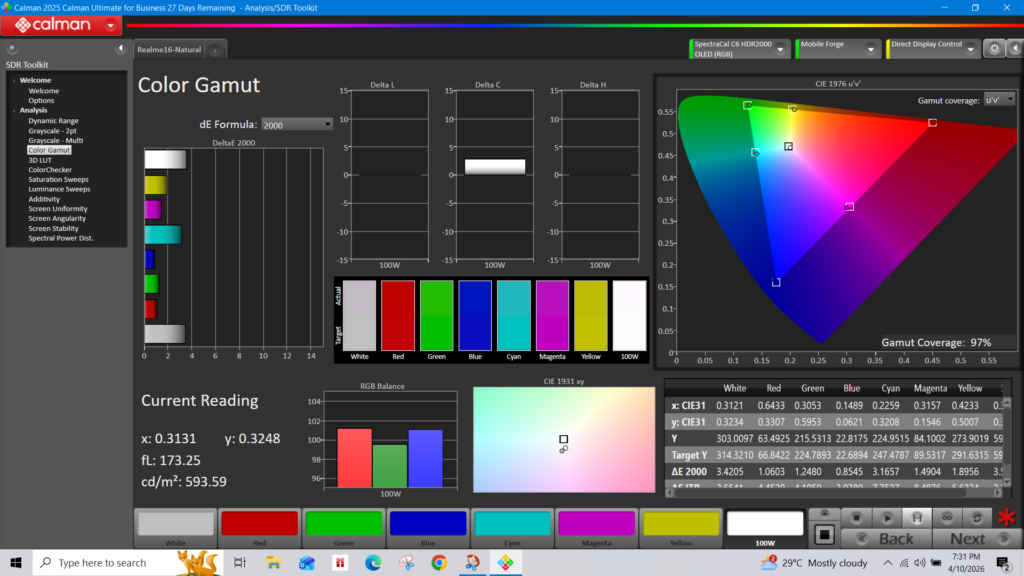
What this means in daily use is simple. The content looks natural, the skin tones do not look off, landscapes have the right colours, and even simple things like reading documents feel easy on the eyes. The display does not try too hard to boost colours, and that actually works in its favour.
Realme also offers multiple colour modes, and the Natural mode is clearly the one to use if you care about accuracy, as it is properly calibrated. On the other hand, the Cinematic mode is not calibrated and leans more towards boosted colours for a more dramatic look.
Overall, after spending time watching YouTube, Netflix and some IPL matches, the screen feels reliable and consistent. But again, in this similar price bracket, as I mentioned, there are brighter options than the Realme 16.
Realme 16 5G performance: Decent build, but the performance is…
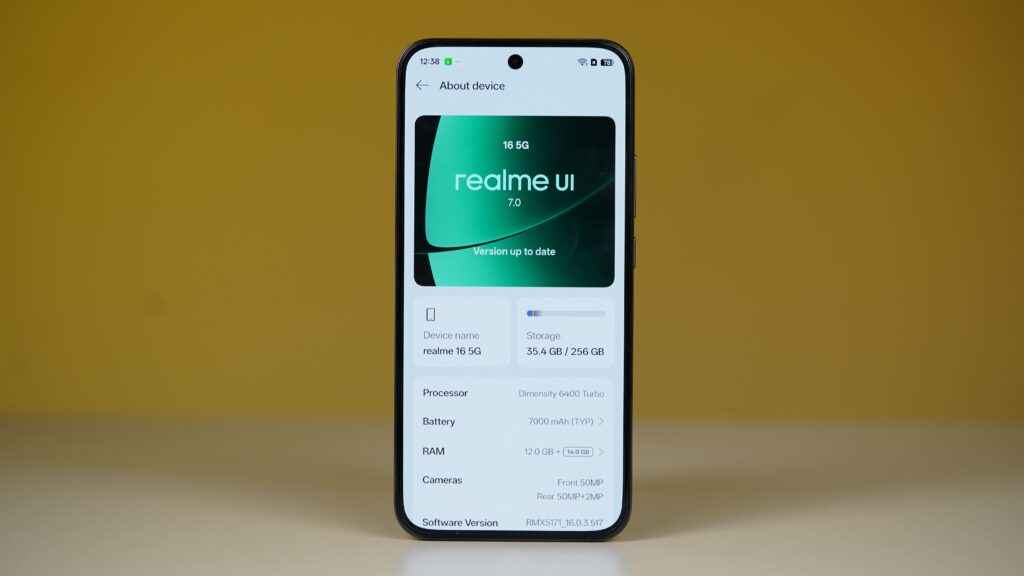
The Realme 16 5G is powered by MediaTek’s Dimensity 6400 Turbo chipset, paired with a Mali G57 MC2 GPU. On paper, the brand tries to sell it as a ‘Turbo’ chip with stable performance and efficient multitasking, along with a large 6050mm² vapour chamber cooling system for thermal management. But let’s be honest, calling this a ‘Turbo’ chip already feels like an overstatement. This is an entry-level to lower-midrange processor being stretched into a price segment where expectations are clearly higher. Granted, the prices of components are rising, and so are the phone prices. Having said this, I still think Realme could have done a better job with the choice of chipset here.
Anyway, in general everyday usage, the phone manages to stay usable, as basic tasks like calling, messaging, scrolling through social media, and light multitasking work fine. However, the moment you push it slightly harder, the cracks start showing, as the app opening speeds are not the fastest, animations occasionally feel delayed, and there are random hiccups that you simply cannot ignore.
Moreover, gaming performance is also not the strongest in the segment. While the casual games like Subway Surfer, Temple Run, Cards and more run fine, the moment you move to something like BGMI or heavier titles with the high-end settings, the device starts to show its weakness. You’ll find the frame dropping frequently, and maintaining stable performance becomes a challenge. Fortunately, the device does not heat aggressively, but that is mainly because it is not pushing enough performance in the first place.
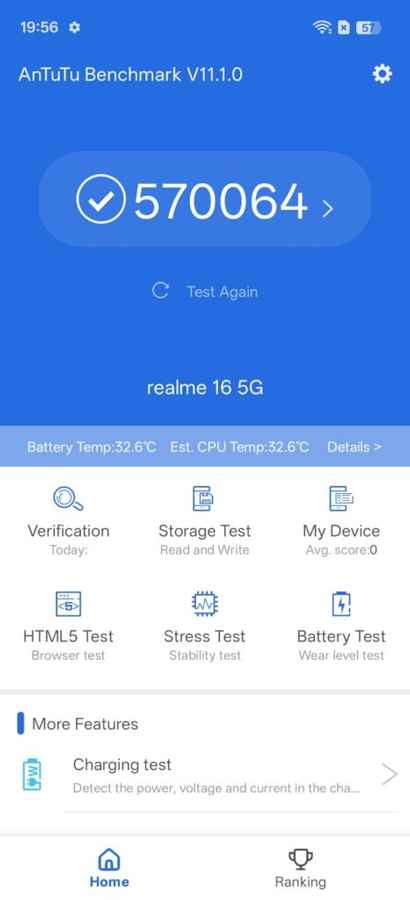
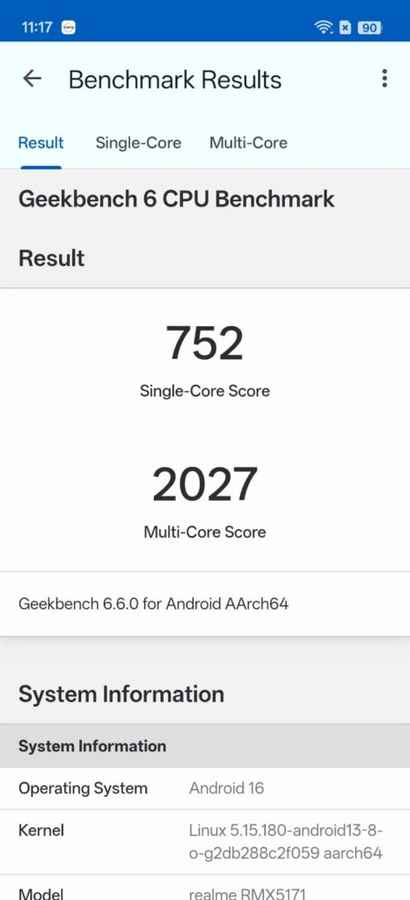
Benchmark numbers make things even clearer. On Antutu, the device scored 5,70,064, which is honestly underwhelming for a phone priced at Rs 31,999. Geekbench 6 results show a single-core score of 752 and a multi-core score of 2,027, which again puts it far behind what competitors are offering in this segment.
GPU performance is where things really start to fall apart. In Geekbench’s GPU test, the device scores just 1,423, while in 3DMark Wild Life Extreme it manages a mere 382, averaging only 2.29 FPS. That figure alone says a lot. It becomes immediately clear that this is not a gaming phone, and these numbers confirm that it does not even come close to earning that label.
Storage performance is decent, but nothing exceptional. Sequential read speeds hover around 552 MB/s, while write speeds reach about 451 MB/s. These are acceptable figures, but once again, there is nothing here that justifies the asking price.
While Realme had a chance to balance this device properly, it instead feels like the company focused too heavily on battery and design, treating performance as an afterthought.
Realme 16 5G battery and charging: Reliable companion
The Realme 16 5G 5G is backed by a massive 7,000mAh battery, which is easily one of its biggest highlights. Realme pairs this with 60W charging, along with features like AI battery management and optimised power efficiency aimed at extending long-term battery health.
Whether it’s continuous social media scrolling, photography, video streaming, navigation, or even occasional gaming, the battery holds up effortlessly. For most of you out there, this is easily your full day’s or half-day’s usage. Moreover, even if you have a heavier usage pattern than that, I feel like getting through a full day without worrying about charging is very realistic with the Realme 16.
What also works in its favour is consistency, as the battery drain feels controlled and predictable, rather than erratic. Realme’s optimisation features, including AI-based power management, seem to be doing their job well in balancing performance and efficiency behind the scenes.
During our testing, the Realme 16 5G went from 0 to 100 per cent in about 1 hour and 40 minutes with the included charger. I know, it is not the fastest, but as mentioned, the solid battery life more than makes up for the slow charging.
Realme 16 5G camera: Versatile or a marketing gimmick?
On paper, the Realme 16 5G tries very hard to sell you a story and stick with me on this. You get a 50MP Sony IMX852 primary camera, paired with what looks like a multi-sensor setup and backed by a long list of features like LumaColor imaging, Vibe Master mode, AI Edit Genie, and even a so-called selfie mirror. It all sounds impressive. Yes? But once you start using the device, reality kicks in, and you realise this is not a versatile camera system at all.
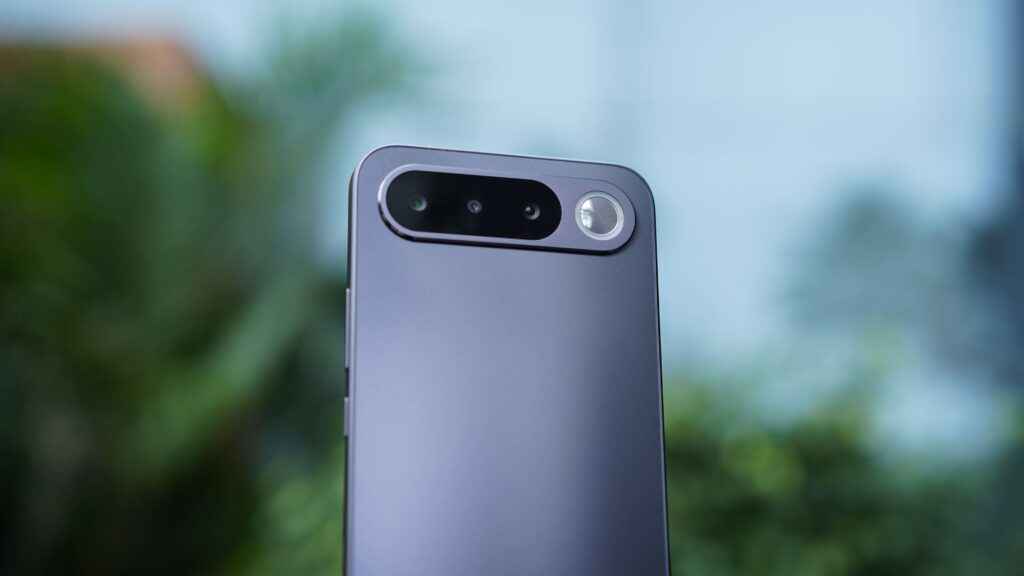
Despite the triple-cutout design at the back trying its best to mimic a flagship-style setup, what you actually get is just a single usable 50MP camera and a 2MP monochrome sensor. That’s it. No ultra-wide, no telephoto, nothing meaningful beyond the basics.
Moreover, the extra sensor cutouts just feel like pure cosmetic fillers designed to trick buyers into thinking they’re getting more hardware than they actually are. This can be quite misleading.




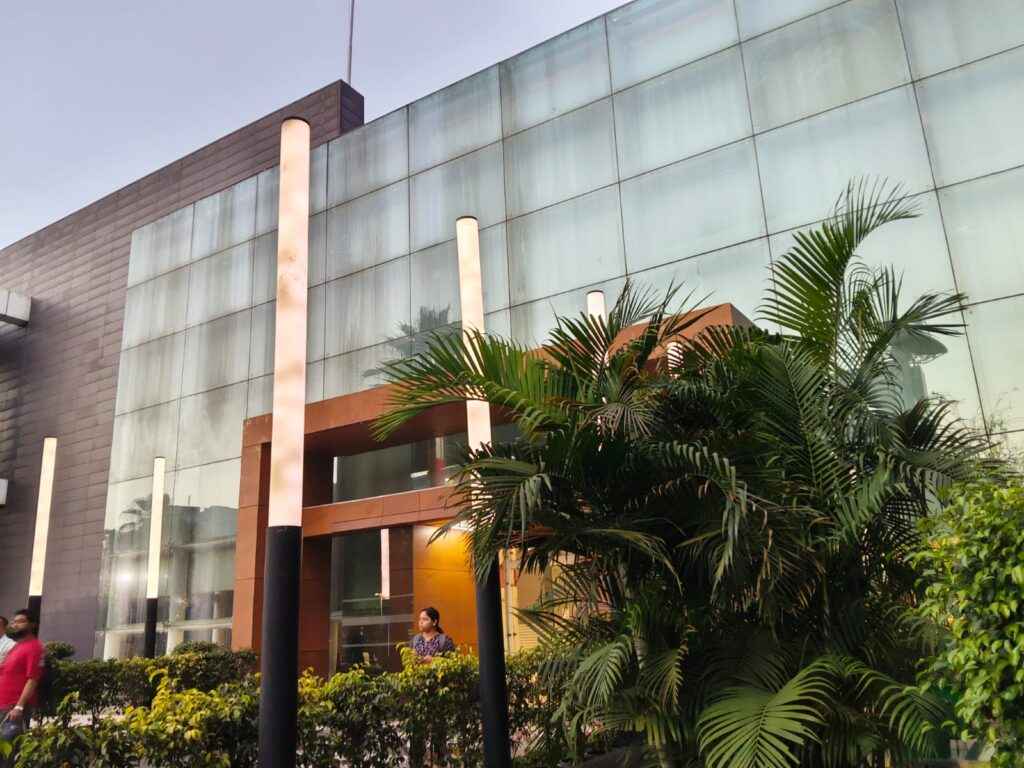

As for the performance, in daylight, the main camera manages to stay fine as the colours are fairly natural, and the detail level is acceptable for casual shots. However, when it comes to capturing images in low light, the expectations go downhill. The output is soft, noisy, and inconsistent. Furthermore, there is visible grain, a weak dynamic range, and poor handling of highlights. The processing doesn’t save the situation either, as it just struggles. Instead of enhancing detail, it often ends up making images look flatter and less usable.





Adding icing to the cake is the so-called ‘selfie mirror’, which is nothing more than a gimmick that sounds clever but delivers a full bowl of nothing. It can neither be used to fix your makeup nor help with selfies (which is typically its actual use). The biggest issue, I feel, is the placement, as when you try to click a selfie using the mirror, your eyes are locked onto the mirror, and that’s pretty much evident in the results.
Even the software additions like AI editing tools and portrait enhancements feel more like checkbox features rather than genuinely useful tools. Yes, the phone pushes things like LumaColor processing and AI portrait tuning, but when the core hardware itself is this limited, no amount of software polish can truly compensate.
Realme 16 5G: Verdict
The Realme 16 5G looks like a solid option at first, but the longer you use it, the more its weaknesses start to show. In a price range where balance matters the most, this phone feels uneven.
Undoubtedly, the standout feature of this phone is its battery. With a capacity of 7000mAh, it performs well and is capable of lasting over a full day with extensive usage. Design-wise too, the phone can get a pass for its looks and nimble feel. However, aside from this, I was really expecting the performance to be better than what we actually got. The Dimensity 6400 isn’t the fastest in this segment with app speeds, multitasking, and gaming. It feels slow at times and simply does not match what competitors are offering. The camera too, while it does a decent job in good light, delivers average results when the light gets dim.
Realme 16 Key Specs, Price and Launch Date
| Release Date: | 02 Apr, 2026 |
| Market Status: | Launched |


