
Qubo R700 review: Best air purifier under Rs 15,000?
 Follow Us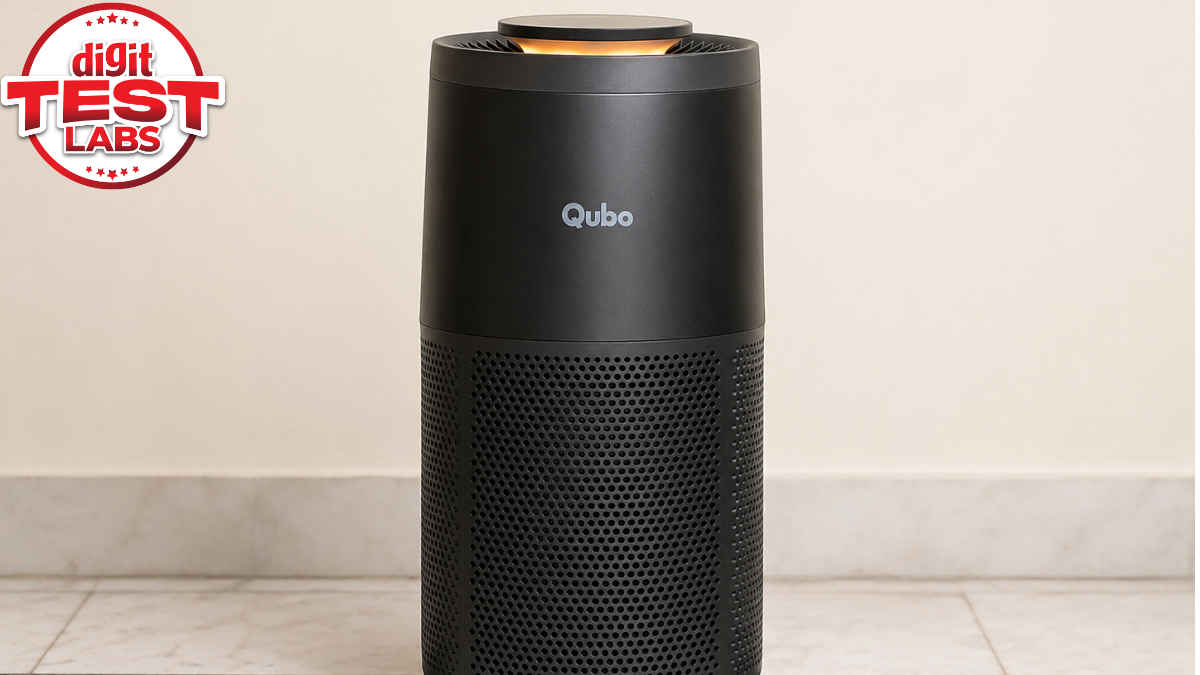

In most Indian cities, you need an air purifier to breathe quality air at home. And today, if you search online, you get plenty of options across budgets. Recently, I made a listicle for air purifiers under Rs 20,000, and one brand that stood out for its offering is Qubo. The Here Group company recently launched the R700 air purifier and sent us a unit for review. It retails at around Rs 15,000 in India, and on paper, it is a very competent product. It boasts a CADR of 460 m³/h, coverage area of up to 700 sq. ft., True HEPA H13 filtration, BLDC motor, app support, and voice assistant integration. But specifications alone do not make a good air purifier. In real-world usage, factors like airflow behaviour, purifying quickness, noise, maintenance cost, and day-to-day convenience matter more. So, I have used the Qubo R700 for a few weeks now and here’s my experience.
Qubo R700: Design and indicators
Most air purifiers I have come across are in white or off-white colour. The Qubo R700 at least tries to look different with its matte black cylindrical design, which isn’t just an aesthetic choice, but the cylindrical form factor with pores on the surface allows for 360-degree air intake. This also means that regardless of the way it is placed, there are some openings to intake impure air.
That said, over time, the black finish does attract smudges, dust, dirt and stains. But you can easily wipe and clean it.
It weighs very little, too. The day it was delivered on a bike, it was easy to carry it upstairs to my room on the first floor. At about 4.1kg, the R700 can be easily moved around the house, if needed.
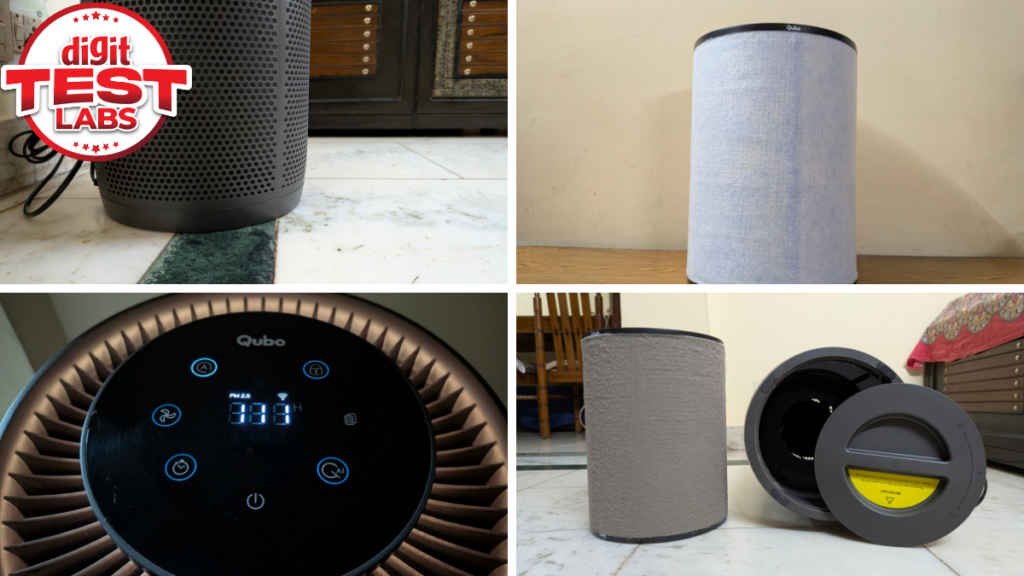
On top, you have the air vents for pure air throw and a control panel with comprehensible text and icons. The control panel is a touch interface. You get toggles for Power On/Off, Fan Speeds, including sleep mode, Timer, Auto Mode, and QSenseAI. Well, the difference between the latter two is that Auto Mode regulates fan speed only between 1, 2 and 3 levels, whereas QSenseAI cycles between Sleep Mode and other fan speeds based on your usage habits and indoor air quality. It is slightly more efficient than regular Auto Mode.
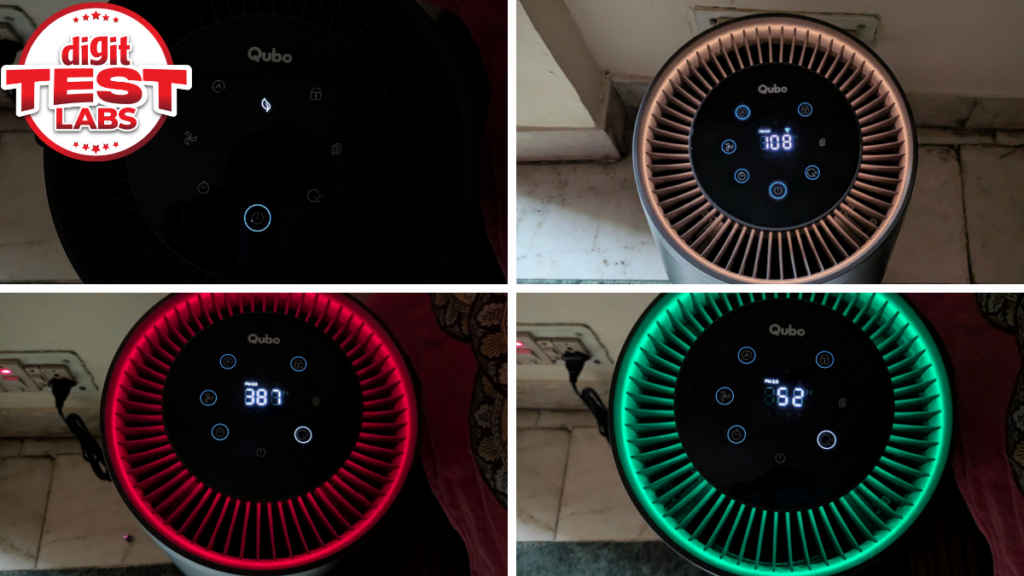
In the centre, there is a PM 2.5 indicator which changes in real-time. And besides the white-coloured lighting of these icons and PM 2.5 numerical indicator, there is also a colour-based indicator: Red for very poor quality, Yellow for poor air quality and Green for satisfactory air quality.
Out of the box, the filter will already be installed inside the purifier, but it will be covered in plastic. To remove it, unlock the bottom cover by rotating it anticlockwise. Take out the filter, remove the plastic cover, place the filter back inside, and lock the cover by rotating it clockwise. Then plug in the purifier and start using it.
Also Read: Best air purifiers between Rs 15,000 and Rs 20,000 in India in 2026
Qubo R700: Filtration and real-world performance
The Qubo R700 purifier claims a CADR of 460 m³/h with room coverage of up to 700 sq. ft. These figures are impressive for the price. I placed it in our bedroom, which measures about 150 sq. ft., and it mostly sat there unintrusive, unless we were lighting up dhoop batti in the pooja room nearby or during the night. While sleeping, the lights on the top can be distracting, so I would always manually enable sleep mode.
You don’t have to always tap the touch panel to control the R700 purifier. The Qubo app also does the same job, perhaps even more conveniently. Say, you are in the living room or on the bed, and want to toggle any mode/settings, you can do that with the app. It works over 2.4GHz Wi-Fi. The pairing is straightforward. When it works, it works reliably. But, sometimes, say when QSenseAI puts the purifier in standby mode, then when the purifier detects impure air and starts working, the app still shows the purifier as off.
I tested it wih dhoop batti lit in different scenarios:
- Lit it for about 15 feet away in an open 550 sq. ft. space, and the R700 took under 10 minutes to reduce PM2.5 by 50 per cent.
- Burned the dhoop batti for 2 minutes in a closed 160 sq. ft. room, and the purifier took under 5 minutes to reduce PM 2.5 by 50 per cent.
- If the dhoop batti is placed really close to the purifier, then it does bring down the pollution level in the room even quicker.
Dhoop batti has dense smoke, and if it takes anywhere around 10-20 minutes for near-normal air, then that is decent. In essence, this test shows the purifier can ramp up quickly and noticeably reduce indoor particulate matter (PM) levels within a short period.
The Qubo R700 uses a 5-stage filtration setup consisting of:
- Pre-filter
- Anti-bacterial filter
- True HEPA H13 filter
- Activated carbon layer for odour, VOCs and cooking smells
- Nano-silver coating
The most important filter is True HEPA H13, which is rated to capture 99.95 to 99.99 per cent of particles measuring 0.3 microns. This includes: PM2.5 pollutants, fine dust, smoke particles, allergens, pollen, and Pet dander. Well, we have a Labrador at our place, and he was seen quite often lying next to the purifier. Perhaps the cool air from it and the purifier don’t get warm either. So, I guess that’s a thumbs up from his end, too.
Another aspect where I appreciate the Qubo R700 is its quiet operation. You see, it is said to run up to 55 dB noise output. So, at the highest fan speed, it is audible. But when it is running at moderate PM 2.5 levels, the fan noise isn’t much. So, during afternoon nap, I didn’t mind using it normally without sleep mode or putting it on standby. But if you prefer the least noise, sleep mode is quiet enough. The BLDR motor inside helps in this sound profile. There is no unnecessary rattling or vibration noises.
That BLDC motor also helps in power efficiency. Qubo claims the R700 draws around 50W at peak operation. But it works dependably, and I figure running it for extended periods should not dramatically increase electricity bills.
Qubo R700: Everyday convenience and long-term costs
So, the purifier supports Wi-Fi connectivity, the Qubo mobile app and within the app, you can enable the Amazon Alexa-based voice control feature. You can say commands like turn on the purifier, turn off the purifier, etc., and the connected R700 does so. But, I feel this is very fancy and in indian homes, using the app controls or directly interacting with the device is more handy.
Besides remotely controlling the purifier, you can use the app to monitor air quality over a period of time, like the last 24 hours, 7 days, 30 days, a year, etc. You can use the app to schedule a timer, set a child lock and configure features like QSenseAI, enable silent mode, change the lighting brightness, or turn it off.
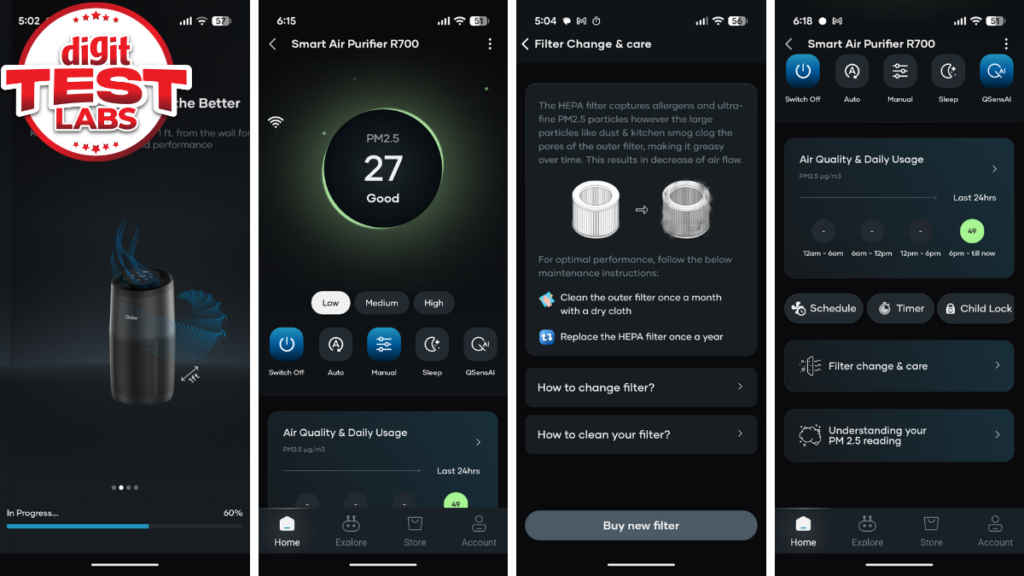
The Qubo app also guides you on how to change or clean the filter, order a new filter and understand the PM 2.5 readings. Well, at one point, I found that this understanding section wasn’t showing a 404 page not found error. I informed the brand about this bug and was assured a fix.
By the way, Qubo says the filter can last for 15,000 hours, and that’s about a year and a half. This could differ based on your usage and pollution exposure in your place. On the Qubo website, the R700 filter costs Rs 4,250. That is not cheap for an Indian middle-class home, but the competition also charges in the range of Rs 3,000 to 5,000. This is as important a factor to consider as the upfront cost since it matters for long-term ownership.
Should you buy Qubo Smart Air Purifier R700?
The Qubo R700 gets most of the fundamentals right. It can automatically and timely detect pollutants and clean the air quickly. The coverage and air throw distance are good enough for bedrooms and even medium-to-large living rooms. It works quietly and has modes to ensure your sleep or focus isn’t disturbed by its operation. The inclusion of a BLDC motor aids in its hushed performance and possibly power efficiency. All of these come packed in a neat and functional design that is portable and should blend well into your room decor. And this is backed by easily accessible LED-lit indicators and a serviceable app experience.
I say serviceable since the Qubo app needs more polish. It has the expected features. But there are some minor sync issues between the app and the on-device controls, and a few bugs and glitches that need to be ironed out. They don’t come in your way, but once Qubo fixes them, the purifier will be even better to use every day.
At Rs 14,990, the Qubo R700 is genuinely competitive and a well-rounded product. It will be a good purchase if you want clean air at your place or where your loved ones are.
Keep reading Digit.in for similar reviews.
Also Read: Qubo Q600: Why you should consider this sub-Rs 15,000 air purifier


