3I/ATLAS is the third known interstellar object after ʻOumuamua and 2I/Borisov, moving at 61 km/s on a hyperbolic path.
It shows a rare sunward “anti-tail” and a composition rich in CO₂, hinting at a pristine, ancient origin.
Harvard astrophysicist Avi Loeb rates it “4” on his “Loeb Scale” of alien likelihood, reigniting extraterrestrial debates.
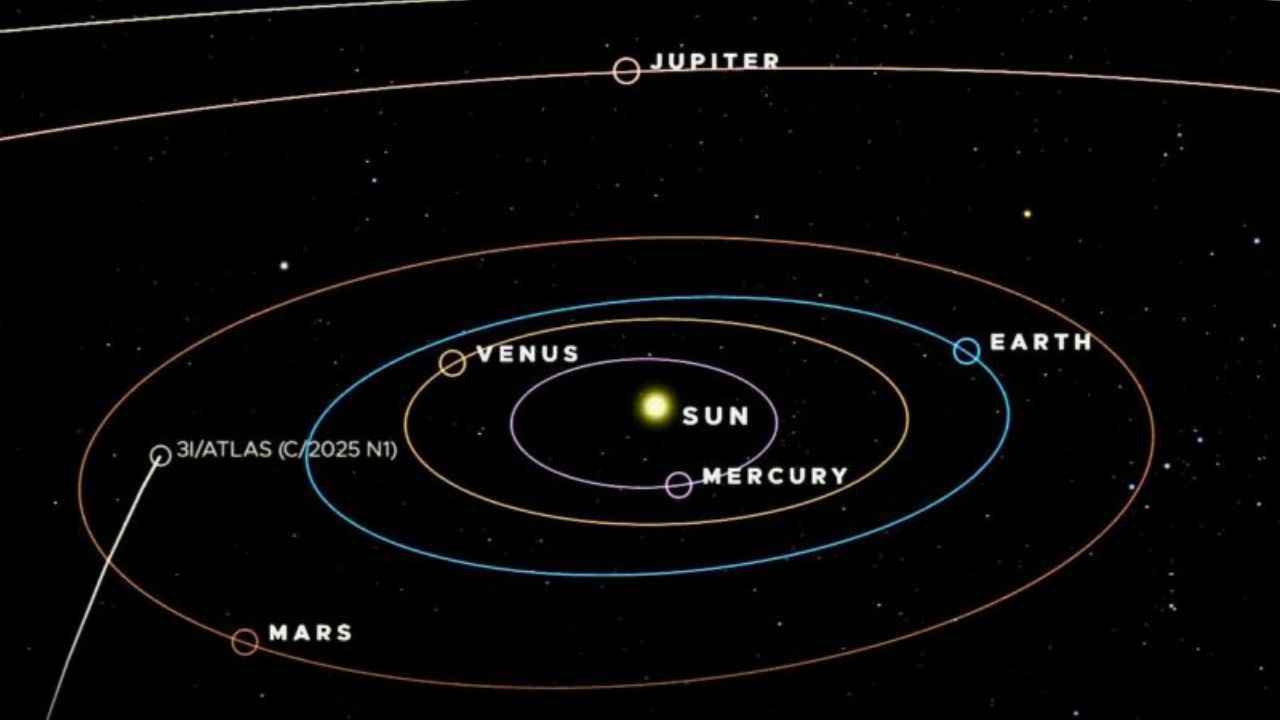
Forget everything you think you know about comets. The interstellar object 3I/ATLAS is defying expectations and fueling the ultimate question, “Is it the aliens?” This unique visitor is baffling astronomers with its bizarre behaviour, including moving at a shocking velocity and sporting a tail that actually points toward the Sun.
 Survey
When it reached its closest point to the Sun on October 29-30, scientists watched for the final clue, a change in speed or direction that could confirm if this third interstellar object is a cosmic marvel or a sophisticated unidentified object.


What is 3I/ATLAS?
Astronomers, along with NASA, have confirmed that this is the third recorded object to enter our solar system from interstellar space. It follows in the footsteps of the famous ‘Oumuamua, discovered in 2017, and the comet 2I/Borisov, spotted in 2019. Remarkably, the Hubble Space Telescope has captured detailed images of this latest visitor as it navigates the void.
Why does the internet speculate it might be aliens?
While most astronomers agree that 3I/ATLAS is a natural interstellar comet, its highly unusual characteristics have sparked an intense debate over the internet, primarily driven by a prominent Harvard astrophysicist.
Dr Avi Loeb, famous for suggesting the first-known interstellar object, ʻOumuamua, could have been an artificial probe, is once again fueling the speculation. His recent comments focus on 3I/ATLAS, which he suggests might also be evidence of extraterrestrial technology rather than a purely natural phenomenon.
He has identified eight unusual characteristics that set it apart from ordinary comets. On his self-devised “Loeb Scale,” where 0 represents a completely natural origin and 10 indicates an artificial one, he assigns it a score of 4.
Some of its distinctive traits include:
- Its path through space closely matches the plane where most planets orbit, a highly uncommon feature for interstellar objects.
- It displayed a bright sunward jet, or “anti-tail,” during July and August, which scientists have verified is not a trick of perspective.
- It outweighs ‘Oumuamua by a factor of about one million and surpasses 2I/Borisov in both mass and size.
However, most of the scientific community still remains unconvinced of his theory.
Also read: Motorola Edge 70 India launch timeline, specifications and all other details
Speed, Trajectory, and Visibility
Comet 3I/ATLAS is on a hyperbolic escape path, which means it will exit the solar system forever after this brief visit. It is moving through space at an incredible 61 kilometres per second, or nearly 137,000 miles per hour.
The comet reached its closest approach to the Sun (perihelion) in mid-October 2025, coming within 126 million miles (203 million kilometres) of our star, according to EarthSky.
3I/ATLAS is currently hidden behind the Sun from Earth’s point of view. It should reappear in the sky just before dawn on November 11, giving skywatchers a rare chance to see this cosmic traveller before it gets close to Earth on December 19, when it will be a safe 168 million miles (270 million kilometres) away.
The European Space Agency (ESA) has confirmed that the comet poses no threat to Earth.
What’s 3I/ATLAS composed of?
Astronomers find interstellar comet 3I/ATLAS special because it offers a direct sample of chemistry from a different star system. Its pristine, ancient composition, potentially older than our solar system, is preserved by a high carbon dioxide content.
Using powerful instruments like the Hubble Space Telescope, James Webb Space Telescope (JWST), and upcoming SPHEREx mission, scientists have already detected water, carbon monoxide, carbon dioxide, water ice, and carbonyl sulfide venting from the comet.
Moreover, the high carbon dioxide content also suggests that 3I/ATLAS has never passed close to another star, preserving its ancient, pristine composition.
 Follow Us
Bhaskar Sharma
Bhaskar is a senior copy editor at Digit India, where he simplifies complex tech topics across iOS, Android, macOS, Windows, and emerging consumer tech. His work has appeared in iGeeksBlog, GuidingTech, and other publications, and he previously served as an assistant editor at TechBloat and TechReloaded. A B.Tech graduate and full-time tech writer, he is known for clear, practical guides and explainers. View Full Profile


