With Canva AI 2.0, Canva expands from visual creation to agentic workflow automation
 Follow Us
Canva AI 2.0 introduces conversational design, agentic orchestration and persistent memory.
The update adds connectors, scheduling, web research, Sheets AI and Canva Code 2.0.
Canva is positioning itself as a broader AI workspace with frontier models of its own.
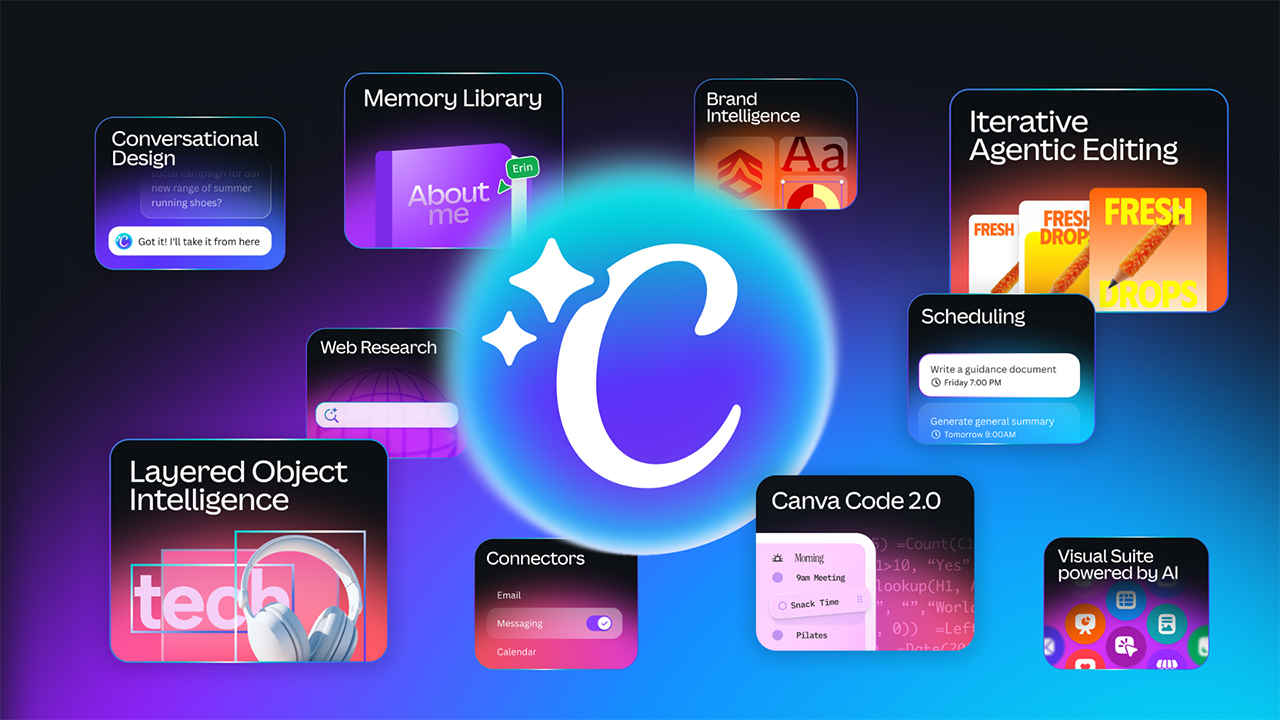

Canva just announced what it describes as its biggest product evolution since launching in back 2013. They’ve introduced Canva AI 2.0 as part of a broader effort to move beyond its roots as a visual design platform. Unveiled at the company’s Canva Create event in Los Angeles, the update brings together a new conversational AI layer, expanded workflow tools, deeper integrations with workplace platforms, and new infrastructure aimed at making Canva central to how teams create, organise and publish work. For most users, Canva has traditionally been associated with quick, accessible design. It simplified the process of making presentations, social media posts, documents and marketing assets by replacing complex desktop software with a browser-based editor built around templates and drag-and-drop controls. With the Canva AI 2.0 announcement, the company has positioned itself as one of the leading frontier model developers in the current AI race.
 Survey
A new architecture layer for design and workflow
At the centre of the update is what Canva calls a new architecture layer. This underpins the core AI capabilities being introduced across the platform, including conversational design, agentic orchestration, object-based intelligence and living memory. Taken together, these features suggest Canva is trying to reshape the design process so that users can move from rough ideas to editable outcomes with fewer manual steps.
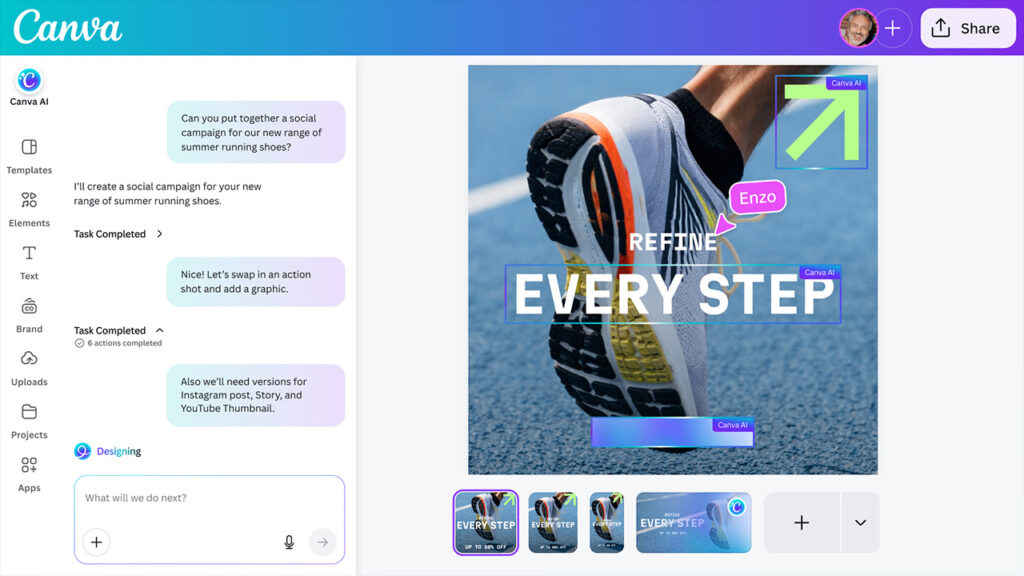
Conversational design is one of the clearest examples of this shift. Instead of starting with a blank page or browsing through templates, users can describe an idea, a goal or even a rough structure in natural language, and Canva AI will generate a fully editable design from that prompt. The company says this process can happen through text prompts or dictation, and that the AI is meant to stay involved throughout the creative process rather than simply producing a one-off result. This brings the experience closer to what users are familiar with all the other AI tools in the market right now such as Google Gemini, OpenAI ChatGPT and Anthropic Claude.
Agentic orchestration basically allowss Canva AI to work across multiple tools behind the scenes. According to the company, users can describe a broader task, such as launching a multi-channel campaign, and Canva AI will determine which tools need to be used, coordinate them, and generate a set of outputs that can then be refined or published. This marks a notable change from single-purpose AI tools that focus on only one format or one step in the workflow.
Keeping AI-generated work editable
One of the more significant parts of the update is Canva’s emphasis on editability. With object-based intelligence, the company says AI-generated work remains layered and fully editable, similar to a design built manually inside the Canva editor. That means users should be able to adjust a headline, replace an image or change a font without needing to regenerate the whole asset.
This matters because many AI tools still generate outputs that look polished at first glance but become difficult to modify once produced. Canva’s approach appears designed to avoid that limitation by keeping each asset structured in a way that supports collaboration and iteration. For folks who’re already using Canva for brand-led or fast-turnaround creative work, this could be one of the more practical elements of the new update.
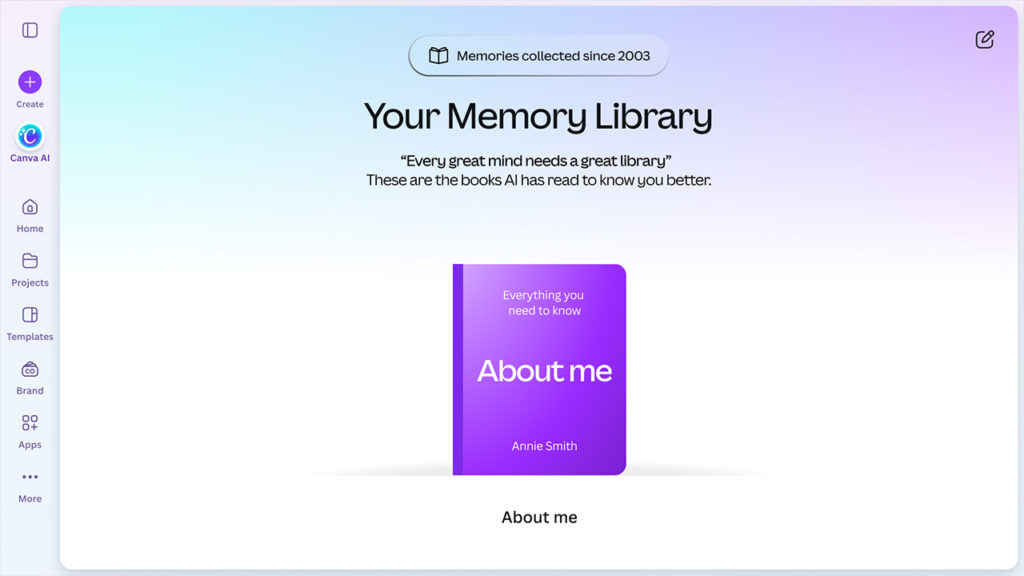
Canva is also introducing living memory, a persistent memory system that can learn from a user’s projects, preferences and design history over time. This is also similar to the personalisation features that Google and OpenAI have incorporated into their tools. The idea is that Canva AI will better understand how an individual or team works, making it easier to keep projects aligned with a certain brand identity or style. Users can also create a custom memory library and an “About Me” profile to shape how the AI responds to future tasks.
From design tool to connected workspace
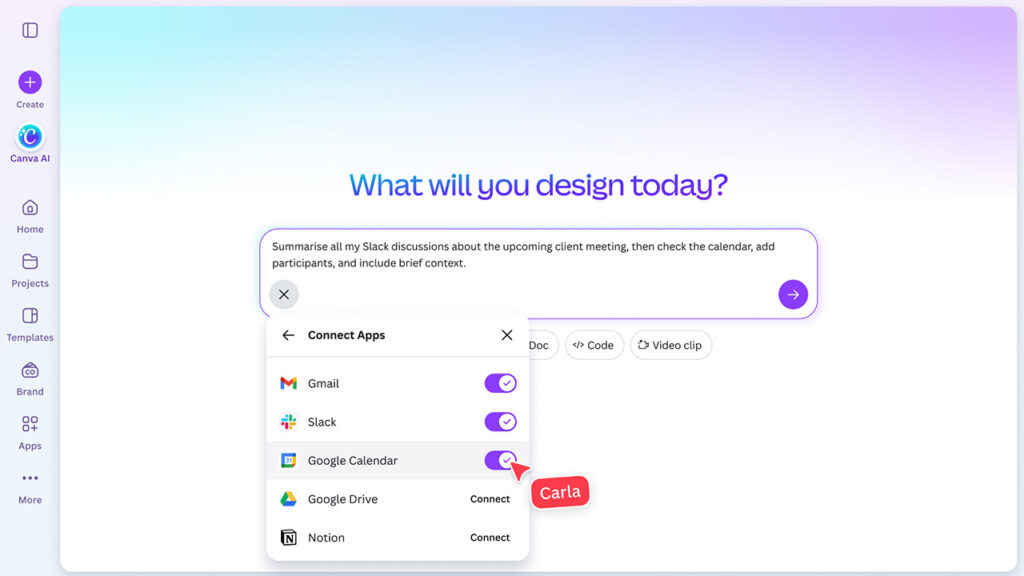
The broader significance of Canva AI 2.0 lies in the way it expands beyond design generation into everyday workplace tasks. Canva is adding a set of connectors that link the platform to tools such as Slack, Notion, Zoom, Gmail, Google Drive and Google Calendar. These integrations are meant to allow Canva AI to draw from conversations, files and schedules when generating outputs. Examples provided by the company include turning Zoom transcripts into meeting summaries, converting customer emails into personalised sales pitches, and creating newsletters based on Slack activity.
This effectively changes the role Canva wants to play. Instead of being used at the final presentation stage of a workflow, the platform is now being positioned much earlier in the process, where ideas are gathered, context is assembled and material is transformed into something structured and presentable. That shift is reinforced by new scheduling features, which Canva says will allow recurring tasks to run automatically in the background, even when users are offline. A team could, for example, have Canva generate social media content each week or prepare briefing documents based on a user’s emails and upcoming meetings.
Research and brand systems built into the workflow
Canva AI 2.0 also adds web research, which brings information from across the web directly into a design as structured, editable content. Canva says users will be able to run research on demand or schedule it as a background task. This is intended to support workflows such as proposal creation, market exploration and general project preparation without requiring users to move between separate tools and tabs.
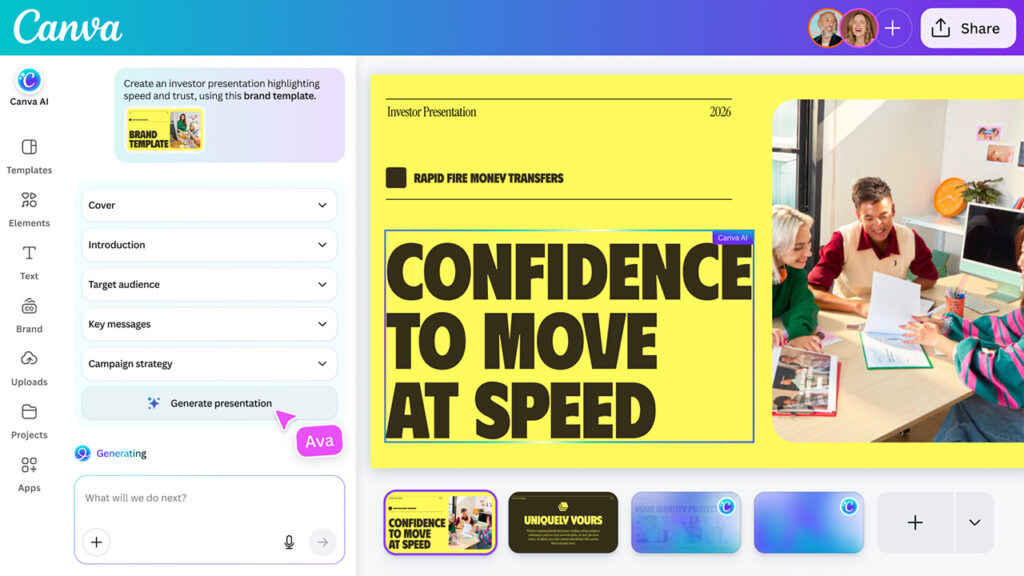
Alongside this, Canva is introducing brand intelligence. This feature is aimed at helping businesses apply their fonts, colours and broader visual identity across generated content by default. It can also be used to update existing work to match a new brand system. While brand consistency has long been part of Canva’s enterprise pitch, Canva AI 2.0 appears to bring that function deeper into automated generation rather than treating it as a separate manual step. For marketing teams, small businesses and in-house communications teams, visual consistency often slows down production because generated work still needs to be cleaned up and aligned with a brand guide. Canva is trying to reduce that friction by making brand alignment a default part of the AI process.
Code, spreadsheets and templates join the AI push
Canva’s update also extends into areas that sit outside what many users would traditionally view as design. Canva Code 2.0 can generate responsive interactive experiences from a description, and now supports HTML importing. According to the company, users can bring HTML files or AI-generated experiences into Canva, edit them with the visual editor, and then add forms, interactive elements or publishing options from within the platform.
The inclusion of HTML importing is notable because it broadens Canva’s role in web publishing and interactive content creation. Rather than limiting users to newly generated code, Canva is trying to provide a layer where imported experiences can still be visually refined and reused.
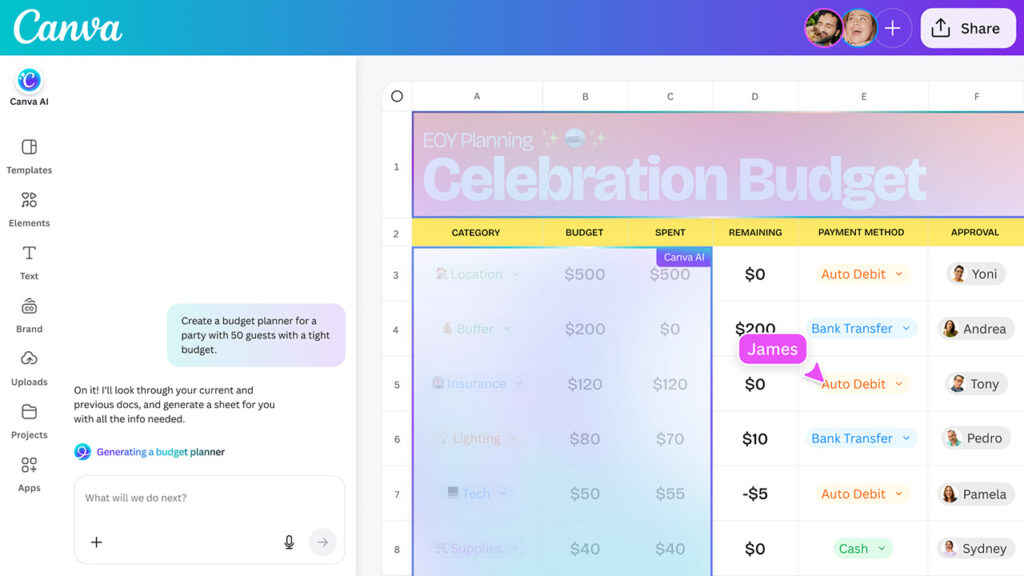
Sheets AI pushes Canva into another familiar workplace category. Canva says users can describe the type of sheet they need, and the platform will generate a structured spreadsheet populated with relevant data and research. The stated aim is to make spreadsheets less dependent on manual setup, particularly for use cases such as budget tracking, project timelines, content calendars and research tables.
Template Remix rounds out the update by repositioning Canva’s template library as a more dynamic source of inspiration. The company describes it as an effectively infinite library, where users can start with a design that catches their attention and then reshape it using Canva AI into something more specific. That continues Canva’s long-standing template-driven approach, but gives it a more generative layer.
The AI infrastructure behind the update
Canva is also placing unusual emphasis on the technology stack supporting these new features. The company says more than 100 researchers across Canva Original Research and Exploration are working on multimodal foundation models purpose-built for design. It adds that newer models are now being trained, evaluated and deployed far faster than earlier generations, helped by advances in infrastructure, architectures and reinforcement learning systems.
According to Canva, its proprietary models are designed not only for output quality but also for speed, editability and practical workflows. The company claims its models are up to 7x faster and up to 30x cheaper than comparable frontier alternatives, with specific figures given for style transfer, image generation and image-to-video tools. It also says it is building a vertically integrated AI stack that includes self-hosted training and optimised inference infrastructure.
That focus on proprietary infrastructure is significant because it shows Canva wants to be seen as more than a company layering generic AI on top of a popular editor. It is presenting itself as an AI platform builder with models and systems tailored to the needs of design-led work.
A broader place in the AI ecosystem
Canva’s announcement also points to a wider platform strategy. The company says it has expanded its collaboration with Anthropic, bringing Canva’s design engine and visual suite into Claude. It also says users can bring artefacts from Claude and ChatGPT directly into Canva, where they can be edited collaboratively and published as websites.
This matters because it suggests Canva is not trying to operate in isolation. Instead, it wants to function as a visual editing and publishing layer that can sit downstream from multiple AI systems. As generative AI tools become more common entry points for ideas and drafts, Canva appears to be positioning itself as the environment where those drafts become usable, branded and ready for distribution.
The company also cites research from Andreessen Horowitz claiming Canva has become the third most-used AI platform in the world and the fastest-growing in customer spend on AI products among leading software companies. Whether those rankings hold over time, the message is clear: Canva sees itself as part of the mainstream AI platform race, not just the design software market.
Research preview rollout begins
Canva says Canva AI will launch as a research preview starting April 16, with access initially rolling out to the first one million users who discover it on the Canva homepage. Wider availability will follow in the coming weeks.
Canva AI 2.0 is less about a single headline feature and more about an expansion in scope. The company is still building on its familiar strengths in visual communication, templates and ease of use. What has changed is the size of the role it now wants to play. With research, automation, memory, spreadsheets, code and workplace integrations all moving into the same environment, Canva is clearly positioning itself as a broader AI workspace built around design, content and day-to-day execution.


