

People who use AI most are more mentally drained, finds study
 Follow Us

I remember seeing a Reddit post a while back of a programmer’s AI agent setup. Just looking at those six terminal windows, four coding agents running in parallel, output scrolling faster than any human could read made me feel overwhelmed. The comments were full of people calling it the future and also some that said it gave them a panic attack just watching. I understood both reactions completely.
 Survey
Also read: ChatGPT timeline: Is OpenAI’s pursuit for speed costing them substance?
A new study by Boston Consulting Group, published in Harvard Business Review, has a name for what that feeling is: “AI brain fry.” I’ve been covering and dealing with AI long enough to recognise the phenomenon before I had the vocabulary for it – that particular mental static that sets in after a day of intensive AI work, where rereading the same sentence four times starts to feel normal and decisions that should take seconds just somehow don’t. BCG surveyed 1,488 full-time US workers and found 14% of those using AI at work have experienced it. I would argue the real number is higher, because most people assume it’s just tiredness or don’t want to admit to using AI at work.
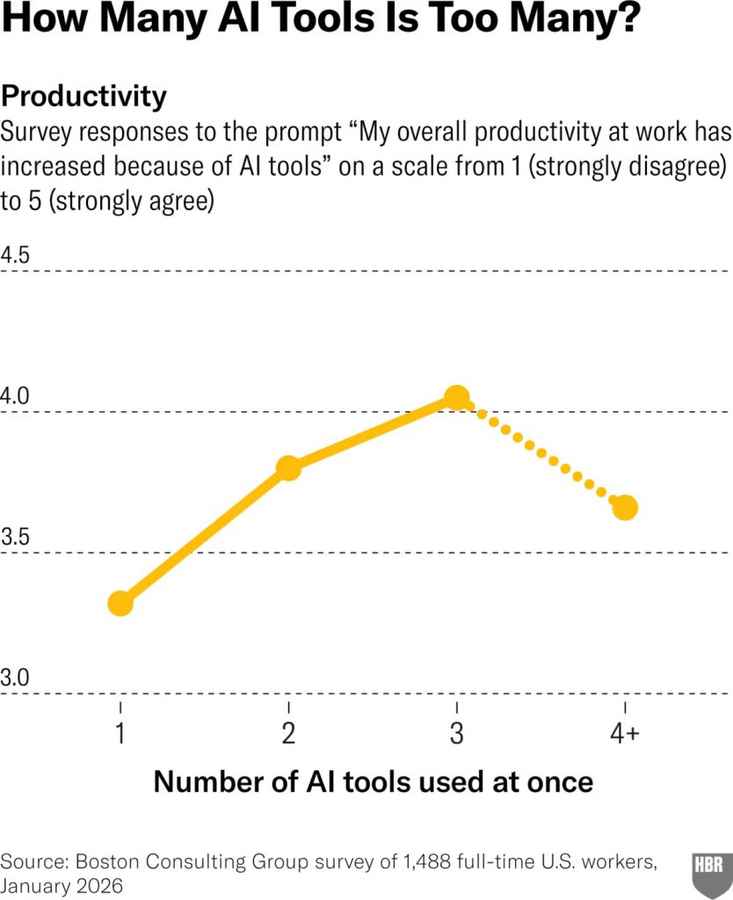
What I find most striking about the findings is who’s getting hit hardest. It’s not reluctant adopters or the AI-skeptics. It’s the power users, the people companies are most aggressively pushing to do more. Meta counts AI-generated lines of code as an engineering performance metric. Firms are measuring token consumption as a proxy for output. The implicit message is that more tools, more agents, more simultaneous AI activity equals more value. The study’s data punctures that logic cleanly, productivity gains climb from one AI tool to two, then again to three, and then after three tools running at once, the numbers start to fall.
Also read: Tata Power-Salesforce want to install solar power units on 25 crore Indian rooftops
The distinction the study draws between brain fry and burnout is one that I think often gets lost in most workplace AI conversations. When I use AI to clear repetitive work off my plate, burnout scores drop by 15% according to BCG’s data. The problem isn’t AI, it’s AI oversight. Monitoring agents, catching errors, toggling between outputs. All of that taxes attention, working memory, and executive control in ways that exhaustion surveys simply don’t capture. Workers experiencing brain fry in the study made major errors at a 39% higher rate and reported 33% more decision fatigue than those who didn’t.
I keep coming back to one line from a senior engineering manager quoted in the piece, “I was working harder to manage the tools than to actually solve the problem.” That’s not a story of losing productivity, that’s more of a design failure.
Also read: 5 key Codex features worth trying in GPT 5.4


