Gemini 3.1 Flash-Lite’s thinking levels: The feature that solves AI’s speed vs. intelligence problem
 Follow Us

There’s a version of you that replies to a text in two seconds with just your gut reaction, barely considered. And there’s another version that sits with a hard problem for an hour before opening your mouth. Both are you and neither is wrong. The question is just: which one does the moment actually call for?
 Survey
Google’s Gemini 3.1 Flash-Lite is asking that same question and handing the answer to developers. The model comes standard with Thinking Levels in AI Studio and Vertex AI, giving developers the control to select how much the model “thinks” for a given task. Four gears: Minimal, Low, Medium, High. It sounds like a small dial to turn but it isn’t.
Also read: OpenAI vs Microsoft: Can ChatGPT replace GitHub as the coding industry standard?
The four levels
Think of Thinking Levels less like a settings menu and more like a spectrum. Minimal is reflex, where the model barely pauses and just answers. Low adds a beat of consideration, enough coherence for simple tasks that don’t need a lot of thought. Medium is where real reasoning begins: the model starts looking at options and weighing trade-offs. High is the full burn, deep work and thorough.
What makes this remarkable isn’t any individual level. It’s that a developer can dial between all four inside a single model, a single API call, depending entirely on what the moment demands.
Why this matters
Also read: Elon Musk’s Starlink shaping 2026 Iran-US-Israel cyber war, here’s how
AI chatbots have carried an uncomfortable trade-off for a long time: fast or smart, pick one. Snappy models were shallow. Thoughtful models made you wait. Developers had to stitch together separate pipelines just to get something that felt both responsive and intelligent.
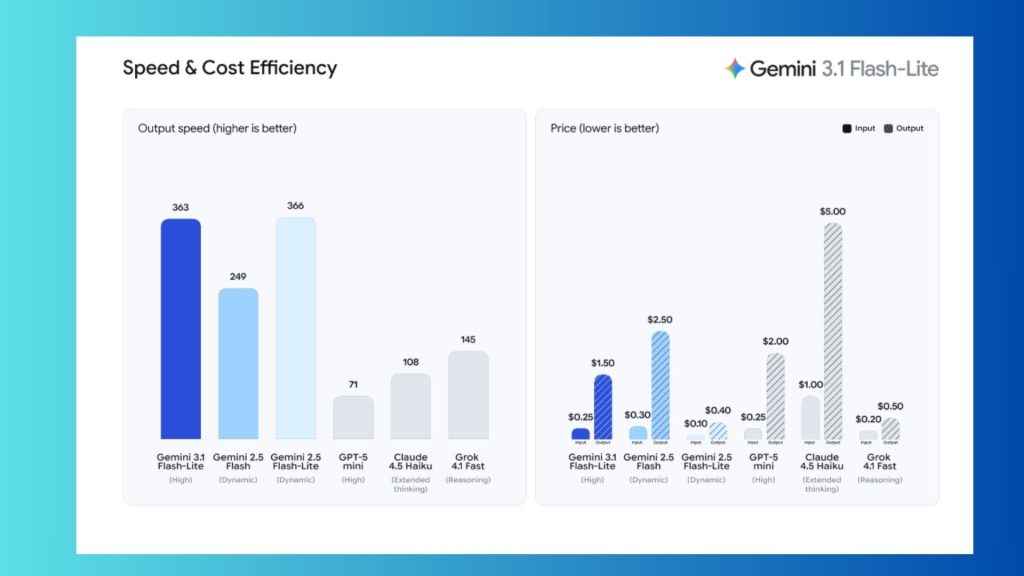
Gemini 3.1 Flash-Lite is built for high-volume developer workloads at scale, and Thinking Levels collapse that old pipeline into a single model with a reasoning toggle. It can tackle tasks at scale, like high-volume translation and content moderation where cost is a priority, and also handle more complex workloads where deeper reasoning is needed, like generating user interfaces and dashboards, or following multi-step instructions.
The apps
Here’s what this looks like in practice: imagine an app that cleans up your dictated note in milliseconds on Minimal, then quietly shifts to High when you ask it to turn those notes into a board-ready strategy. You didn’t change anything. The app read the room.
Gemini 3.1 Flash-Lite can be very effectively used to solve complex problems at scale. If this works as well as I have thought it to, we will soon be moving toward a world where Reasoning Toggles become as standard as dark mode. Some apps will surface it explicitly. Others will infer it silently from context.
Also read: India’s greatest strength is building digital public infrastructure at scale


