

‘Feel the fear and do it anyway’: Lenovo’s Fiona O’Brien tells women in tech
 Follow Us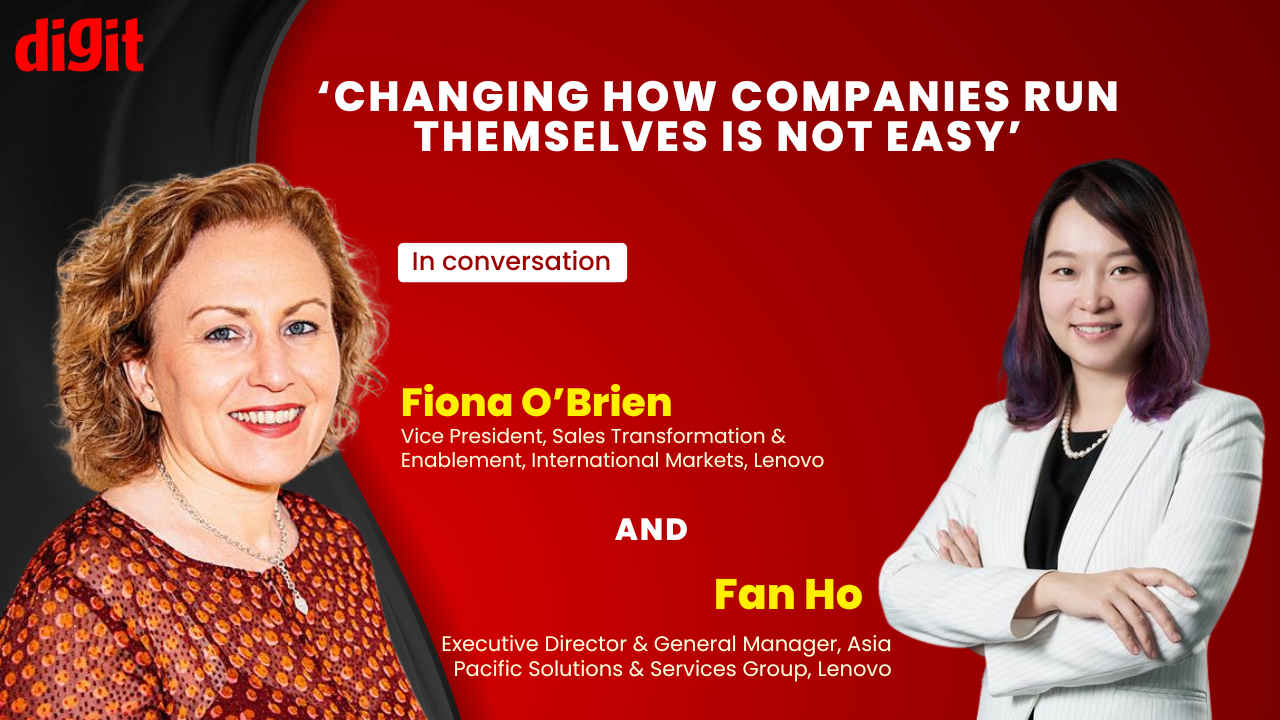

Why is it that women enter a workspace with full gusto but leave just as quickly? Why is it that when you look at a female colleague having lunch during her break, you automatically assume she might have cooked it herself? And why is it that we are still asking these questions in 2026. I may not have a simple answer to the first two questions, but I know why the third one matters. Because these conversations are still necessary.
 Survey
Progress has been made for women in tech workplaces, yes. Yet subtle bias, uneven expectations and quiet barriers continue to shape careers of women in tech in ways we do not always acknowledge. And until we confront them honestly, real change will remain incomplete.
As far as the tech industry is concerned, the phrase “Women in tech” is loved and used by all. But few manage to look at the barriers that female colleagues face, sooner or later.
In an exclusive conversation with Digit, Lenovo’s Fan Ho – Executive Director & General Manager, Asia Pacific Solutions & Services Group, and Fiona O’Brien – Vice President, Sales Transformation & Enablement, International Markets, talked about this overly used phrase, what it takes to occupy a leadership role, and more.
Also read: Lenovo Yoga Book 9i hands-on: Are dual-screen laptops the future of work?
Here are excerpts from the conversation:
The tech industry loves the phrase women in tech, but leadership still skews male members. In 2026, what structural barriers would you say still exist that people don’t really talk about enough?
Fiona:
There is a balancing act at workplaces, and that balance often becomes most intense when someone is being considered for leadership. Family responsibilities, whether children or parents, can become a pinch point. That is true for both men and women, although depending on the society, the burden can fall more heavily on women. This is where we still need to make progress. It is about changing the way we work and being more open to flexibility. Do we talk about it enough? Probably not, because changing how companies run themselves is not easy.
Fan:
Structural barriers are both external and internal. 30 years ago, when women first entered the business, there was far less female involvement, particularly in Asia Pacific. Many women did not have professional careers, they dedicated their lives to their families.
Today, across Asia Pacific, we are seeing women discover themselves and the kind of life they want to lead. More women are choosing professional careers, and that in itself is a significant societal change. This change requires cultural evolution and self realisation. At the same time, the external environment matters. Companies like Lenovo are really putting in a lot of programs in order to make that career transition work for females, and I think that has helped a lot in terms of accelerating the change.
What career decision or risk would you say most accelerated your rise, and what advice would you give to women who hesitate to take similar risks?
Fiona:
The most important decision was taking a role when I had no idea if I was fully qualified for it, but choosing to take a leap of faith anyway. In 2005, when I moved from IBM to Lenovo in 2005, part of the business was transitioning and I could have stayed at IBM. But deciding to move gave me exposure to the end to end running of a business, with a high degree of autonomy.
That autonomy meant having the freedom to make mistakes as well as good decisions. And with it came confidence in my own ability. After that, every other decision became easier because I understood that I could learn and adapt.
The advice I would give to women is that do not constrain yourself. There might often be an inner voice that asks whether you are qualified to be there. Believe that you are. Every job requires learning. So do not hold yourself back because of what you think you do not know. Learn as you go, use the skills you already have, and take the leap of faith. Even if it does not work out, you gain experience. Feel the fear and do it anyway.
There are many young women who enter tech, but then really few stay long enough to actually lead. What does retention require that hiring alone you think cannot solve?
Fan:
Retention requires conscious effort. It is closely linked to performance measurement, goal alignment and how people see their career progression. We still have fewer high profile senior female leaders in the industry, and that recognition means career development requires additional focus.
This includes practical support such as returning to work after giving birth, offering flexible career options and helping employees make thoughtful transitions. At Lenovo, we approach this systematically and with a human element. Our mentoring programmes pair senior leaders with mentees, whether female to female or male to female. The focus is on the individual’s development, not just business outcomes. Retention improves when employees feel seen as individuals and supported in their growth.
Fiona:
Specifically retaining women is about sponsorship as well as mentorship. In technology, there is still a perception of a high octane culture with long hours and a small group of people in very senior roles. And breaking into such a network requires someone on the inside to advocate for you. Sponsorship means that when decisions are being made, someone in the room is actively saying, have you considered this person for that role?
At Lenovo, sponsorship programmes ensure that people are not only present at the table but also supported when they are there. And this to me is intensely powerful in terms of retaining people, because if you know you’ve got an advocate and you’ve got somebody speaking on your behalf, then you’re more likely to stay in a company.
Can you share a couple of examples where having more women in leadership directly influenced a product, service or maybe customer strategy?
Fiona:
The most pertinent example today is AI development. For AI to be effective and deliver meaningful outcomes, it must be developed from an inclusive base.
At Lenovo, our AI environment includes strong diversity and strong female leadership. That diversity shapes a different kind of development cycle. It is more inclusive, not only in terms of gender but also culturally.
Another example is the Product Design Office, established and run by female colleagues. It was created with the recognition that products are built for a multitude of uses and different people.
Fan:
In our global AR and VR development, many people initially focused on specifications. However, a female engineer responsible for the product development raised a practical concern and said “who would want to wear a heavy headset that makes it difficult to move comfortably?” As a result, weight became a critical element in the first generation of our VR goggles. That focus helped define the trend toward lighter devices. Lenovo introduced one of the lightest VR goggles three to four years ago, driven by that perspective.
On the Motorola side, another female product owner focused on blending local culture into the design. This included keyboards that support local languages and specialised layouts. In Asia Pacific, details such as Japanese keyboard formats matter significantly. These small design choices make a real difference in usability.
What role do male allies play in accelerating women’s leadership, and where do current allyship models fall short?
Fiona:
Securing a seat at the table often depends on those who already occupy it, and many of those seats are still held by men. Even once you are at the table, being the only woman in the room can make speaking up challenging. In those moments, allyship matters.
It does not have to be performative or huge. It can be something as simple as inviting someone to share their view or amplifying a point that has already been made. I have been in many rooms where I was the only woman, and knowing that my colleagues supported me gave me the confidence to contribute fully.
Where allyship can fall short is often not through active resistance, but through a lack of awareness. Many male colleagues may not recognise when someone feels uncomfortable or needs support, simply because it is not an experience they share. That is why awareness is important. When male colleagues understand the need, they are generally very willing to act.
Fan:
I think setting up the right kind of stage and then actually putting women on that stage is the simplest and easiest way. Visible leadership matters. When women see others who have reached senior positions, it builds conviction that it can be done. In my experience, many women prefer to see a clear path before taking a risk. They want evidence that success is possible. That makes visible role models and shared success stories especially important. I have had mentees and colleagues tell me that hearing these stories energises them and gives them confidence.
RAPID FIRE:
One stereotype about women in tech that you want buried forever.
Fiona: We don’t belong.
Fan: It’s not me.
One leadership habit that helped you most.
Fiona: Listening
Fan: Cannot anymore (laughs)
One change tech companies must implement by 2030.
Fiona: Active sponsorship
Fan: In a metric way, therefore senior female percentage in the organization,
One piece of advice to young women entering AI, forced workplaces in training.
Fan
Challenge yourself and just go through with it.
Fiona
Don’t think it’s all about the tech. It’s also about the human, because if we can build the human into AI, then we’ll have a more successful AI environment.
Also read: Lenovo Legion Go 2 first look: Bold and beautiful


