
Coca-Cola’s new ad: GenAI scaling content or diluting creative value?
 Follow Us
Coca-Cola doubles down on AI despite global backlash
Inside Coca-Cola’s fast-tracked AI holiday campaign process
How AI is reshaping global ad production timelines


The red trucks are back – and so is the algorithm behind them.
 Survey
For the second year in a row, Coca-Cola’s “Holidays Are Coming” campaign has been powered by generative AI. What began as an experiment has now evolved into a deliberate creative direction. Despite widespread criticism of its earlier AI-made ads – panned for looking “creepy,” “soulless,” and “dystopian” – the company has chosen to double down.
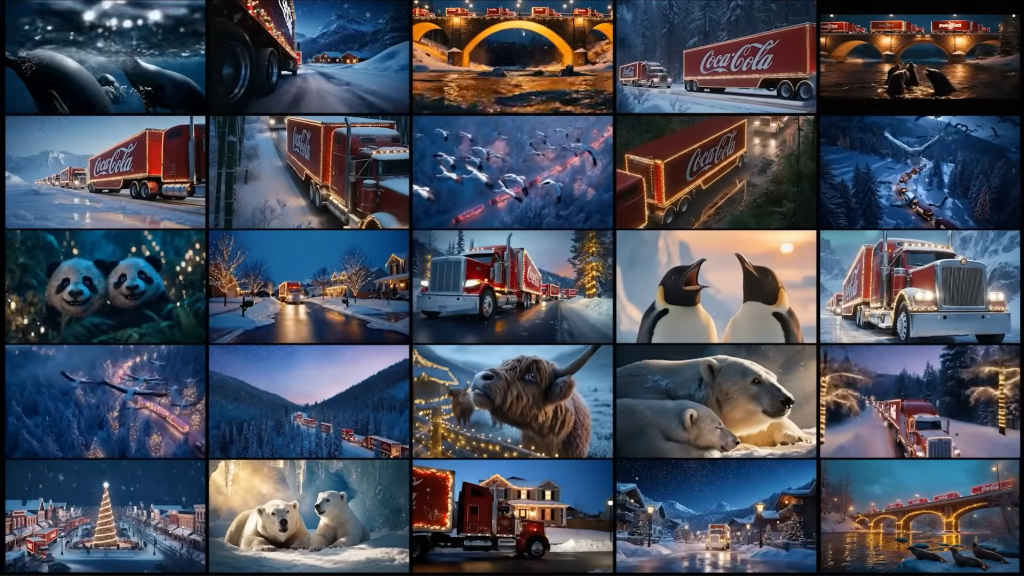
This year’s global spot trades awkward, semi-realistic digital humans for AI-animated animals, polar bears, pandas, and sloths, a clear attempt to bypass last year’s uncanny gap when the AI-generated humans looked almost real, but not quite. The visuals are smoother, the pacing brisker, and the timeline shorter than ever. As Coca-Cola’s Global Chief Marketing Officer Manolo Arroyo told The Wall Street Journal, “Before, when we were doing the shooting and all the standard processes for a project, we would start a year in advance. Now, you can get it done in around a month.”
Efficiency has replaced patience, and it seems like iteration has replaced intention.
Also read: ChatGPT Atlas and Perplexity Comet can bypass online paywalls, study finds
The rise of AI as creative infrastructure
For Coca-Cola, AI is no longer a side tool, it’s part of the brand’s creative DNA. With generative models, the company can scale content across 140 countries, instantly tweak visual themes, and generate endless festive variants at record speed. The red truck has become global software.

This shift mirrors a larger trend across the advertising industry. According to the Interactive Advertising Bureau, about 30% of connected-TV and online video ads now incorporate generative AI, a figure expected to approach 40% by 2026. The lure is obvious: AI compresses production timelines, cuts costs, and ensures global consistency. But in that pursuit of scale, creative storytelling risks becoming formulaic – optimized, polished, and emotionally flat.
From storytelling to templating
Coca-Cola’s holiday campaigns once set the emotional standard for seasonal advertising. The soft glow of truck lights, the familiar jingle, the cozy imperfection of a snow-dusted street, these details made the brand feel human.
The new AI-assisted spot, though visually impressive, feels emotionally weightless. The bears grin, the snow glitters, the music swells – all perfectly arranged, yet none of it lingers. It’s nostalgia rendered by pattern recognition, sentiment that is simulated rather than experienced.
Also read: ChatGPT’s flirting with the future when it stops being just an AI assistant: Here’s why
The brand insists that human artists remain central, refining AI outputs and guiding the creative process. But the artistic role has shifted from inventing to editing. That transition may be efficient, but it raises uncomfortable questions about authorship. When imagination turns into prompting and the artist’s role is reduced to refinement, can the result still be called creative?
Efficiency’s hidden cost
Advertising has always thrived on imperfection – the offbeat, the unexpected, the small human errors that make emotion believable. AI, in its pursuit of perfection, often smooths out those edges. What emerges is a kind of algorithmic sentimentality, warm but hollow, familiar but forgettable.
Coca-Cola’s earlier AI ads drew laughter and derision because they tried too hard to look human. This year’s pivot to animals dodges the eerie faces but not the outrage. Viewers have already branded it a hollow, corporate imitation of Christmas spirit.
For many viewers, the ad may still “work.” Most won’t know or care that it was AI-generated. But advertising isn’t just about recognition, it’s about resonance. And resonance doesn’t come from flawless pixels; it comes from authenticity, from the sense that someone, somewhere, felt what they were trying to show.
Coca-Cola’s decision to double down on AI reflects how modern marketing is shifting, creativity isn’t vanishing, but it’s definitely being industrialized.. Generative tools are powerful, but when they become the creative engine rather than a creative aid, they risk draining the humanity that gives stories their staying power.
AI can accelerate production and expand access, but it cannot replicate emotion. It can generate beauty, but not meaning. And that distinction, between scaling content and feeling something real, will decide which brands endure in the age of machine-made storytelling.
Because nostalgia, much like the holidays themselves, can’t be automated. It has to be felt.
Also read: Grokipedia vs Wikipedia: Is Elon Musk’s Free Encyclopedia Better?


