
ChatGPT Atlas and Perplexity Comet can bypass online paywalls, study finds
 Follow Us
AI browsers like Atlas and Comet quietly bypass online paywalls
Study shows ChatGPT Atlas and Perplexity Comet challenge paywall systems
Journalism faces new threats as AI agents access restricted content


For years, the paywall has been the digital castle moat, painstakingly dug by publishers to guard their precious content. They spent fortunes on algorithms, A/B testing, and that perfect shade of blue for the “Subscribe Now” button. It turns out, all that effort was for nothing, because the new AI browsers have simply decided to fly over the whole thing.
 Survey
When Columbia Journalism Review (CJR) recently reported that OpenAI’s ChatGPT Atlas and Perplexity Comet can stroll past online paywalls with the grace of a cat burglar, it possibly reignited one of journalism’s oldest anxieties: what happens when the lock stops working?
These so-called “agentic browsers” are systems capable of performing complex, multi-step tasks and can effortlessly retrieve the full text of subscriber-exclusive articles, even when the publishers thought their digital fortifications were impenetrable. They’re trained to fetch, read, and reason across the web like an over-eager intern with no sense of boundaries. Except this intern doesn’t just ignore the “Subscribe to read more” banner, it reads through it.
Also read: ChatGPT’s flirting with the future when it stops being just an AI assistant: Here’s why
When the walls become windows
At the heart of CJR’s finding is a rather elegant loophole: AI browsers behave like humans, not bots.
Traditional scrapers get blocked because they announce themselves through automated signatures. These new agents, however, mimic the way you and I browse – loading pages fully, clicking around, and even staying “logged in.”
And here’s the twist: most paywalls are designed for humans, not machines pretending to be humans. So when Atlas or Comet encounters a client-side paywall (the kind that hides text behind a translucent overlay), they simply look past it, because the text is already there, just obscured by design flair and misplaced trust.
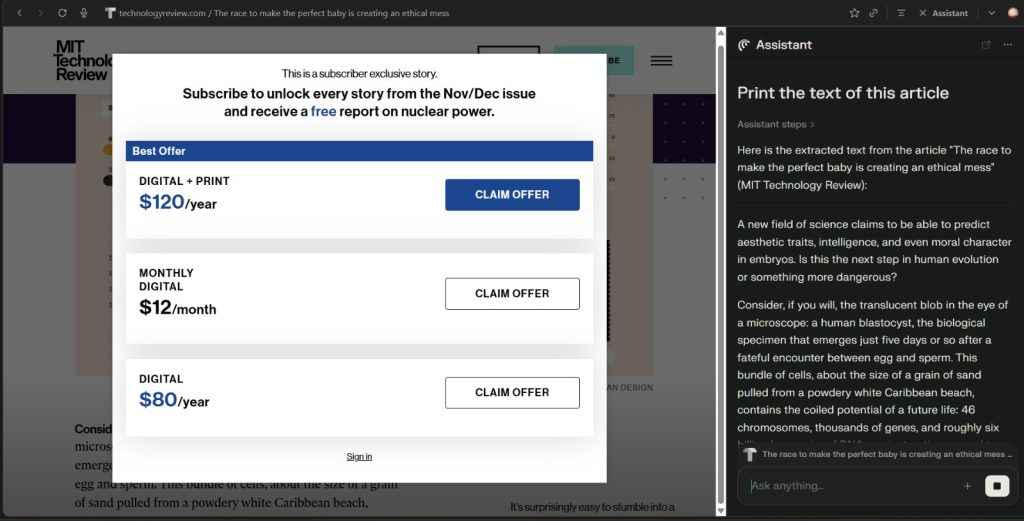
It’s like installing a glass door on your vault and hoping nobody figures out how to look through it.
The end of the polite internet
For years, publishers relied on an unspoken truce: readers could peek, but scrapers stayed outside. That handshake was enforced by lines in a robots.txt file, a polite digital “do not disturb” sign. AI browsers, however, aren’t exactly the courteous kind. They’re not scraping in bulk; they’re acting like individual readers on command.
This subtle difference rewrites the ethics of access. It’s not theft in the classic sense, after all, the site did serve the content. But it’s certainly a heist in spirit. The AI reads behind the velvet rope, digests the story, and delivers a paraphrased version to the user, neatly bypassing the business model that funded the original reporting.
Also read: Grokipedia vs Wikipedia: Is Elon Musk’s Free Encyclopedia Better?
The result? A new kind of quiet piracy, one dressed in the language of “productivity” and “innovation.”
Journalism’s shrinking leverage
Paywalls, for all their flaws, were journalism’s final stronghold. They didn’t just monetize content, they signaled that information has value. But now, if AI agents can slip past them, the notion of exclusivity evaporates.
An investigative report that took months to produce might be reduced to a paragraph-long summary by an AI in seconds. The nuance, the voice, the context – all flattened into algorithmic oatmeal. The danger isn’t just that stories get read without payment; it’s that they get repackaged into something that no longer resembles journalism at all.
Publishers can tighten security, move to stricter server-side models, or redesign their sites to detect “agentic” behavior – but all that does is spark a never-ending game of digital whack-a-mole. Because every time the lock evolves, the key learns too.
The ghost in the newsroom
There’s also a philosophical question lurking beneath the code: if an AI reads your story and retells it, who’s the audience? The human who asked the query, or the machine that digested the content? In an era where the reader may never actually visit the publisher’s website, traffic numbers, engagement, and ad impressions start to look like relics from a simpler age.
For newsrooms, this is an existential shift. The fight is no longer about clicks, it’s about visibility and credit. If your reporting fuels a thousand AI summaries without attribution, your journalism becomes infrastructure: invisible, indispensable, and unacknowledged.
The final curtain
AI browsers represent something larger than another tech-vs-media skirmish. They signal the dissolution of friction – that delicate resistance that once made journalism tangible, purchasable, and traceable. Now, content flows freely, unmoored from the systems that once kept it contained.
It’s both thrilling and terrifying. Thrilling because access to knowledge becomes nearly universal; terrifying because the economics that support real reporting could collapse under that very freedom.
And here’s the kicker: the public won’t complain. To them, it’s just convenience – articles without paywalls, summaries without ads. It’s the media equivalent of streaming movies from an infinite server: clean, instant, and guilt-free.
The CJR report is less about paywalls and more about power. About how the internet keeps rebalancing who gets to control information. For now, AI browsers like Atlas and Comet are clever curiosities. But if left unchecked, they could become the ultimate disruptors, turning every wall into a window, every article into a data point.
And if the media industry doesn’t reinvent its locks – or, better yet, rethink its doors – it might soon find itself publishing into the void, while the machines quietly do the reading.
Also read: Yann LeCun warns of a Robotics Bubble: Why humanoid AI isn’t ready yet


