
Bharat Taxi is using AI, data and open networks to change how people book rides in India
 Follow Us
Bharat Taxi uses AI mainly to set fair pricing for both drivers and customers, instead of focusing only on complex algorithms.
The platform focuses more on accurate pickup locations rather than route optimisation to improve real-world user experience.
Its zero-commission model and driver-friendly features aim to give drivers better earnings and more control on the platform.

Over the last few years, booking a taxi in India has changed a lot. Earlier, what used to be a task is now as easy as tapping a screen. While most of us just look at the price and how fast the car arrives, there is a lot of smart technology working in the background. This includes data science, AI, and digital maps that make every ride possible. Most big apps try to build every single piece of technology themselves. Whereas Bharat Taxi is taking a different path. Instead of starting from zero, they use open systems. This is like using high-quality shared tools to build a better house. They also work closely with local taxi owners across the country instead of competing against them.
 Survey
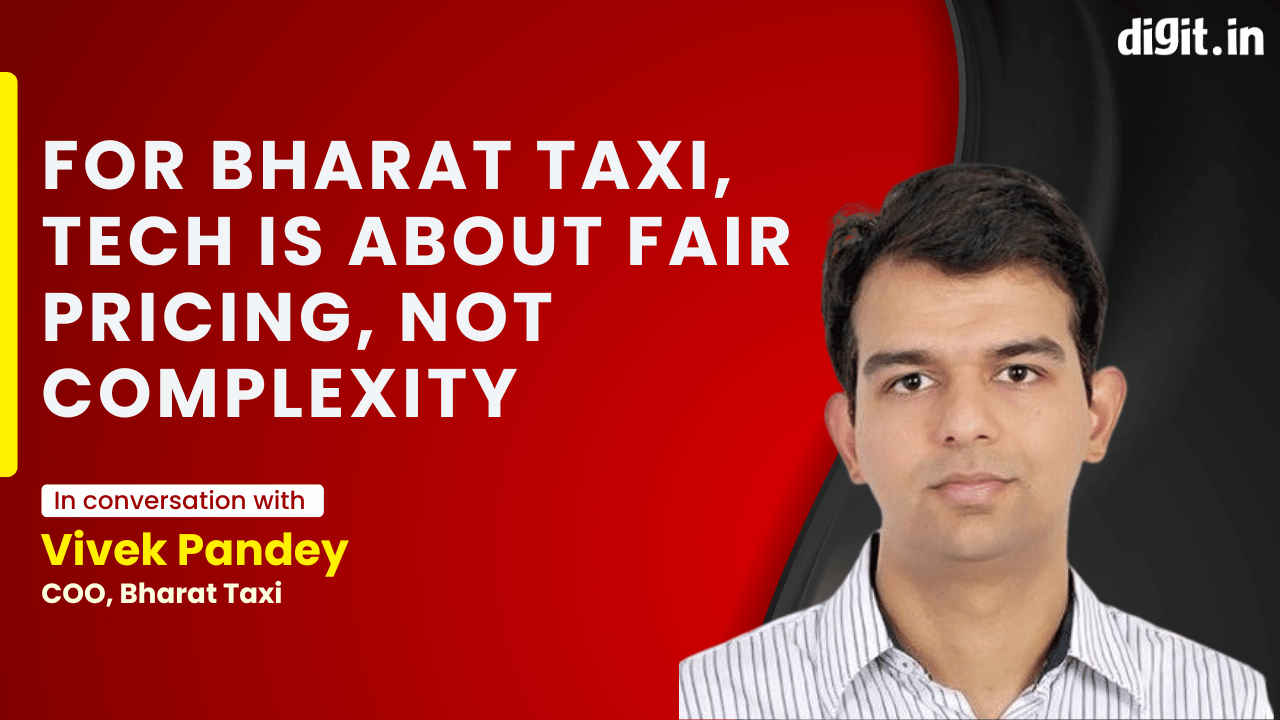
To understand how this practical tech approach is changing long-distance travel, we sat down with Vivek Pandey. He is the Chief Operating Officer of Bharat Taxi. We talked about how technology can help drivers earn a steady and fair living. Along with that, we discussed using data and tracking to keep passengers secure. Finally, looking at what it really takes to grow a travel platform in a country as big as India.
Why does pricing matter more than algorithms?
When people hear about AI in ride-hailing, they often imagine complex routing systems or predictive demand engines. However, according to Vivek, the actual impact of data science begins at a much more basic place.
He said, ‘data science primarily helps us in getting to the right pricing,’ and he explained this by saying, ‘we have teams inside the company, and they use AI to look at what’s going on in the marketplace, what the right price is, and how different factors impact the cost of a ride.’
The goal is not just to offer cheaper rides but rather to be about the balance. As he said, AI helps them analyse ‘the right price both for the consumer and the driver’. This balance becomes important in a market where drivers often feel underpaid while customers remain sensitive to price hikes.
Bharat Taxi follows cost-based pricing, and by this, it is implied that they consider fuel costs, expected monthly payments (EMIs), maintenance costs, and a basic living cost for drivers. Using this information, the company can increase fares when fuel prices or other costs go up. You can also say that the system tries to reflect real-world economics instead of relying only on demand spikes.
Getting your exact pickup location right matters most
While many platforms highlight route optimisation as a key tech advantage, Vivek believes that is not where the real differentiation lies. He said that ‘everyone in the ecosystem uses available maps.’ He further added that ‘whether it is us or anyone else, the routes are coming from the same mapping systems.’
Because of this, route suggestions for most trips, especially shorter ones, tend to be quite similar across platforms. Vivek explained that the available maps already factor in traffic and give the best possible route.
He further explained that instead of focusing on something that is already standardised, ‘Bharat Taxi is putting its efforts into improving the pinpoint accuracy of the pickup location.’ As more users book rides from the same spots, the system starts recognising exact entry points, building names, and commonly used pickup markers.
This has a direct impact on user experience. Riders do not have to explain their location repeatedly, and drivers spend less time circling around or calling for directions. In a category where small delays can quickly frustrate users, this focus on improving real-world pickup precision may matter more than adding another layer of route optimisation.
Fixing the problem of drivers running empty
One big problem in ride-hailing is something drivers call the dry run. After they drop off a passenger, they often can’t find another ride to go back in their direction. Bharat Taxi solves this by allowing drivers to choose a destination they prefer so they can get rides going that way.
‘Let’s say you stay in Noida and want a ride back from Delhi. You can mark your go-to location,’ Vivek explained. The system then tries to assign trips that move the driver toward that destination.
On the customer side, the platform follows a layered search model. It starts with nearby drivers and expands the search radius if supply is low.
‘The idea is to provide service to the customer, so we expand the radius in steps,’ he said.
This approach mirrors what food delivery platforms do, but here it helps reduce idle time for drivers while improving ride availability.
Electric vehicles and the limits of platform control
With the rise in fuel prices and an increasing focus on sustainability, electric vehicles are often seen as the future of mobility. However, Bharat Taxi’s approach is shaped by its business model. When asked whether the platform is looking to increase the use of electric vehicles, Vivek clarified, ‘Bharat Taxi is just an aggregation platform, so we do not purchase vehicles.’
He further added, ‘While EVs are cheaper to run, their upfront cost remains high. The initial CAPEX is almost one and a half to two times that of a standard CNG vehicle.’ However, he ensured that the company supports thrifts looking to switch to electric vehicles in other ways.
Vivek pointed out, ‘We have an MoU with SBI, and our members can avail loans at around nine to ten per cent. Instead of direct investment, the company focuses on enabling drivers through financial access. It also helps drivers secure Mudra loans at relatively lower interest rates through partnered banks.
A new model where drivers have more control
One of the most distinct aspects of Bharat Taxi is its cooperative structure. Drivers, who are also known as ‘sarathi’, can become members by buying shares.
Vivek explained that while this is not mandatory, it changes how Sarathi interacts with the platform. He added that ‘the sense of ownership increases a lot as they become co-promoters of the platform.’
Furthermore, the members are also eligible for profit sharing when the company becomes profitable. He emphasised that around 80 per cent of profits are planned to be distributed as dividends.
There are also governance implications as the platform includes driver representatives on its board. Backing his statement, he told us that ‘Bharat Taxi currently has two members who are part of the board and have a voice in decisions.’
This implies that the platform has a different kind of feedback loop, and instead of purely algorithmic decision-making, human input from drivers becomes part of governance.
How do open networks work without risking your data?
Bharat Taxi operates on ONDC, India’s open digital commerce network. This shapes how it handles user data and platform security.
‘We follow the same security protocols and DPDP Act guidelines,’ Vivek said. He further said that the platform avoids building isolated systems and instead integrates with standardised protocols. This also means that its security posture is comparable to other large digital platforms in India.
Handling real-world challenges like surge pricing
Dynamic pricing is a sensitive topic in ride-hailing. Users often complain about sudden spikes during rain or peak hours. And as the rainy season is just around the corner, we put Vivek in a tough spot as we asked him if the prices on Bharat Taxi will shoot up as much as we’ve seen on any other ride-hailing platform, and the response was somewhat astonishing.
Responding to the question, he said that ‘our pricing will be dynamic and may shoot up, but we do have capping on surge.’ He further added that ‘it will not be two or three times like some platforms.’ This means fares may increase when demand rises, but not beyond a certain threshold.
However, he also pointed out that a practical challenge still remains. He brought up that drivers may still switch to other apps if they find better earnings elsewhere, and this creates a natural tension between fair pricing and supply retention.
A zero-commission model with a different logic
One of Bharat Taxi’s headline features is its zero-commission model. Unlike traditional platforms, it does not take a percentage cut from each ride.
‘This will remain till eternity,’ Vivek said. ‘We will not charge a percentage of the ride.’
Instead, the company plans to rely on a small daily subscription fee. Currently, this is around Rs 40 per day, with discounts based on ride activity.
‘If you do three or more rides, the fee is completely waived off,’ he explained.
This model shifts the economics of the platform. Drivers keep more of their earnings, while the company earns through predictable, smaller fees.
Safety tech and real-world integration
Safety is also an important aspect, and Bharat Taxi has incorporated GPS and SOS facilities in the app. Moreover, they are also integrating with the local police to tackle hardships.
Vivek clarified that the SOS system only works during the active rides, ensuring that alerts are context-specific.
Moreover, he also said that the external SOS buttons installed in vehicles depend on government mandates and are not controlled by the platform.
Talking about the driver’s verification, he told us that the process is handled digitally. Furthermore, clearing the air, he also clarified that instead of physical checks, the platform uses Aadhaar, driving licence, and police database integrations to verify a driver before they become a Sarathi.
Safety features that actually work in real life
As a newer platform, Bharat Taxi is still in what Vivek calls a ‘confidence-building phase’.
Driver cancellations and customer uncertainty are part of this stage. ‘These things will improve as drivers gain more confidence,’ he said.
The company is expanding steadily, with plans to enter 30 to 35 cities within a year, including tier two and tier three markets.
Cities like Lucknow, Chandigarh, and Jaipur are already on board with this.
The bigger picture
What’s perhaps the most interesting thing about Bharat Taxi’s strategy is the focus on practical technology. Instead of reinventing the wheel and developing all the technology in-house, Bharat Taxi is using existing technology and data-driven changes.
From pricing models to incentives for the driver, the focus is on solving the problem rather than using technology to impress. As Vivek explained to me during the conversation, ‘The idea is to balance both sides of the equation, the consumer and the driver.’
We hope that in an industry that’s all about growth and complex technology, perhaps this is what will make Bharat Taxi stand apart.


