Apple M5: AI-first chip improves upon M4, rewiring MacBook and iPad’s potential
 Follow Us
Apple M5 makes every core an AI-accelerated powerhouse
30% faster memory and 4x GPU AI performance boost creativity
Unified architecture redefines MacBook and iPad as intelligent workstations

With the launch of the M5 chip, Apple is finally going all in on AI at the silicon level like never before. Don’t believe me? Because you can tell a lot about a company by what it chooses to accelerate. And for years, Apple’s silicon story has been a dance between CPU ambition and GPU swagger. With M5, that drumbeat changes with a very clear direction, as far as I’m concerned.
 Survey
This is an AI-first chip that threads intelligence through every subsystem – CPU, GPU, Neural Engine, and memory – so the next MacBook Pro or iPad Pro you buy isn’t just faster, it’s tangibly smarter at the things modern workflows actually demand.
At the heart of M5 is a 10-core CPU
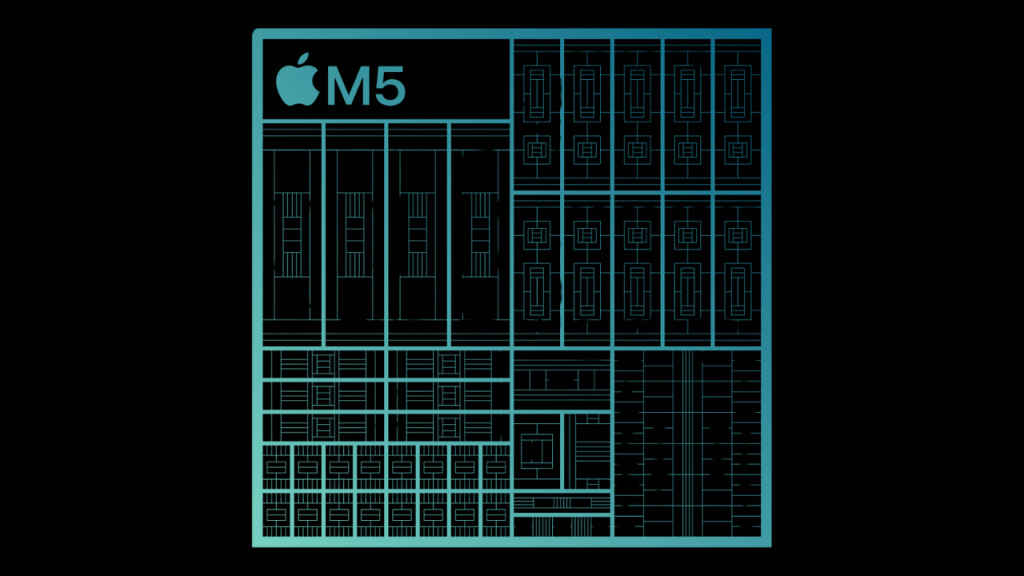
At the centre of M5 sits a 10-core ARM CPU (which has 4 performance cores, 6 efficiency efficiency) built on TSMC’s third-gen 3nm process (N3P). Apple calls the big cores “Avalanche-class,” and – marketing adjectives aside – they’re designed to be the world’s fastest performance cores in a mobile SoC.
More than the four performance cores, the six efficiency cores are the unsung heroes here, as they quietly handle background tasks and light web/app work at miserly wattage, extending battery life on both MacBook Pro and iPad Pro without making you babysit your battery percentage like it’s 2009.
A small but meaningful detail that I saw with the M5 announcement is that Apple hasn’t just thrown cores at the problem. The scheduler, prefetchers, cache hierarchy, and media paths have all been massaged to keep latency predictable under pressure. The result is not just peak performance that shoots up on demand but stutters to keep up on prolonged load, but a more smoother median CPU graph which is more consistently quick at handling whatever you throw at it.
GPU has neural accelerators in each core
This is the big swing right here from Apple. Because, fundamentally, M5’s 10-core GPU isn’t just for graphics rendering, as each core embeds a Neural Accelerator. Think of it as a local tensor engine welded to every graphics unit. Apple says that makes AI workloads run up to four times faster on the GPU versus M4’s design, while pure graphics – especially ray-traced scenes – see up to 45% uplift thanks to a third-generation RT engine.
How will this have a real-world impact, I sense you wonder?
Imagine masking a subject in 8K ProRes while simultaneously applying an AI upscaler – all live on the edit timeline. The per-core Neural Accelerators push those model inferences load parallely, so your frames don’t fall off a cliff when you toggle “smart” effects on and export the video. This AI-infused GPU will impact gaming as well, where in the past ray-traced titles used to flirt with 30fps on the base M-class can now hold smoother, more stable performance at higher fidelity, without cooking your lap.
Running an on-device, offline LLM with multiple billions of parameters (inside Docker and Ollama, for example) becomes much easier on the Apple M5. Because the accelerators sit inside the GPU cores and share the same unified memory, you can push larger context windows and batched inference and expect quicker response as well.
All of this is to say that Apple no longer treats “AI” as a sidecar. It’s fused into the graphics machinery you already rely on, so intelligent features stop feeling like plugins and start feeling like physics.
16-Core Neural Engine continues
Apple is sticking with a 16-core Neural Engine count, but don’t be fooled by the numerology – as its internal throughput is up. Its job description has evolved from “do ML here” to “coordinate ML everywhere.” Between the CPU’s upgraded SIMD paths, the GPU’s per-core accelerators, and the NE’s higher-speed datapaths, M5 runs Apple Intelligence features and third-party models with far less friction.
This will be apparent when the iPad Pro translates handwritten notes to typed text and searches your photo library for “Bombay Canteen dinner receipt” and noise-cleans a voice memo – concurrently, offline, and without bulldozing your battery. On Vision Pro, Apple talks about “dramatically faster” spatial photo processing and real-time transformations. Ultimately, it’s the same architecture that pays dividends in a laptop or tablet or smart HUD that now treats AI like a first-class workload, not a background novelty.
153GB/s of unified memory bandwidth
Bandwidth is destiny. M5’s unified memory subsystem jumps 30% to 153 GB/s and supports up to 32GB in the base class. This impacts literally everything, from deciding the ceiling for model sizes you can infer on-device, the resolution at which you can edit without proxies, and the number of heavyweight apps you can keep resident while syncing to the cloud.
Unified memory’s magic trick is that the CPU, GPU, and Neural Engine all sip from the same high-speed pool. No redundant copies, fewer cache coherency issues, and much less of the overhead that haunts discrete designs. If your day involves Final Cut Pro, Blender, Photoshop, and a LLM-powered writing assistant jogging in the background, M5’s memory will be the difference between flow and force quit.
How M5 improves upon M4
Here in a nutshell are the five key ways the new Apple M5 chip is fundamentally better than the previous M4 chip.
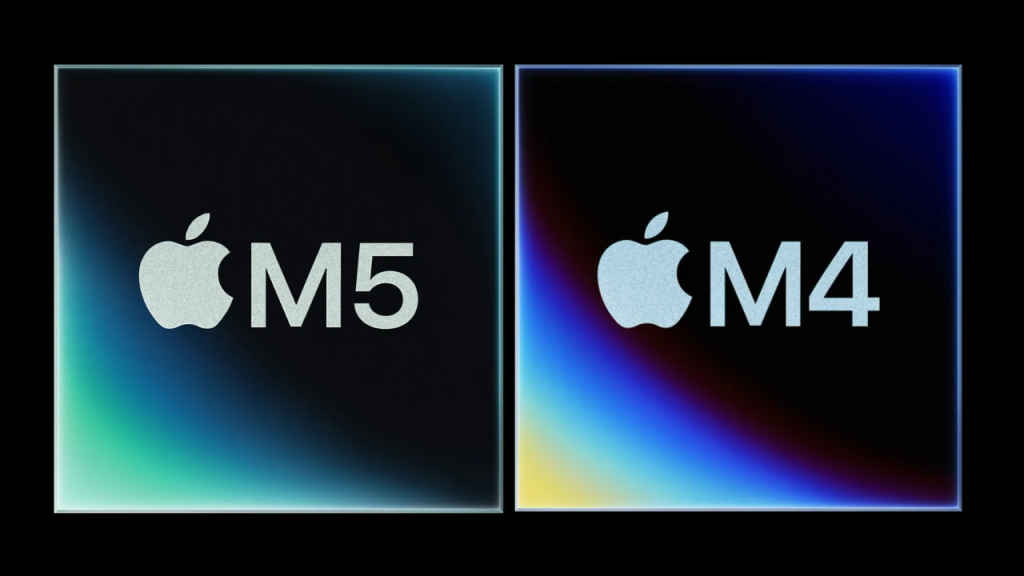
- Improved process node: M5 moves from N3E to TSMC’s third-gen 3nm (N3P), which buys Apple efficiency and density headroom. That translates into faster cores at similar or lower power – and thermal behaviour that doesn’t turn every burst into a throttling contest.
- GPU architecture: M4’s GPU was fast, but M5’s is strategic. The integration of Neural Accelerators inside each GPU core is the architectural headline – pushing a 4x peak AI compute jump and up to 45% better ray tracing, powered by a 3rd-gen RT engine and Metal 4 tensor paths, according to Apple’s claim.
- Neural Engine and media: Core count stays at 16, but throughput and fabric access have been tuned to keep the NE from becoming a traffic cop. Media engines play nicer with AI filters, speeding up generative and vision transforms in creative apps and spatial pipelines.
- Memory subsystem: Bandwidth climbs 30% to 153 GB/s. That’s oxygen for improved breathing room for both AI and graphics – and it’s a key difference when you’re juggling multi-GB models, textures, and video streams.
- System cohesion: M4 treated AI acceleration as something you scheduled, whereas M5 treats it as something you compose. CPU, GPU-Neural, and NE now play in a more tightly integrated orchestra, which is why real-world tasks (Topaz-style video enhancement, Blender renders, Xcode builds) see 1.2x to 1.8x bumps even before developers fully retune, according to Apple.
What does Apple M5 enable that you couldn’t before
It’s easy to get lost in the numbers. Here’s the pragmatic upgrade path M5 opens on MacBook Pro and iPad Pro:
- Run bigger, better local AI. Diffusion models with larger context windows. Higher-fidelity voice cloning and noise suppression in Final Cut or Logic. Real-time transcription that doesn’t tap the cloud. On-device assistants that understand your photo library, documents, and schedule without shipping them to a server farm.
- Heavy edit workload on battery. Multicam 8K timelines with AI-assisted stabilization and object removal now feel less like a life choice. The per-core Neural Accelerators shoulder the “smart” bits while the GPU keeps the viewport moving. You keep the charger in your bag.
- Unfiltered 3D rendering on a tablet. On iPad Pro, Blender and pro-grade CAD apps benefit from the Neural-accelerated GPU for denoising and texture synthesis in interactive viewports. You’ll iterate materials and light rigs faster, without round-tripping to a desktop.
- Smarter photo pipelines. Bulk de-noise + super-resolution + subject relight across a thousand RAWs, with previews that update in near-real-time. M5’s AI-leaning GPU turns a dreaded overnight batch into an extended coffee break.
- Coding with AI that actually stays local. Xcode builds accelerate (15% multithreaded helps), but the subtler win is an on-device coding assistant that indexes your repos and runs inference locally, so suggestions stay fast and private even offline.
While the headline devices are MacBook Pro and iPad Pro, Apple notes that M5 brings a dedicated display controller for 120Hz micro-OLED panels and can push ~10% more pixels than before with lower latency. On Vision Pro, that’s obviously great news, allowing for smoother motion and snapper spatial capture/processing.
Also a note on battery life. Thanks to N3P (which is kinder to electrons), Apple’s M5 chip is more battery efficient at the atomic scale. Also the architecture is smart. By offloading the “clever” work to the right accelerators, M5 avoids waking up big CPU cores for tasks that don’t need them. That’s why you can run a diffusion upscaler while browsing and not instantly trigger thermal panic. The MacBook Pro should feel serenely quick, and the iPad Pro feels less like a performance demo and more like a portable studio.
Also read: Apple MacBook Pro with M5 chip available for pre-order, here is how much it costs in India


