
AI will create jobs we cannot even imagine today: Nutanix Chief AI officer Debo Dutta
 Follow Us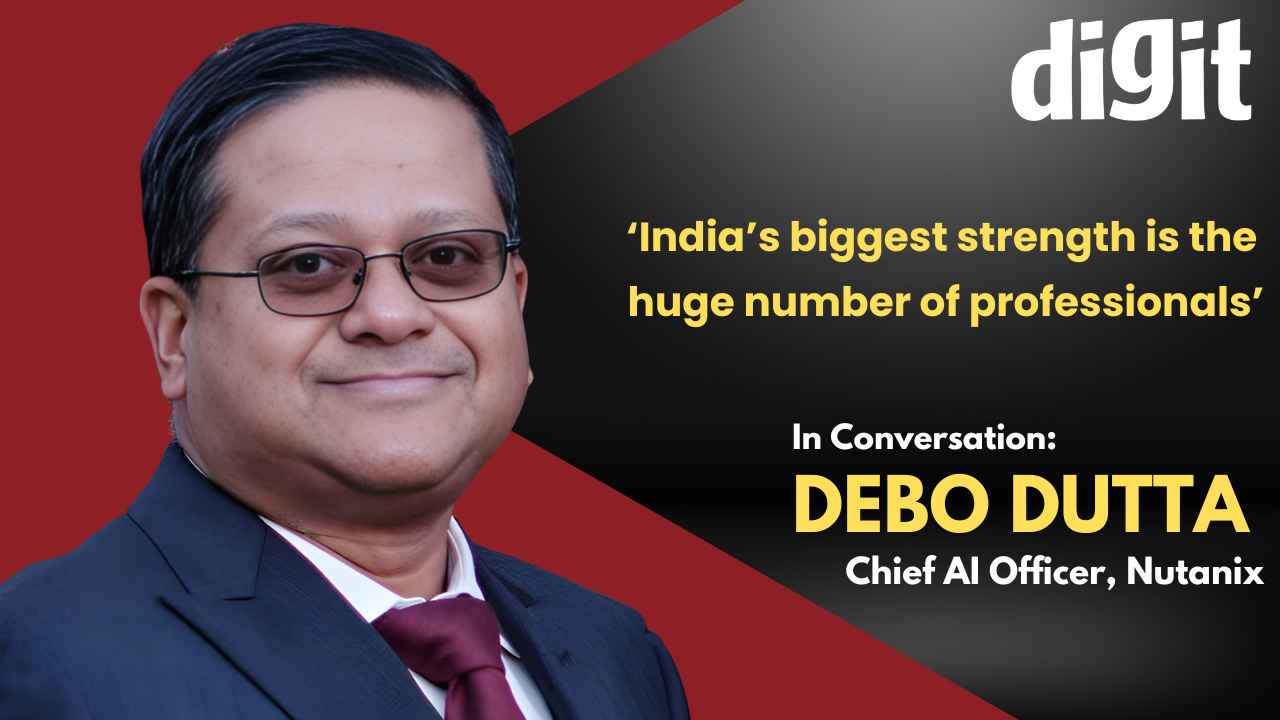

Roughly 2 years back, DeepMind co-founder Mustafa Suleyman had predicted that in the next couple of years, AI assistants will be accessible for all. And he isn’t the only one to believe that. Nutanix chief AI officer, Debo Dutta, also believes that agentic AI will be used in future not just by companies, but also by the general public. And this isn’t just a shot in the dark statement, Dutta says this after years of leading AI operations at a company that helps other businesses run large LLM models and much more without necessarily having the infrastructure for it.
 Survey
In an exclusive conversation with Digit, Dutta imagined a future where not just the urban population in India, but even the rural population is seen benefitting from the technology. He also talked about the idea of AI taking away jobs, Nutanix’s role in ensuring companies’ data remains secure and more. Here are excerpts from the conversation.
ALSO READ: Nutanix unveils new tools aim to simplify AI, cloud and enterprise IT: All you need to know
India has a huge developer base and a startup ecosystem. What role do you see India playing in the global AI race over the years?
The biggest strength of India is the huge number of engineers as well as professionals. On the engineering front, I think people in India will be doing a lot more agentic software development. And then in general, amongst the educated population in India, there will be massive users of AI agents. But the real value I see is when each person can automate some of their lives with agents. Whether it is a farmer, or a shopkeeper, small businesses.
If you had to make a prediction about what AI could look like for a regular user 5 years from now, what do you think will change?
Seeing the growth in India, I think people will rely on AI agents for a lot of things that they now do manually. As for me, I imagine a typical morning in India where you wake up, grab your tea or coffee, and instead of scrolling through multiple apps, you simply ask your AI assistant what’s happening today. It could give you a quick rundown of what you’re supposed to do today or maybe even catch you up on a cricket match you missed.
This was just about urban India. In rural areas, people could have shared access to AI-driven healthcare and education. For me, AI’s biggest impact, for over a billion people, is the ability to augment doctors and teachers. AI will create a very different level of society with better education, healthcare, and understanding of what’s happening around us.
There is a growing concern of AI taking away jobs of professionals. What do you feel about it?
The answers are different when you look at this question from a short-term and long-term perspective. In the long run, AI will create more jobs. But in the short run, people who don’t upskill themselves with AI will be at a disadvantage. Because today, AI is making people much more productive. So, my recommendation to my own team, friends, family is that please learn AI just as a tool. And we’ll have jobs that we haven’t imagined before.
Coming to enterprise tech, what is the biggest mistake companies make while trying to adapt to AI?
In pre-agentic they thought AI can solve a lot of problems without really defining the metrics. If you look at your entire workflow, it isn’t enough to just think about one part. You have to look at the whole workflow and cost of ownership for deploying that AI.
Now with AI agents, people need to understand their workflow, the cost of their AI agent, data privacy, and where they want to run this agent. So I think there are quite a few places to make mistakes.
AI is getting more powerful, as well as expensive. How do you help companies to manage the cost of deploying models?
Even though models are getting larger, they are also getting more efficient and can run on smaller devices. And this is a sweet spot. There is a class of LLMs that can run on smaller amounts of infrastructure. We do a lot of internal evaluations of these LLMs to see how we can map them with what our customers have. We manage the complexity basically.
Companies are also worried about data privacy. How does Nutanix ensure that enterprise AI doesn’t end up exposing sensitive data of companies?
If you look at agents today, they need tools to access data. And if you restrict some of those tools, you can protect the companies’ data. So you can make sure that the particular agent has access to just the data that it needs and that’s what we have done. Another way is to restrict AI agents to use certain kinds of models through a gateway, so that these agents do not have access to rogue ways. Then of course, the agentic memory layers run on our infra and that foundation of that is a secure data platform.
Taken together, Dutta’s view points to a future where AI quietly becomes a part of our everyday life, handling the small, repetitive tasks while opening up access to bigger opportunities. It might look like AI is taking away jobs for now, but in future, more opportunities will open up and we will get to see ‘jobs that we could never imagine’.


