
Split AC vs Desert Air Cooler: From price to cooling performance, every key factor compared
 Follow Us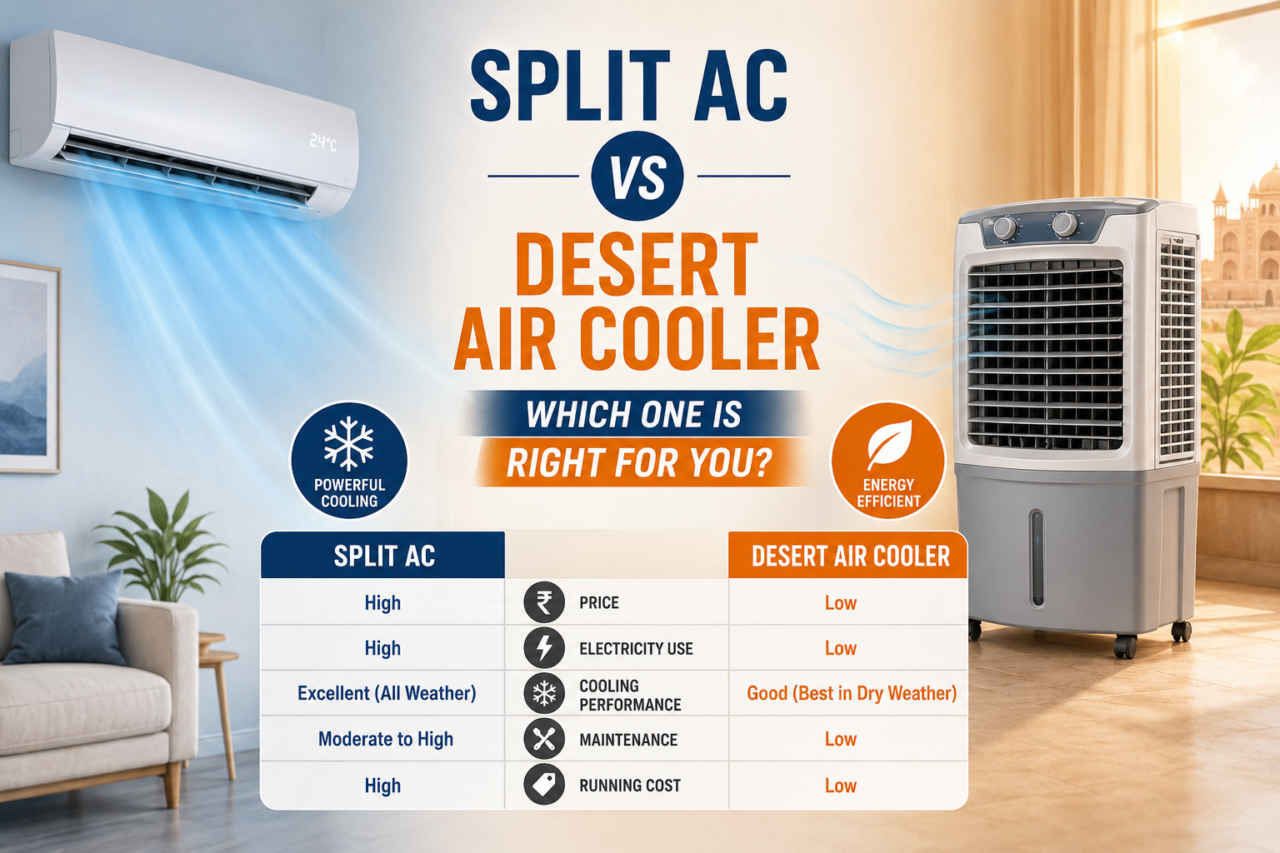

India has dominated global heat charts with 98 of the world’s 100 hottest cities these past few weeks. As temperatures rise sharply across India and in some regions above 45 degrees, having the right cooling appliance at home can make a difference of night and day. If you are confused whether to buy a split air conditioner (AC) or a desert air cooler, stay with me as we discuss the pros and cons of both.
 Survey
While both are designed to make your room more comfortable during the heat, they work on entirely different principles and that difference has a direct impact on your electricity bill, your comfort and how much you end up spending over the years. A split AC is a sealed, compressor-driven cooling system, while a desert air cooler is an evaporative device that works best in specific weather conditions. Here is a detailed comparison.

Also Read: Window AC vs desert air cooler: Power consumption, operating costs and other factors compared
Split AC vs Desert Air Cooler: How they work
A split AC uses a refrigeration cycle to cool the room. It has two units: an indoor unit that blows cool air into the room and an outdoor unit that houses the compressor and expels heat outside. The system circulates refrigerant between the two units, absorbing heat from the indoor air and releasing it outside, leaving the room cool and dry.
A desert air cooler works on the principle of evaporative cooling. It draws warm air and passes it through water-soaked cooling pads. As the water evaporates, it absorbs heat from the air, lowering its temperature before the cooler pushes it back into the room. This process also adds moisture to the air, which is why desert coolers work best in hot and dry conditions and lose their effectiveness as humidity rises.
Split AC vs Desert Air Cooler: Which one uses less electricity?
If keeping electricity consumption low is your priority, a desert air cooler is the clear winner. Most desert air coolers consume between 150 W and 250 W of power. A split AC draws typically between 1,000 W and 2,000 W depending on capacity and star rating. Inverter split ACs are more efficient and can bring consumption down to around 800 W to 1,500 W, but even at their most efficient, they consume several times more electricity than a desert cooler.
Split AC vs Desert Air Cooler: Monthly operating cost
The difference in power consumption translates directly to your monthly bill. Running a desert air cooler through a summer month will add roughly Rs 150 to Rs 300 to your electricity bill. A split AC, by contrast, can add anywhere between Rs 2,000 and Rs 4,500 per month depending on usage, capacity and the electricity tariff in your area.
Over a five-month summer, a split AC could cost Rs 10,000 to Rs 22,500 in electricity alone, while a desert cooler would amount to only Rs 750 to Rs 1,500 for the same period.
Split AC vs Desert Air Cooler: Cooling performance
This is where the split AC has a clear and decisive advantage. A split AC can cool a room to a precise set temperature regardless of the weather outside. It also removes humidity from the air, making it effective during the sticky pre-monsoon and monsoon months.
A desert air cooler, however, becomes progressively less effective as humidity rises. Since it adds moisture to the air as it cools, it performs well only in dry, hot conditions, such as Rajasthan, Uttar Pradesh and Madhya Pradesh or during the peak dry-heat phase of summer. Even in coastal cities or during the monsoon, a desert cooler provides limited relief.
For room size, a 1.5-tonne split AC can comfortably cool a room of up to 180 sq ft. A desert cooler is most effective in rooms up to 300–400 sq ft, provided there is adequate ventilation to allow the humid air to escape.
Split AC vs Desert Air Cooler: Maintenance
Desert air coolers are much easier to maintain at home. Regular cleaning of the water tank, cooling pads and filters is sufficient to keep it running well. Cooling pads may need replacing once a season, which is an inexpensive task.
Split ACs require more involved upkeep. Filters need regular cleaning and the coils and drainage system need professional servicing at least once a year. If the refrigerant level drops, only a certified technician can recharge it. Annual servicing for a split AC typically costs between Rs 500 and Rs 1,500, not counting any component repairs.
Split AC vs desert air cooler: Price comparison
Desert air coolers are far more affordable upfront. A good-quality desert cooler with a large water tank and powerful motor is available for between Rs 9,500 and Rs 15,000.
A 1.5-tonne split AC, by comparison, typically costs between Rs 35,000 and Rs 55,000 depending on the brand and star rating, with professional installation adding another Rs 2,000 to Rs 4,000 on top of that.
Split AC vs desert air cooler: Which one should you buy?
A split AC is the better choice if you live in a humid region, want consistent and powerful cooling regardless of weather conditions, or need to cool a room through the night. It is also the right option if your city regularly sees high ambient temperatures combined with high humidity, where a cooler would simply be ineffective.
A desert air cooler makes more sense if you live in a dry region, want to keep electricity bills low and need practical cooling for daytime use. It is also a sensible option for rental homes or situations where permanent installation is not possible.
In short, if budget and running costs are the priority, a desert air cooler delivers strong value. If comfort and consistent performance across all weather conditions matter more, a split AC is worth the higher investment.


