
Split AC vs window AC: Which one consumes less electricity, cheaper to operate and install in your room
 Follow Us
A window AC is a single unit where all the important components are packed inside one box.
A split AC has two separate parts.
Split ACs consume less electricity, especially inverter models with 3-star or 5-star rating.


Summer has arrived, and with temperatures rising day by day across many cities, ACs have become more of a necessity than a luxury. Whether you are working from home or trying to sleep comfortably at night, buying an AC can make a huge difference during the season. But once you start looking at different options, one question often creates confusion: should you buy a split AC or a window AC? Both are designed to cool your room, but they differ in terms of electricity usage, installation cost, noise levels and more. Here’s a simple comparison to help you decide which one suits your needs better.
 Survey
Split AC vs window AC: Basic difference
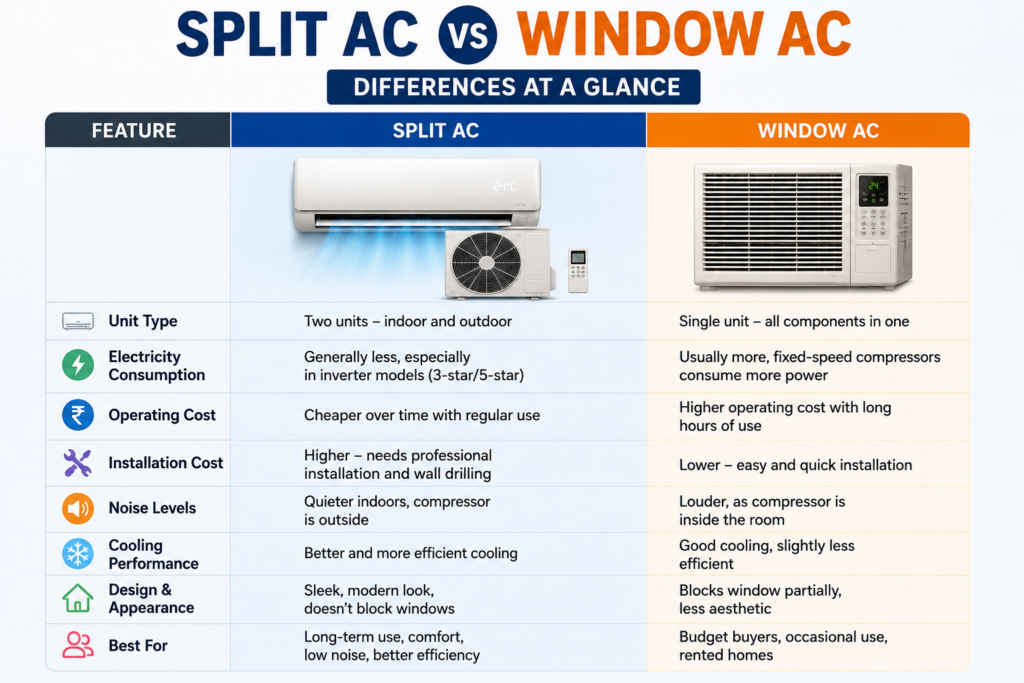
A window AC is a single unit where all the important components are packed inside one box. It is usually fitted into a window or a wall opening. Since it comes as one compact unit, installation is easier and quicker. On the other hand, a split AC has two separate parts. One indoor unit is placed inside the room to blow cool air, while the outdoor unit containing the compressor is installed outside the house.
Split AC vs window AC: Which AC consumes less electricity?
In most cases, split ACs consume less electricity, especially inverter models with 3-star or 5-star ratings. These ACs automatically adjust compressor speed depending on the room temperature instead of running at full power all the time. This helps reduce electricity usage during long hours of operation.
Many window ACs still use fixed-speed compressors that switch on and off repeatedly at full power. Because of this, they usually consume more electricity if used continuously for long periods.
Split AC vs window AC: Which AC is cheaper to operate?
If you use an AC regularly for several hours every day, a split AC can help lower your monthly electricity bill over time. However, if you only use the AC occasionally or during peak summer days, a window AC may feel more affordable because of its lower purchase price.
Split AC vs window AC: Which AC is cheaper to install?
Window ACs are simpler to install because they come as a single unit. In many cases, installation can be completed quickly without major changes to the room. Split ACs need professional installation. Extra work like drilling walls, fitting pipes, and placing the outdoor unit safely increases the installation cost.
Split AC vs window AC: Other factors
Noise levels: Window ACs are usually louder because the compressor is inside the same unit placed in the room. Split ACs are quieter indoors since the noisy compressor remains outside.
Design and appearance: Window ACs can block part of a window and may not look very modern. Split ACs are mounted high on the wall and offer a cleaner appearance with less visible wiring.
Split AC vs window AC: Which one should you buy?
If you are on a tight budget, live in a rented house or want a simple installation process, a window AC is a practical choice. But if you want quieter cooling, better energy savings and improved cooling efficiency, investing in a split AC makes more sense.
Also read: Window AC vs desert air cooler: Power consumption, operating costs and other factors compared


