
SBI to Salesforce: Arundhati Bhattacharya on Women in Tech leadership
 Follow Us
Leadership grows when belief precedes credentials and opportunity, says Arundhati Bhattacharya
Structural barriers, not talent, limit women’s rise in tech, says President & CEO of Salesforce - South Asia
Real change needs accountability, not just diversity conversations

There’s a certain quiet authority in the way Arundhati Bhattacharya tells her story. Not as a sequence of milestones, but as a series of moments where someone chose to believe. It’s a theme that runs through her journey, from walking into the corridors of State Bank of India in 1977 — when leadership pathways for women were at best undefined — to now steering Salesforce South Asia at a time when technology leadership itself is being rewritten in real time with AI disruptions.
 Survey
Bhattacharya’s perspective is unique because it highlights both sides of India’s leadership equation — the structured public sector institutions and the more fluid promise of the tech industry. Her insights land on uncomfortable truths about leadership pipelines, waiting for opportunities, and merit alone dictating who gets a seat at the table.
And yet, Bhattacharya’s optimistic. What follows is a verbatim Q&A, in many ways, a blueprint for what it will take to move ‘Women in Tech’ from representation to real influence.
Q) What were the defining moments when someone trusted your potential before the world saw it?
Arundhati Bhattacharya: Trust showed up in quiet moments, not grand gestures. When I joined SBI in 1977, there was no playbook for women in banking leadership — we were writing it as we went. But I remember my first manager picking me to head the Letter of Credit division in the largest Forex Operations in Eastern India, when everyone expected I’d be relegated to back-office work because I came from a liberal Arts background.
He didn’t announce it. He just told me to take charge and said, “You’ll figure it out.” Years later, when I was promoted to Chairman, it wasn’t because the system had suddenly evolved. It was because a few people — at every stage — chose to bet on capability over convention. The defining moments weren’t when I proved myself. They were when someone saw something in me that I hadn’t yet claimed for myself.
Also read: ‘Feel the fear and do it anyway’: Lenovo’s Fiona O’Brien tells women in tech
From SBI’s government corridors to Salesforce’s tech-innovation, one thing remains constant: leadership isn’t about waiting for perfect conditions. It’s about people who extend trust before you’ve earned every credential — and then prove them right. The pipeline still isn’t perfect. But every time I trust someone’s potential before the boardroom does, I’m paying forward to what was given to me.
Q) In your own journey, what did mentorship and sponsorship actually look like in practice?
Arundhati Bhattacharya: Mentorship provided me with direction, laid out the choices I had and helped clarify my doubts while encouraging me to believe in myself. Sponsorship gave me a seat. Early in my career, mentorship looked like senior officers pulling me aside after meetings — “Here’s what you missed” or “Next time, lead with the numbers.” It was generous, but still advisory. Sponsorship was different. It was someone putting my name forward when I wasn’t in the room.
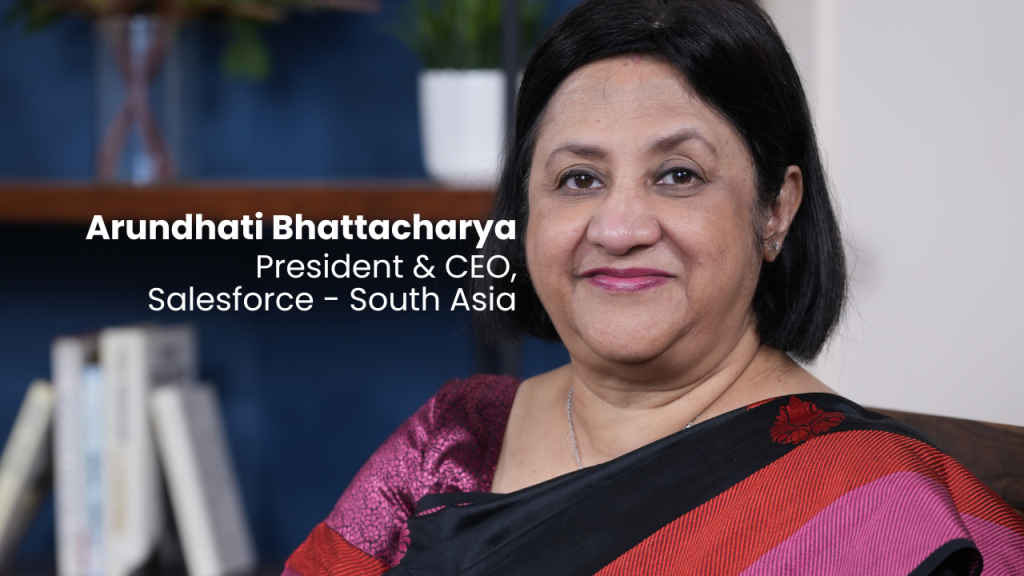
I’ll never forget when a senior executive nominated me for a high-stakes international banking assignment. I hadn’t asked for it. I wasn’t even sure I was ready. But he said to the committee, “She’ll deliver, and if she doesn’t, it’s on me.” That’s sponsorship. Skin in the game. It taught me that great leaders don’t just give advice — they spend their capital on people who deserve a bigger stage.
Now, when I see potential in someone at Salesforce, I don’t just mentor them. I make sure their names come up in conversations and introduce them to people who can change their trajectory. I use my access to open doors they didn’t know existed. Because the best thing anyone ever gave me wasn’t wisdom. It was an opportunity backed by belief.
Q) What barriers continue to hold women back from the C-suite in tech?
Arundhati Bhattacharya: Women exit or plateau between ages 28-35, precisely when leadership tracks accelerate. We promote availability over capability, and that math never works in women’s favour. Sometimes, C-suite decisions happen in golf clubs and informal circles where women simply aren’t present. You can’t mentor your way out of structural exclusion.
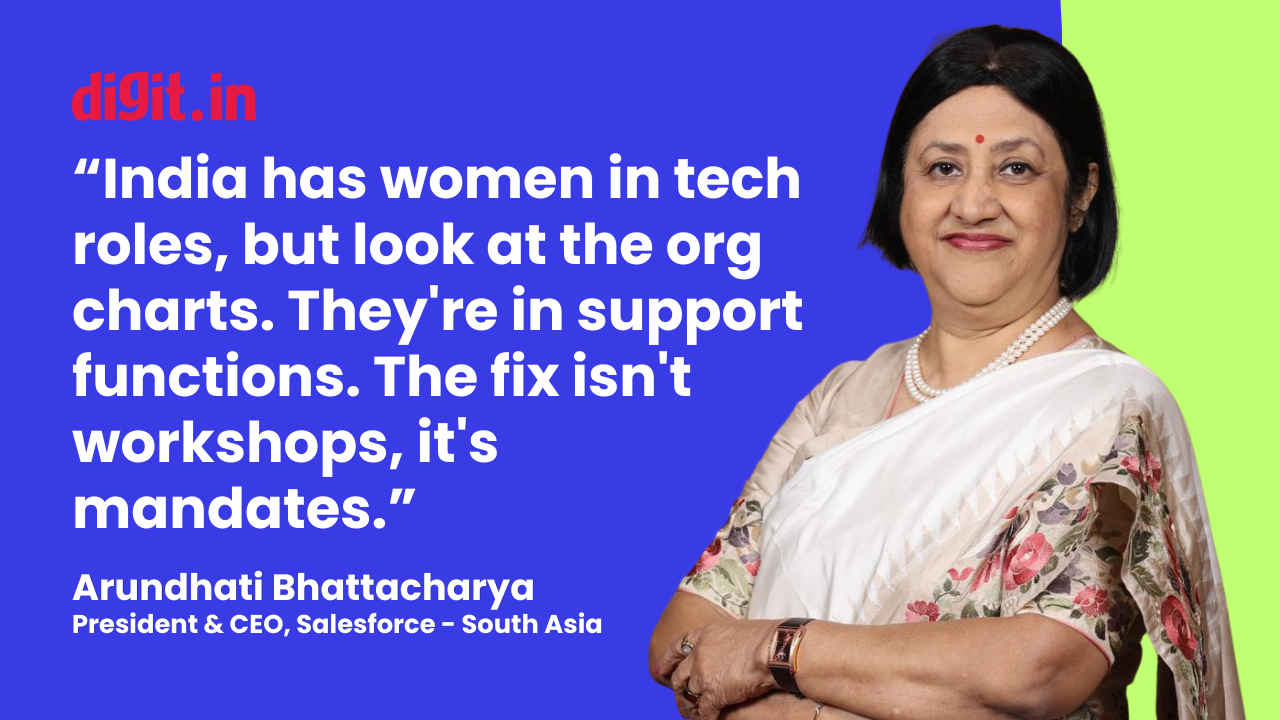
India has women in tech roles, but look at the org charts. They’re in support functions. The P&L owners, the revenue drivers, the product chiefs? Still overwhelmingly male. The fix isn’t workshops. It’s mandates. Until we treat gender equity like we treat quarterly earnings — with metrics, accountability, and consequences — the C-suite will remain exactly what it is: a closed loop that replicates itself.
Q) Do you see differences in how leadership opportunities for women emerge in traditional sectors versus technology?
Arundhati Bhattacharya: My experience across the public and private sectors has shown me that the systems are quite different. When I started my career at State Bank of India, the structure was far more rigid. Career progression followed a defined path, and opportunities were closely tied to tenure and specific assignments. For many women, the real challenge was ensuring they had access to those critical roles that shaped leadership trajectories.
In the technology sector today, including at Salesforce, the environment is far more fluid. Organisations are more conscious about inclusion, flexibility, and leadership development, and there is a stronger recognition that diverse perspectives improve outcomes. What has changed most over the years is the mindset. Earlier the conversation was often about whether women could lead. Today the question is increasingly why there are not more women in leadership roles. That shift itself signals meaningful progress, even though there is still work to be done.
Also read: Women in tech on how AI & semiconductor innovation is reshaping Indian tech

Q) Many companies talk about diversity, but what concrete organizational mechanisms have you seen actually move the needle?
Arundhati Bhattacharya: In my experience, real progress happens when organisations move beyond intent and build structures that support women through different stages of their careers. Pay equity is fundamental because it signals fairness and respect for contribution. Equally important are programs that help women return to the workforce after career breaks and mentorship or leadership initiatives that actively prepare women for senior roles.
At Salesforce, we try to approach this in a structured way. Initiatives such as the EQE: LEAD Women South Asia program focus on building a strong pipeline of women leaders by creating mentorship networks and leadership communities. Our Return-to-Work program supports women who may have taken career breaks and want to restart their professional journeys with confidence. Ultimately, companies that redesign their systems to enable full participation do not just advance women, they unlock stronger and more sustainable leadership pipelines.
Q) Why is women representation in teams building AI systems so important for ensuring ethical and inclusive AI?
Arundhati Bhattacharya: AI systems are beginning to shape decisions across every sector, so the perspectives of the people building them matter a great deal. If those teams are not diverse, there is always the risk that unconscious biases or blind spots find their way into technology. Representation helps prevent that. When people with different experiences are part of the conversation, they ask different questions and challenge assumptions. That ultimately leads to more thoughtful and responsible innovation. At Salesforce, we see trust and equality as central to how AI should be developed. Ethical AI is not just about the technology itself, but about ensuring that the teams creating it reflect the diversity of the world it will serve.
Q) What skills will determine who leads in this new AI era?
Arundhati Bhattacharya: Technology will keep evolving, but some fundamentals remain constant. First, build deep competence. Credibility comes from understanding your craft and delivering consistently. Whether someone is working with cloud platforms, AI, or data, strong technical foundations will always matter. At the same time, leadership in this new era will require curiosity and adaptability. Technologies change very quickly, so the ability to keep learning and evolve with them becomes just as important as you already know.
Equally important are skills such as collaboration, communication and the confidence to speak up with your perspective. The most effective leaders in technology will not just understand the tools, they will understand how those tools can solve real problems and create value.
Q) You reinvented yourself from banking to enterprise technology. What does your own transition teach us about lifelong learning in leadership?
Arundhati Bhattacharya: One of the biggest lessons from my transition was that learning never really stops. Moving from banking to a technology company like Salesforce meant stepping into an entirely new ecosystem, and I had to be willing to listen, ask questions, and learn from people who had spent their careers in technology.
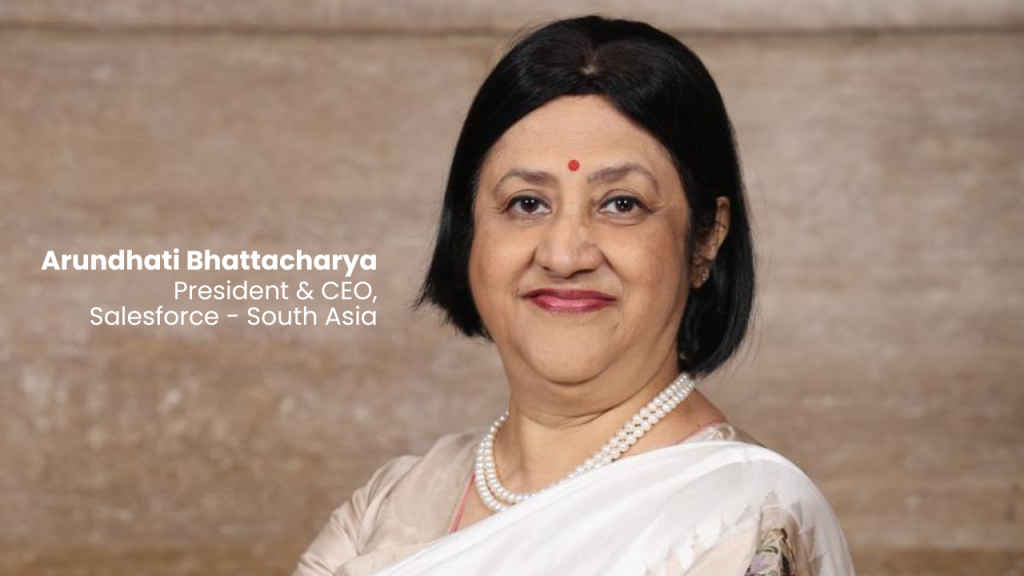
What helped was the mindset that leadership is not about knowing everything. It is about understanding problems, bringing the right people together, and continuing to learn along the way. Working with a much younger workforce has also been energizing because they bring new ideas and perspectives that constantly challenge you to think differently. For me, that is what lifelong learning in leadership really means. The willingness to stay curious and adapt, no matter how long you have been in your career.
Q) Many talented women reach middle management but never make the leap to senior leadership. Why?
Arundhati Bhattacharya: One barrier I often see is that many capable women wait until they feel completely ready before stepping forward. Leadership opportunities rarely come with that level of certainty, and waiting for perfection can sometimes hold people back. This is where mentors and organisations have an important role. Encouraging women to take on stretch roles earlier and backing them when they do can make a real difference. Ultimately, competence builds confidence. When women deliver consistently and see their work recognised, it becomes much easier to step into larger leadership roles
Q) If we fast-forward ten years, what would success actually look like for women in India’s technology ecosystem?
Arundhati Bhattacharya: Ten years from now, success would mean that women’s leadership in technology is no longer seen as an exception. It would be entirely normal to see women leading teams, building startups and shaping decisions in boardrooms. I am optimistic because the pipeline is already stronger. More women are entering STEM and the next generation is far more confident about where they belong.
At Salesforce, for instance, we focus on building leadership communities, mentorship networks and inclusive policies that help women grow and stay in the ecosystem. If more organisations continue to build those systems, the next decade can move the conversation from representation to real influence.
Also read: Tata Power-Salesforce want to install solar power units on 25 crore Indian rooftops


