
Is your job at risk from AI? Anthropic’s new study measures real displacement risk
 Follow Us

Most studies measuring AI’s impact on jobs have one thing in common: they measure what AI could do, not what it’s actually doing. A new study from Anthropic changes that and the results are more unsettling in some places, and more reassuring in others.
 Survey
Also read: ‘Safety Theater’: Why Anthropic’s CEO says OpenAI’s DoW deal is a betrayal of AI safety
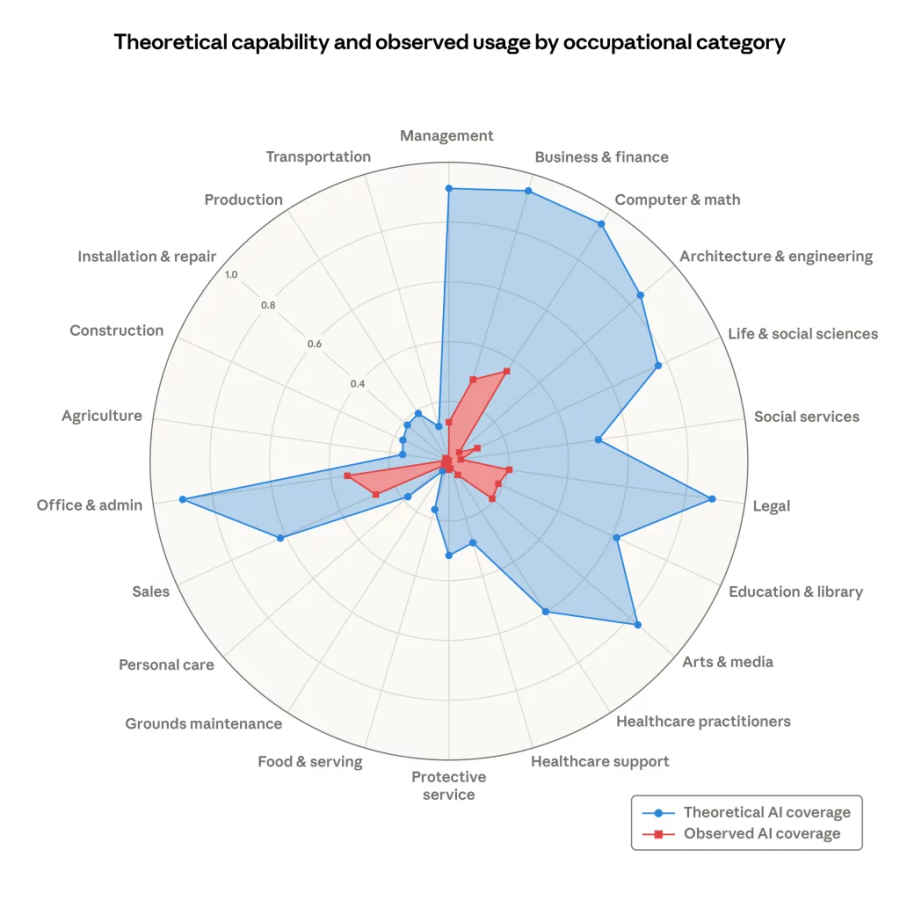
The research introduces a new metric called observed exposure, a tool that tracks real AI usage across hundreds of occupations, weighting automated and work-related tasks more heavily than casual or augmentative use. It’s a meaningful shift from previous models that tended to ask “could AI do this job?” rather than “is AI doing these tasks right now, at scale?”
The findings are striking in places. Computer Programmers face the highest displacement risk, with 75% of their core tasks now covered by AI in real usage. Customer Service Representatives and Data Entry Keyers follow closely. These roles share a common thread: repeatable, task-heavy work that AI handles well in automated settings. At the other end of the scale, Cooks, Bartenders, Lifeguards and Motorcycle Mechanics show zero measurable exposure, their work remains stubbornly human for now.
Also read: Is ChatGPT Health safe? Study finds AI missed half of medical emergencies
Perhaps the most surprising finding is how far AI still lags behind its own potential. Even in the heavily exposed Computer and Mathematics sector, AI currently covers just 33% of tasks – a fraction of what is theoretically possible. The capability exists; widespread adoption hasn’t caught up yet.
The demographic picture is equally unexpected. The most exposed workers tend to be better educated, higher paid, and more likely to be female. Graduate-degree holders are nearly four times more represented in high-exposure roles than in low-exposure ones. This quietly dismantles the assumption that AI primarily threatens low-wage, low-skill workers.
As for whether AI has actually cost people their jobs, the evidence remains limited. Anthropic found no significant rise in unemployment among highly exposed workers since ChatGPT launched in late 2022. There is one early warning signal worth noting, however: workers aged 22 to 25 appear to be getting hired into exposed roles at a noticeably slower rate. It may be the first concrete sign that AI is beginning to reshape who gets a foot in the door. The disruption, it seems, is coming. It’s just arriving more quietly and hitting different people than most of us expected.
Also read: Apple launches its most affordable MacBook yet: 5 reasons you may want to buy it


