GPT-5.5 explained: More intelligence at the same speed
 Follow Us

The AI arms race just got a new frontrunner, and this time, the upgrade isn’t just about raw power. OpenAI dropped GPT-5.5 on April 24, and the headline feature isn’t a faster model or a flashier interface. It’s something more interesting: a meaningfully smarter AI that doesn’t ask you to wait longer for the privilege. That balance, more capable at the same speed, sounds deceptively simple, but it’s one of the hardest engineering problems in AI development. If OpenAI has genuinely cracked it, this is a bigger deal than the version number suggests.
 Survey
Also read: Return of Xbox: CEO Asha Sharma prioritises daily active players
So what’s actually new?
GPT-5.5 is designed to handle what OpenAI refers to as “agentic” prompts, or those that require planning, execution, checking its output, and repeating this loop over and over again without being micromanaged all along the way. Rather than spoonfeeding the model through the process, you can just give it an unwieldy prompt with many sub-steps and expect it to make sense of it all by itself. The model excels in programming, debugging code, researching on the internet, performing data analysis, and using software.
The biggest improvements compared to the previous version are in agentic coding and computing. OpenAI claims that the model achieves better output quality with fewer tokens and tries than 5.4, meaning that there will be less need for micromanagement, and the context won’t get wasted as easily. The model also displays better judgment regarding when to continue working and when to stop and reconsider its output. This may seem insignificant until you’ve spent hours fixing mistakes made on its behalf for six consecutive turns.
The efficiency angle
In previous cases, increased capacity always involved the same trade-off of improved intelligence coming at a price of slower performance. As we understand, GPT-5.5 can provide the same level of latency per token as GPT-5.4, but with more efficient work. This fact alone will be very important for developers and users with advanced needs.
Also read: Five AI apps every student should use, beyond NotebookLM
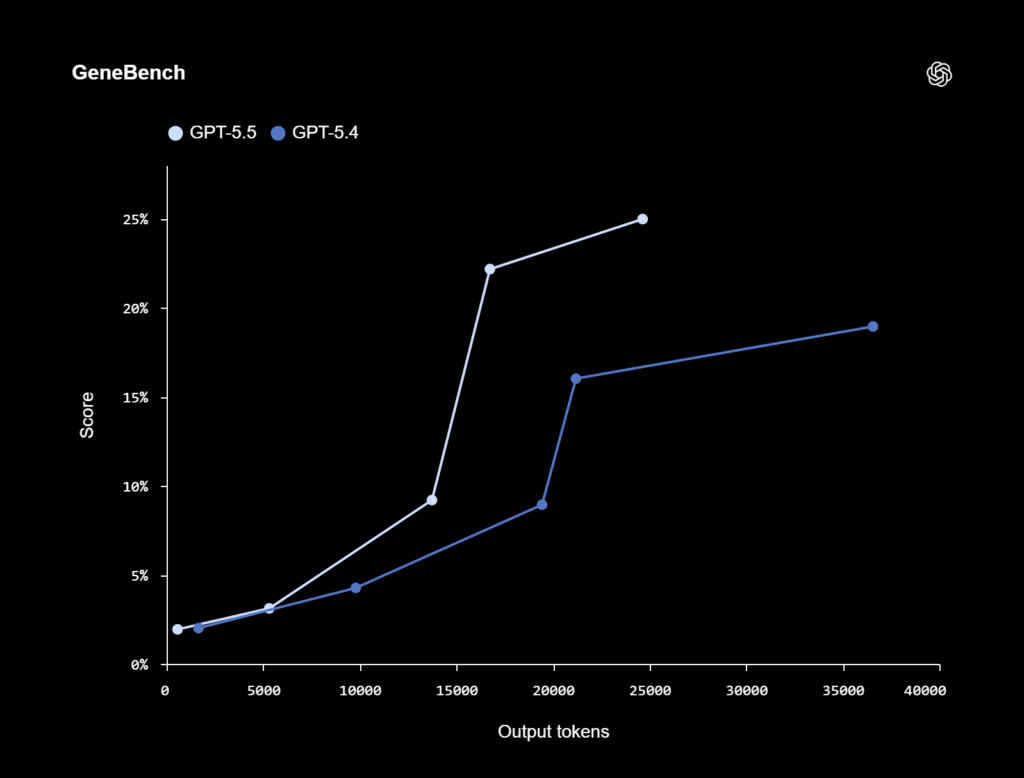
The scientific research angle deserves more attention than it gets. They have improved significantly in terms of multi-stage scientific data analysis in areas like genetics and quantitative biology. In this case, OpenAI’s research chief specifically mentioned drug discovery as something to look at. In any case, the presence of such improvements proves the usability of GPT-5.5 in areas where making mistakes has heavy consequences.
In the case of GPT-5.5, the qualitative leap becomes clear only when you start using it in practice. It processes your input better and follows your logic much more consistently. The move from a tool to a partner has been discussed many times in relation to artificial intelligence, but 5.5 makes it tangible.
Also read: ChatGPT Images 2.0 vs 1.5: Is this update really an upgrade?


