
Duplex, security, and service: what MSMEs really want from printers
 Follow Us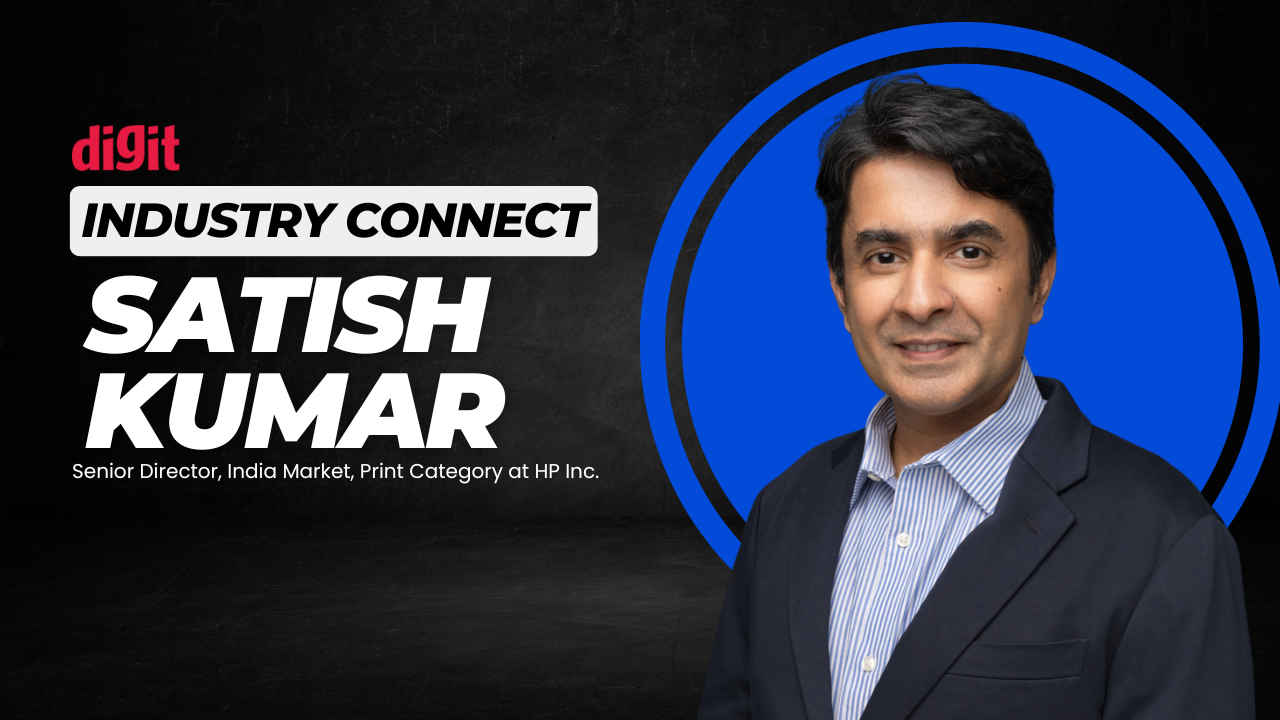

India’s MSME engine is getting more digital every quarter, yet paper refuses to disappear. Invoices still need filing, compliance still likes hard copies, and many small businesses still live in a hybrid reality: some records are born digital, some arrive on paper, and plenty need to move between the two.
 Survey
In our conversation with Satish Kumar, Senior Director, India Market, Print Category at HP Inc., the core argument was not that print is making a comeback for nostalgia’s sake. It was that MSMEs are still trying to stitch together reliable, secure workflows with limited IT support, and printing and scanning remain practical “glue” in that process.
As Kumar framed it early on, this is bigger than a single device category: “It’s not a print solution thing.” Instead, he sees a broader opening in how small firms equip themselves end-to-end: “Big opportunity because if I look at the print penetration in India at home, it is less than 3%, right? And if you look at most of the micro SMBs and small businesses, they may not be really IT equipped today, even from an endpoint solution standpoint, PES (Laptops, PCs, desktops and related client services within Personal Systems), PC, print and I think where HP can come in is able to integrate all this and build it on the overall productivity of an enterprise out of the country.”
Hybrid MSMEs are a lived reality
Small business can quickly spread across locations now, and how that changes the way documents move. “Because the future is going to be a lot of hybrid eventually,” Kumar said. “If a small company starts in Delhi today, it doesn’t take, it is not a big effort for them to start branching out to a tier-two, tier-three cities. And that’s where hybrid work will come into play.”
That hybrid reality is where printing, scanning, and record-keeping become less optional than people assume. “How you exchange information, how you keep digital records, how you keep physical records. And in printing, scanning is a big part of that,” he said, adding a useful nuance for anyone assuming print volumes only go one way: “So while you have pages coming down in certain segments, you have scanning going up on those segments as well.”
From HP’s perspective, the goal is to move away from transactional hardware thinking and towards longer-term service relationships. Kumar called it “building a solution partnership with customers” and connected that to “contractual businesses” as HP approaches SME customers.
Auto-duplex as the new baseline
HP has been talking about making auto-duplex a standard expectation, and we were curious to understand where that promise actually holds up, especially in India’s price-sensitive market.
Kumar drew a fairly clear line between business-oriented devices and typical home needs: “We have HP Smart Tank 700 series, which are auto-duplex or duplex, but those go more into businesses than home because home doesn’t have that requirement.” He also acknowledged that standardisation in India is uneven, using connectivity as a parallel: “But as duplex becomes standard, like Wi-Fi today is still not a full standard in India. We still have a lot of non-Wi-Fi printers that sell as a segment, right? But as HP, we are working towards moving that market to Wi-Fi. The same thing will happen in duplex…”
The “why” is a mix of sustainability and direct operating cost. “One is that from a customer standpoint, we are sensitive about sustainability,” he said. “So auto-duplex saves you paper. It makes printing much more productive from a cost efficiency standpoint, how you use power. So everything kind of gels together when you do that.”
On why home printers have not followed the same “feature democratisation” curve seen in smartphones, Kumar pointed at affordability and usage patterns: “I think in home, it boils down to cost and affordability of the customer, right? So what auto-duplex also has is cost element.”
He also described home printing as heavily learning-led: “Home is more of learning in my personal opinion, like a lot of things… Students use it a lot. You know, parents who are really looking at student productivity use it a lot.”
And he placed India’s low home penetration in a wider services context, including outsourced printing: “At the end of the day, printing is a category that today also gets outsourced a lot.” He referenced “Jobber as a community that we follow in India,” and added: “With evolution of e-commerce, quick commerce, for example, there’s print as a service already happening on that front.”
For Kumar, the inflection happens when cost and utility finally meet at scale, using a familiar analogy: “We used to go to internet cafes to do internet because the internet was not affordable. But when it became affordable, it came home.”
Laser vs ink tank
For MSMEs stuck between mono laser devices and increasingly capable ink tanks, Kumar’s view was that real-world business requirements usually make the decision for you. On the Laser M300 series positioning, he emphasised mono speed and business reliability: “So the 300 series is more mono, which is what is getting used in most businesses today. And it is 30 to 33 ppm (pages per minute), which is what businesses want. They want faster, reliable printing and also on top of that, security. Security becomes a big part of, because you’re wireless, you’re connected and all your other electronic equipments are connected to printers,” he said.
Where does tank fit then? He framed it around colour needs, convenience, and creative use: “But you could have scenarios where you need to do some color printing. And that is where tank comes in.” In home use, he argued the appeal is avoiding a two-printer setup making smart tank printers the clear choice.
He also suggested tanks map well to very small setups: “Tanks, we would like more to go towards the real micro, very micro SMBs that are a 1-2 person show or running something out of their home, for example. Tanks become the smarter choice.”
Saving on paper, energy, and more
When asked what day-to-day savings auto-duplex and faster output can deliver, Kumar went beyond a simple “you save paper” line and broadened it into energy and operational efficiency: “So cost saving in auto-duplexes, as I said, you save on pages, you save on energy cost, you’re much more energy efficient.”
He also linked sustainability to procurement logic for newer MSMEs: “Today, I think as the new set of MSMEs are coming on board, I do see that most of them, I would say, are very, very passionate about their impact to the environment. They look at how what they do has an impact on sustainability. Most of our ink cartridges today are basically 88% of the ink cartridges made out of recycled plastic. On toner, it’s 100%.” He added: “We have committed to 75% circularity by 2030. We’re already at 42%. So we are ahead of the curve.”
The more practical MSME angle, though, was reliability. Not glamorous, but deeply tied to cost. Kumar pointed out, “the overall cost of operation story builds up well because these printers have been tested. They’re very, very reliable, which means that you don’t have to go through a lot of downtime or experience service issues per se.”
The market looks towards subscriptions
No MSME print discussion stays clean for long once supplies come up. Kumar did not deny the reality of third-party refills, and he described HP’s pitch in two layers: “Value of supplies is one part is the cost part, but the second part is on sustainability, on reliability.” He also underlined a security linkage: “All our toners come with chips, which especially if you are a small and medium business, it has got a security element of the printer also sits on the toner.”
Rather than claiming HP can fully stop third-party behaviour in a price-sensitive market, he argued the long-term counter is structural: subscription and contractual printing. “If you look at the Western markets, they have moved to a new concept or new business model called instant ink. If I’m an end user at home, I subscribe for inks. I don’t buy them.”
On the enterprise side, he pointed to contracts and managed print services, and suggested these models will flow down into smaller businesses over time: “What is happening is that the channel market is going to evolve over time and go into contractual model, also in the small and medium enterprise.” He referenced HP Managed Print Services as one such model.
India, in his view, will get there, just later: “The market on print will eventually move to subscription and contractual modelling. And countries like India will take a little longer. I think as we continue to develop, that will move faster.”
Printer security
Security came up repeatedly, especially as MSMEs adopt wireless printing and mobile-led workflows. On HP’s approach, he leaned on firmware and automatic updates as baseline defences: “When you’re using HP printers, the security part is taken care of because there’s a lot of auto firmware upgrading, and it kills any spamware that comes in. So the printer by itself is very secure.”
He also described HP’s “HP app” as a central layer that will expand beyond print: “We have the HP app today which basically talks to all our printers and the HP app is going to evolve not just for printing but also for all our products whether it is PC, print or poly…”
That said, he was candid about where vendor control ends, especially around how scanned documents are handled once they leave the device: “But how do you manage a mobile user to scan and protect? I think that reliability will depend on every organization how they’re going to use their printer pages. I don’t think we can control that.”
For network printing workflows, he was more confident about tracking and control in managed contexts: “Anything from a mobile device printed to a printer which is on a network and which is contracted with services and solutions, yes, absolutely. Every page can be tracked.”
He tied that back to operational visibility as well: “The HP app can also give you, what’s the level of toner, what are the page uses, etc. So you can actually track productivity. That is pretty secure.”
Support in tier-2 and tier-3 cities
On service reach, Kumar distinguished between retail touchpoints (HP World) and support mechanisms. “When you buy a product, it comes with a warranty where servicing is taken care of and there’s always an opportunity to upgrade that. You can buy care packs which can enhance the SLAs. For example, on tanks we have 699 cities where we service at the moment.”
The most interesting bit was how support is being modernised to reduce visits where possible: “There is a logging system both from, if a customer has got an issue, there is an option to go and log in from a PC, from a mobile phone as well, to contact the center and there’s live chat that goes on and then, you know, there is now a concept of remote resolve.”
He described what that looks like operationally: “A service engineer actually comes on mobile and does a video call and if they can resolve it right then and there, then they resolve it then and there, otherwise they’ll send an engineer to solve the issue.” And he added: “Today, our remote resolves have really, really gone up from the past couple of years.”
A workflow infrastructure
Across the interview, HP’s thesis was consistent: in India’s MSME segment, print is not “old tech”, it is workflow infrastructure that needs to be faster, cheaper to run, simpler to support, and safer by default.
Or, as Mr. Satish Kumar put it right at the start, the opportunity is not about pushing a box, it is about outcomes: “It’s how, as one HP solution, we can come to build up businesses for better productivity than where it is…”


