Artemis II’s best picture: First ever solar eclipse from beyond the moon
 Follow Us
Artemis II captured first-ever human-viewed eclipse from lunar orbit
Moon appeared larger than sun, erasing familiar eclipse view
Nearly hour-long totality revealed raw cosmic alignment


There are some space photographs that will forever be epic. Voyager’s Pale Blue Dot, Hubble’s Pillars of Creation, and one specific picture taken by the crew on Artemis II on their historic mission to the moon. This picture showcased how humanity briefly stepped outside its own frame of reference and presented proof that the universe is even more beautiful when viewed from a new perspective.
 Survey
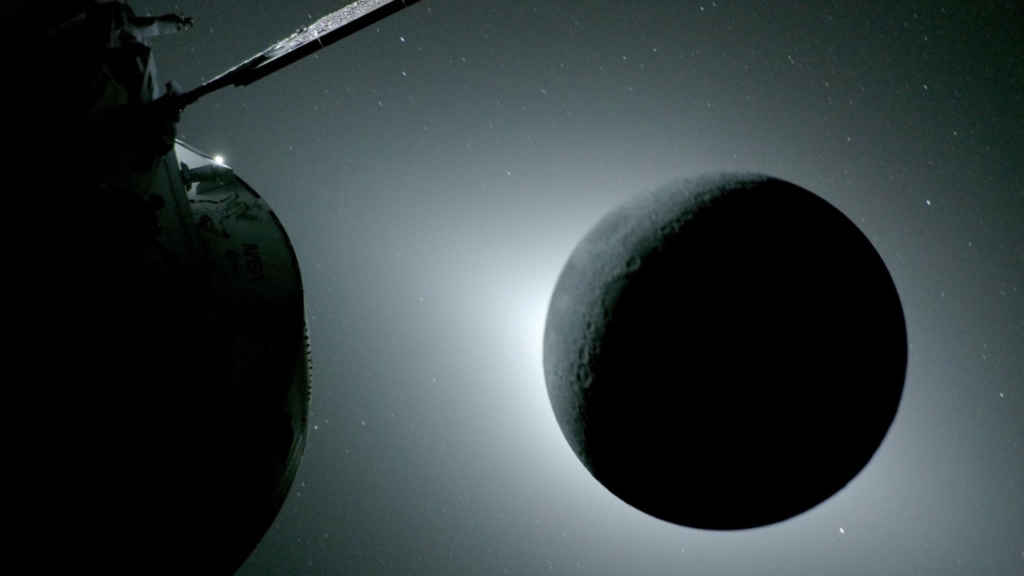
The solar eclipse captured during Artemis II is unlike anything we have seen before from here on earth. And this specific picture is amazing for several key reasons.
From Earth, a total solar eclipse is a delicate celestial dance, where the sun’s radial disc never truly vanishes. But in the images of this rare solar eclipse clicked by astronauts flying past the moon, the moon isn’t playing second fiddle to the sun.
It’s overwhelming in its presence, large enough to blot out the sun, leaving behind a halo to remind us of our host star. That’s what a solar eclipse looks like when it’s observed from 384,400 kilometres away beyond the dark side of the moon.
Also read: NASA Artemis II mission isn’t landing on moon: Here’s why
As the Orion capsule swung behind the moon’s far side, astronauts on the Artemis II lunar mission witnessed a total eclipse that lasted nearly an hour — not the fleeting minutes we get to experience from the surface of the earth.
In that prolonged darkness, our sun didn’t peek through the moon’s circumference as a ring. It vanished completely, leaving behind just a soft glow of its corona. From the far side of the moon, we saw the sun reduced to a whisper like never before.
It’s a perspective of the sun and moon in the sky we were never meant to see, and one we can only get because of brave, space-faring missions. A solar eclipse on the earth is at the mercy of the elements. Pray there are no clouds, if you are lucky, and even then the light bends and colours soften.
But out there in space, beyond the interference of air or atmosphere, the Artemis II crew saw the eclipse in its natural form with no filters, which is a raw alignment of bodies in vacuum.
Unlike the sky dimming when viewed from earth, during this solar eclipse viewed from space, the picture revealed faint glimpses of planets, stars, and other deep space glitter. It was an extraordinary sight, if I may say so!
Also read: Smartphones, cameras: Artemis II astronauts will use all these tech gadgets on moon flyby
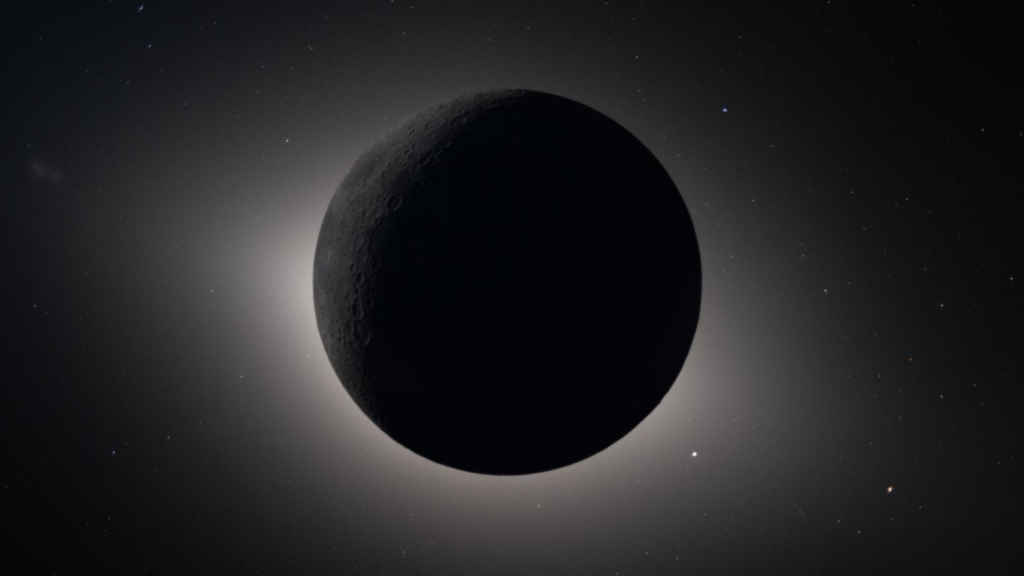
There is another detail that elevates this image beyond spectacle. This solar eclipse wasn’t captured by some distant observatory or a billion-dollar telescope. It was photographed by human hands using a Nikon D5, a DSLR camera that anyone here on earth can purchase and use.
That matters. Because the crew of Artemis II — Reid Wiseman, Victor Glover, Christina Koch, and Jeremy Hansen — were standing in a place and time where no human had ever seen an eclipse from this perspective before. And in doing so, they extended our senses.
Also read: Apple’s iPhone 17 Pro Max got approved for the Artemis II moon mission, here’s how


