
Adobe Summit 2026: CX Enterprise, GenStudio and Firefly updates show Adobe wants AI to run the workflow
 Follow Us

Adobe Summit 2026 just got done in Las Vegas and like all major tech companies, Adobe is no longer talking about AI as just a handy add-on feature. The company is now pitching AI as the connective tissue across its entire software stack, from creative tools and video editing to campaign planning, brand governance and customer engagement. Across the keynote announcements, the messaging was clear about Adobe wanting to use agentic AI to improve fragmented workflows and help businesses and creators not get overwhelmed.
 Survey
Adobe’s enterprise moves often shape the tools and features that eventually reach mainstream creators, freelancers, small businesses and even everyday users. Whether it is smarter editing in Firefly, easier campaign production in Express-linked workflows, or AI assistants that can actually understand context across apps, the bigger underpinning message here is about software becoming more proactive. Instead of waiting for commands one step at a time, Adobe wants its tools to understand intent and carry out complex tasks across multiple stages of work.
CX Enterprise is Adobe’s biggest strategic play
The biggest announcement from Summit was Adobe CX Enterprise, a new end-to-end agentic AI system designed to manage the full customer lifecycle, from acquiring a potential buyer to retaining them over time. Adobe says the platform brings together AI agents, reusable agent skills, Model Context Protocol (MCP) endpoints, and a governance layer so companies can automate more of their marketing and customer experience work without losing sight any of the above aspects.
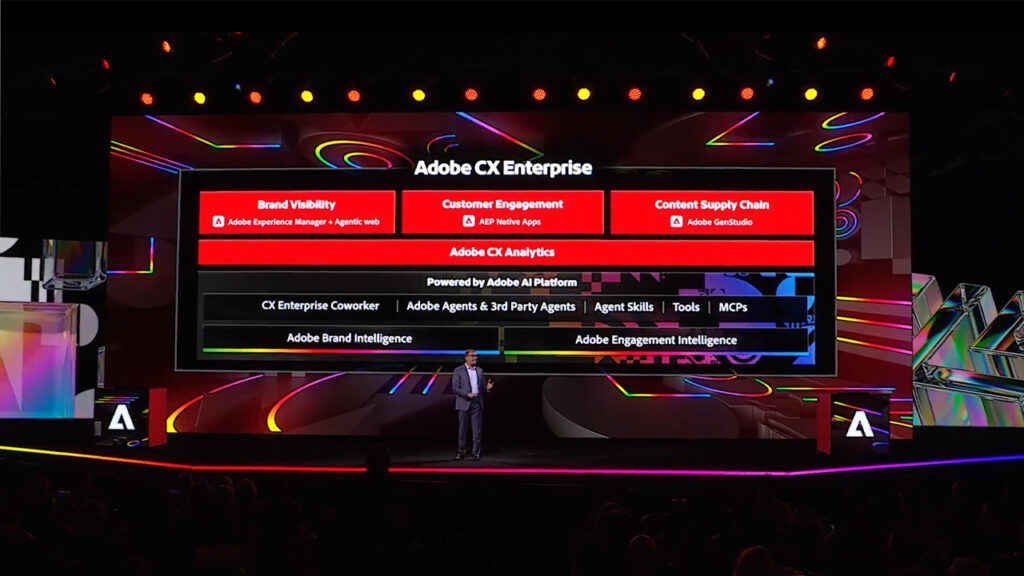
In simpler terms, Adobe is trying to build a kind of AI operating layer for customer experience. Instead of having one AI tool for analytics, another for content, and another for campaign execution, Adobe wants everything tied together through a coordinated system. It is also layering this over Adobe Experience Platform, which already powers a large amount of enterprise customer data and interactions. The company says that platform handles over one trillion experiences annually, and now it wants that same data foundation to guide AI-driven decision-making.
Most businesses do not struggle because they lack data or content. They struggle because the data, the content and the tools do not work together smoothly. CX Enterprise is Adobe’s attempt to stitch all that together. If it works as promised, brands could move faster on personalised campaigns without needing large teams to manually connect every dot.
Firefly AI Assistant works across apps
Another interesting announcement for creators was Firefly AI Assistant. Adobe says this upcoming assistant, powered by its creative agent, will let users describe the result they want in natural language and then have the system orchestrate multi-step workflows across Firefly, Photoshop, Premiere, Lightroom, Illustrator, Express and more.
That is a meaningful shift. Right now, creative AI often feels like a collection of separate tricks: generate an image, extend a video clip, remove an object, clean up audio. Adobe’s idea is to turn those isolated tools into something closer to a collaborative assistant. A creator could ask for a polished social campaign, a retouched image set, or a refined edit with feedback incorporated, and the system would carry that work across apps while preserving context. Adobe also says the assistant can learn user preferences over time, understand brand assets and even integrate with Frame.io so review feedback can loop back into changes automatically.
For the average creator, this is the part that feels most useful. It suggests a future where creative software becomes less about hunting through menus and more about steering outcomes. Adobe is careful to say the creator stays in control, but the practical appeal is obviously about less friction, fewer repetitive steps, and faster movement from idea to finished output.
Firefly’s editing upgrades
Adobe also expanded Firefly’s editing feature set in ways that feel more grounded in real production work. Firefly Video Editor is getting studio-quality audio improvements, including speech enhancement, noise and reverb reduction, and better balancing of dialogue, music and ambience. It is also adding more advanced colour controls and direct Adobe Stock integration, which gives users access to a very large library of licensed media from within the workflow.
On the image side, Adobe announced Precision Flow and AI Markup. Precision Flow lets users generate a range of image variations from one prompt and then adjust the result through a slider, moving from subtle changes to more dramatic ones. AI Markup gives more direct control over where edits happen by letting users draw or brush onto the image to guide changes.
These features may not sound as dramatic as a new AI assistant, but they matter because they address one of the core frustrations with generative tools, that of unpredictability. Adobe is trying to make AI editing more precise, more iterative and less like gambling on random outputs. For users who care about control, that is arguably more useful than sheer novelty.
Third-party integration AI integration
Adobe is also continuing to make Firefly a hub for multiple AI models rather than relying only on its own. The company says Firefly now offers more than 30 creative AI models, with new additions including Kling 3.0 and Kling 3.0 Omni, alongside models from Google, Runway, Luma, ElevenLabs, Topaz Labs and others.
In a time when the AI market is moving too quickly for any one company to dominate every creative use case, having a central hub that gives you the flexibility to switch between models can be quite the value addition. Some models are better at video, others at voice, still others at image generation or enhancement. Adobe’s strategy is increasingly about becoming the front end where creators can access multiple best-in-class models with a familiar interface and commercial safety controls.
For users, that could mean less hopping between different AI tools. The trade-off, though, is that Adobe is turning Firefly into a more complex ecosystem. The company will need to make sure choice does not become clutter.
GenStudio is Adobe’s answer to the content bottleneck
On the enterprise side, Adobe also announced a wave of updates to GenStudio, its content supply chain platform. The headline addition is Brand Intelligence, which Adobe describes as a continuously learning engine that goes beyond static brand guidelines. Instead of relying on a PDF of rules, the system is meant to learn from approvals, rejections, annotations and feedback over time, then make that understanding available to AI agents working across content production.

Adobe also announced new AI agents in Workfront for cross-team collaboration, improved campaign brief creation, Firefly Creative Production for Enterprise Workflow Builder, and a new GenStudio for Content Marketing module that can turn long-form documents and videos into campaign-ready assets such as case studies and web articles. There is also an OpenAI partnership that brings support for ChatGPT Ads in GenStudio for Performance Marketing.
Those of us on the content creation side of the world know that content teams are under pressure to produce far more material for far more platforms than they were even a few years ago. Adobe is trying to position GenStudio as the system that keeps that machine moving without losing brand consistency.
Adobe’s pushing for more interoperability
Another major theme at Summit was interoperability. Adobe announced expanded partnerships with Amazon Web Services, Anthropic, Google Cloud, IBM, Microsoft, NVIDIA and OpenAI, while also deepening integrations with agencies, system integrators and enterprise platforms. Adobe Marketing Agent is now generally available in Microsoft 365 Copilot and in beta across Amazon Quick, Claude Enterprise, ChatGPT Enterprise, Gemini Enterprise and IBM watsonx Orchestrate.
Businesses are not going to rebuild their workflows around a single vendor’s dream platform. Adobe seems to recognise that the real opportunity is to make its intelligence, content systems and agent tools available inside the software that people already use every day.
Summit Sneaks shows what’s next
Finally, Summit Sneaks offered a look at Adobe’s experimental pipeline, and some of these demos were among the clearest illustrations of where the company wants marketing workflows to go. Project Concurrent turns static visuals into designs linked to live data. Project Face Off simulates A/B testing before launch. Project Page Turner builds personalised web pages in real time based on user intent. Project Wise Wire converts static assets into personalised email workflows, while Project Asset Amplify and Project Tailored Takes aim to scale assets and videos across platforms and markets.
These are not shipping products yet, but they reveal Adobe’s thinking which revolves around the belief that marketing content should be dynamic, testable, personalised and reusable from the start, not manually rebuilt for every channel.


