
What is Ghost Font? The text humans can read but AI struggles to understand
 Follow Us
Ghost Font uses moving dots to hide text that humans can read but many AI models fail to detect.
The experiment highlights differences between human visual perception and how current AI systems process motion.
Researchers say Ghost Font is not an encryption tool and future AI models are likely to become better at decoding it.
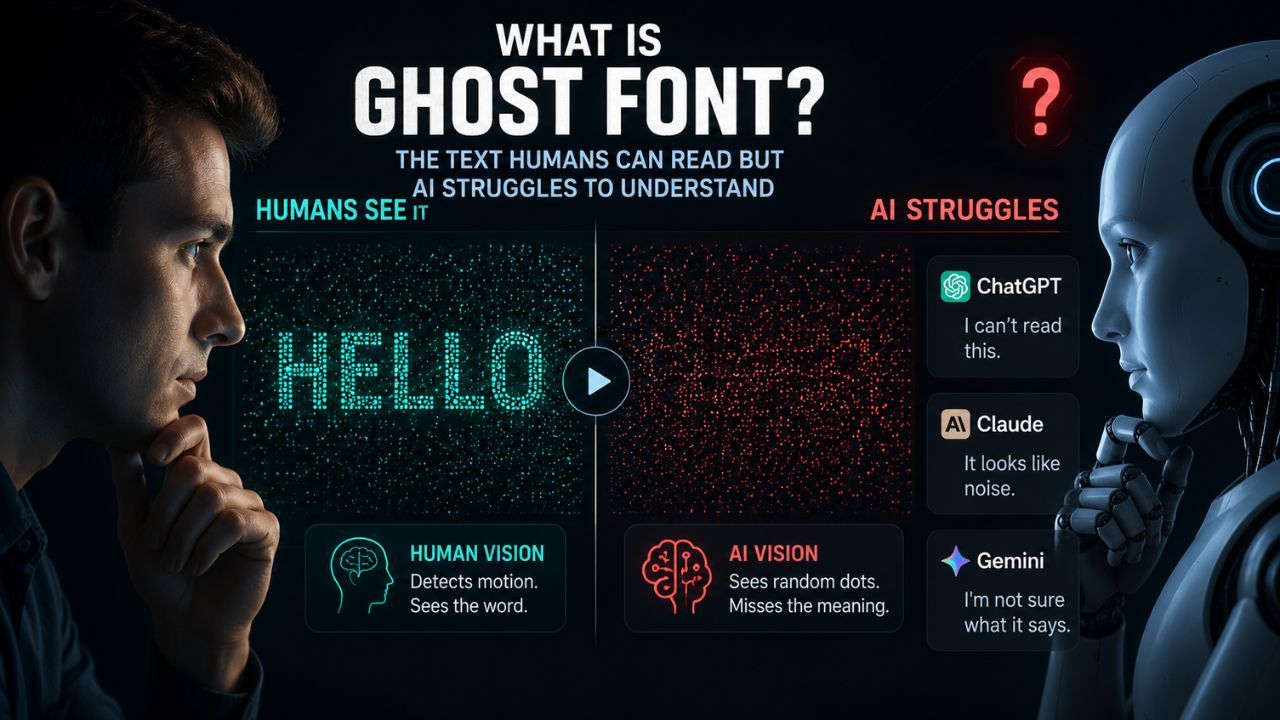

AI has become increasingly capable. It can read notes, extract text from blurry images and even understand scanned documents. However, a new visual experiment called Ghost Font is now going viral for exposing a limitation in how many AI vision models interpret moving images. While humans can easily spot the hidden words, several AI chatbots struggle to identify the same text.
 Survey
Ghost Font is developed by the designer Eric Lu and is an experimental typography project that explores the difference between human and machine vision. It relies on motion to reveal the hidden text rather than on displaying letters with visible outlines.
How Ghost Font works
Instead of using traditional fonts, Ghost Font creates words using thousands of tiny moving dots. The dots that make the hidden letters often move in single direction while the surrounding dots move differently. And the human visual system naturally groups these moving patterns together, allowing the hidden text to become visible even though there are no defined letter shapes. Once the animation is paused, however, the illusion disappears completely, leaving behind what appears to be random dots.
Also read: OpenAI’s first AI device may be a screenless ChatGPT speaker with a camera: What to expect
The project can also generate misleading or decoy text, which can cause AI models to identify an incorrect message while human viewers continue to see the intended one. Anyone can test the concept by creating a Ghost Font animation and uploading it to AI chatbots such as ChatGPT, Claude or Gemini to compare how each model interprets the hidden text.
Why AI finds it difficult
As per the project, the illusion takes advantage of key differences between human vision and the way many current AI systems analyse videos. Humans naturally process motion over time, making it easier to recognise moving patterns.
According to the project, the illusion takes advantage of a key difference between human vision and the way many current AI systems analyse videos. Humans naturally process motion over time, making it easier to recognise moving patterns as meaningful objects.
Many multimodal AI models, however, still interpret videos largely as a sequence of individual frames. Since Ghost Font removes the stable edges and letter outlines that optical character recognition systems typically rely on, the hidden words can become difficult for AI to detect.
This does not mean AI cannot decode Ghost Font. The report suggests that advanced computer vision techniques such as optical flow analysis or frame by frame processing can help in recovering the hidden message.


