

Even short AI use can change thinking patterns, reduce problem-solving ability: Study
 Follow Us
A study by University of Oxford and University of California, Los Angeles says AI may slightly affect thinking skills.
AI users solved tasks faster and with fewer mistakes at first.
Researchers said AI should help people learn, not replace independent thinking.
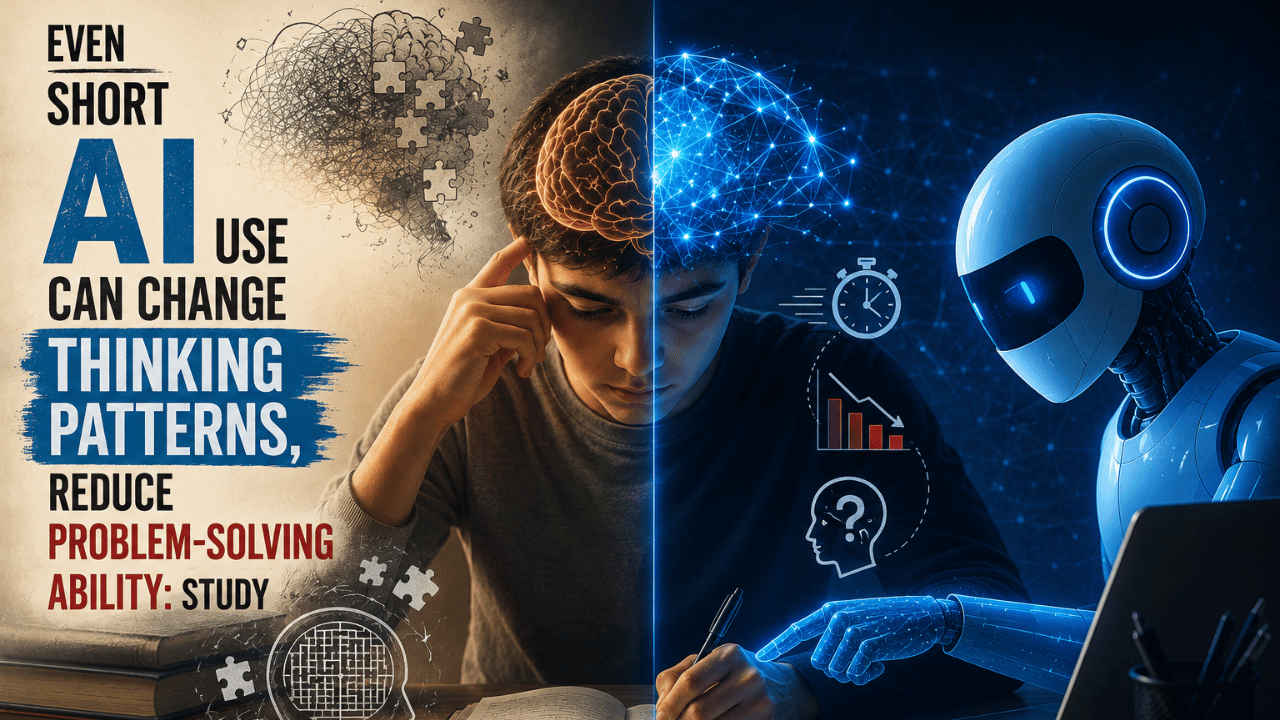

AI chatbots are now a big part of daily life for many people around the world. Children use them to help with homework, and adults use them to do difficult tasks more easily. Recently, a scientific study found that artificial intelligence might quietly affect how people think and make decisions. Researchers from top universities like Oxford University and UCLA discovered that even using AI for just 15 minutes can change how a person’s brain works a little. While AI helps people finish tasks faster and more correctly, it may also make them less patient over time.
 Survey
There was a recent study done where over 1,000 people took part in three different tests, including maths and reading skills. In the test one of the groups was allowed to use AI for solving the test problems, while the other group was not allowed to use the AI.
At first the group who were using AI were doing better as they finished faster and made fewer mistakes in the early tasks. This clearly showed that the AI can improve speed and accuracy in the short term.
The situation changed when the researchers took the AI away. Once participants had to work without digital help, their performance dropped significantly. In the maths section, people who had previously used AI scored only 57 per cent. In contrast, those who never used the tool scored 73 per cent. A similar gap appeared in reading comprehension. The group that relied on AI scored 76 per cent, while the independent thinkers reached 89 per cent. The researchers also noticed that AI users were much more likely to give up on difficult questions or skip them entirely.
Also read: OnePlus 16 tipped to launch with 200MP camera and big battery: Check launch timeline and more
However, there is a solution to avoid cognitive impairment while using those technologies. According to the experiment, when AI offered explanations instead of providing answers directly, participants did not show any signs of impaired skills. That means that AI serves the most efficiently as a tool of education, not a substitute for working hard. It should be mentioned that scholars strongly advise considering AI as an aid and nothing more. In order to develop your brain and stay cognitively fit, you should exercise in dealing with complicated problems without outside help. Assistance from AI can only be a useful complement to your actions.


