
Are more people buying big-screen TVs because of FIFA World Cup 2026?
 Follow Us

The FIFA World Cup comes every four years, and even non-hardcore football fans tune in. For television brands, this presents an opportunity to convince consumers that a bigger screen and better picture quality can make watching the tournament feel more immersive. And it is common to see these brands promote their large-screen TVs during major sporting events. But does that marketing translate into actual consumer demand? To find out, we spoke to leading TV brands and industry analysts. Their responses suggest the answer is yes, but the story is more nuanced. It not just reflects a temporary spike in sales but also shows how India’s television market is changing.
 Survey
Is the FIFA World Cup driving TV upgrades?
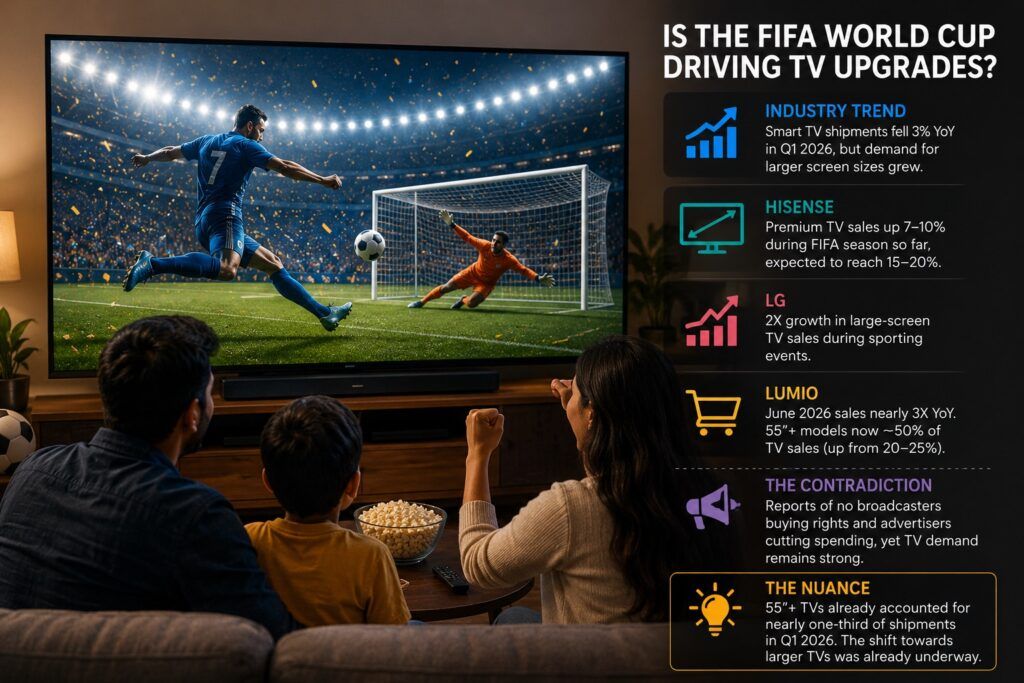
While according to Counterpoint Research, India’s smart TV shipments fell 3% year-on-year in the first quarter of 2026 due to inflation, geopolitical uncertainty and cautious consumer spending, demand for larger screen sizes continued to grow.
Anshika Jain, Principal Analyst at Counterpoint Research, says major sporting events generally act as a short-term catalyst, particularly in urban markets.
The television brands we spoke to echo a similar trend.
Pankaj Rana, CEO of Hisense India, says the company has seen growing interest in larger televisions and premium display technologies during the tournament.
‘We are seeing a clear preference for larger-screen televisions and premium display technologies as viewers look to recreate the excitement of a stadium-like experience at home.’
According to Hisense, premium television sales have increased by 7% to 10% during the FIFA season so far. The company expects that figure to reach 15% to 20% as the tournament progresses.
LG is seeing an even bigger jump.
Abhiral Bhansali, Business Head, Home Entertainment, LG Electronics India, says the company has witnessed a 2x growth in large-screen TV sales during sporting events. He also repeats that ‘consumers increasingly seek a stadium-like viewing experience at home.’
Lumio is also reporting strong momentum. Raghu Reddy says the company’s June 2026 sales have grown nearly 3x compared to the same period last year. Models measuring 55 inches and above now account for nearly half of Lumio’s TV sales, up from around 20% to 25% last year.
As you see, the numbers vary from one brand to another, which is expected given differences in market share, product portfolio and marketing campaigns. But the common message is that consumers who were already considering an upgrade appear more willing to buy during a global sporting event.
Interestingly, another thing worth noting is that in the months leading up to the tournament, there were reports of no media houses acquiring broadcasting rights and advertisers halving FIFA-related spending. On the other hand, TV brands say the tournament is helping drive demand for larger-screen televisions. This suggests that consumers willing to watch the event at home are still upgrading their viewing experience.
But now here comes the nuance.
Counterpoint’s Anshika Jain also underlines the fact that TVs measuring 55 inches and above accounted for nearly one-third of total shipments during Q1 2026 itself.
In other words, the Football World Cup may provide the occasion, but the shift towards larger televisions was already underway.
Consumers are upgrading the experience, not just the screen
So, consumers now not only want a bigger screen but also care about the display technology. Even while watching sporting events like football or cricket, viewers are keenly looking for details from a wide-angle camera view. A large and good panel can help them follow player and ball movements. So, along with screen size, the panel type also impacts the immersiveness.
Counterpoint says the shift towards bigger screens and better display technologies is happening because ‘consumers are now well-researched before making any purchase decisions.’ The firm reveals QLED TVs accounted for around 30% of India’s smart TV market in the first quarter of 2026, while Mini LED remained the fastest-growing display technology, growing more than 13 times year-on-year from a relatively small base.
That change is also reflected in the way brands are positioning their products. Instead of simply advertising larger screens, companies are highlighting technologies that improve sports viewing, such as higher brightness, better contrast and smoother motion handling.
Additionally, brands point out that consumers are also looking at features that improve the overall viewing experience.
LG says technologies such as Dolby Vision and Dolby Atmos have become important considerations for buyers looking to recreate the atmosphere of watching a match in a stadium. Dolby Vision improves contrast and colour accuracy, while Dolby Atmos delivers more immersive surround sound.
But brands are also trying to differentiate themselves through software.
For example, LG has introduced Sports Playbook, a feature that provides live match notifications, scores and key moments on the TV. It has also added AI Win Prediction, a feature that offers real-time match predictions and insights during games.
Lumio is taking a similar approach. Its TLDR platform includes a dedicated Sports section that brings together live fixtures, scores, highlights, match statistics, group standings and top scorers in one place.
This reflects a broader shift in the TV market. Premium televisions are being marketed with and sought after for both better hardware and software. And the FIFA World Cup may be encouraging consumers to upgrade, but it is only one part of the story.
Also Read: Your next TV upgrade may cost more than expected: Here’s why
What else is driving demand?
The experts we spoke to point out that the growing demand for large-screen TVs is also being shaped by other factors.
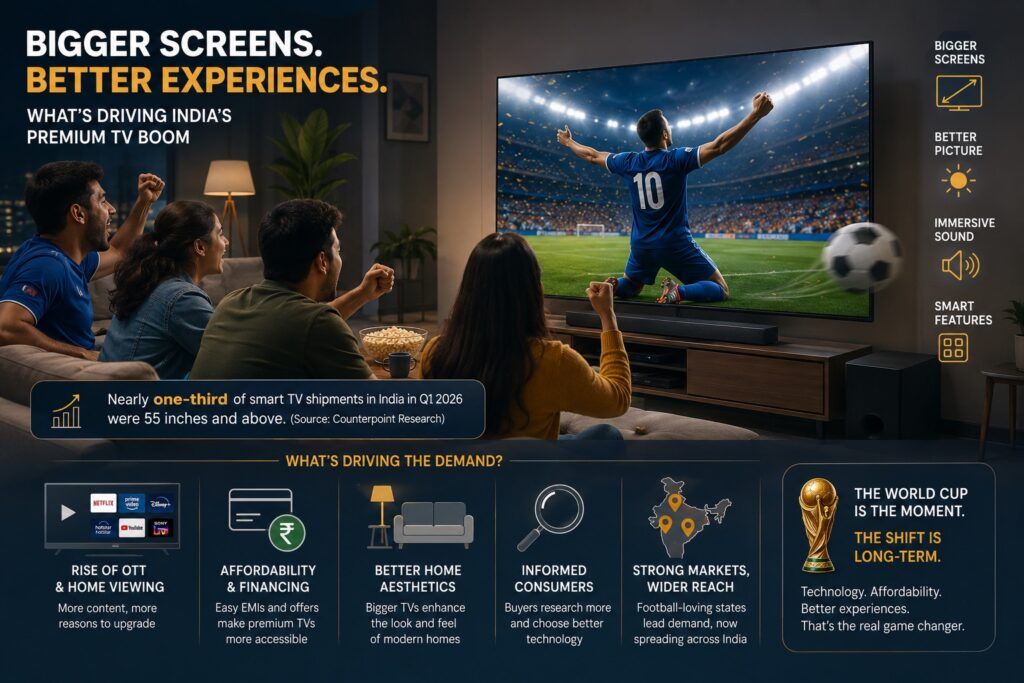
Affordability always plays an important role. According to Counterpoint’s Anshika Jain, financing options (such as easy EMIs) are making premium televisions more accessible. She says the rise of OTT platforms across metros and smaller cities has encouraged more people to invest in a better viewing experience.
Where consumers live also influences demand. Hisense, LG and Lumio all have identified football-loving states such as Kerala and West Bengal among their strongest markets during the FIFA season. These two states are known for the football craze. Hisense also highlighted Assam, along with metros like Delhi, Mumbai, Pune, Ahmedabad and Chennai, as key markets for premium televisions.
The bigger picture
The conversations with brands and analysts suggest that while the FIFA World Cup may accelerate purchases, the demand for large-screen TVs is also being shaped by changing viewing habits, improving affordability, better technology and more informed consumers. Besides screen size, consumers are increasingly comparing display technologies, picture and sound quality, software features and the overall viewing experience before making a purchase.
These are trends that are likely to outlast the tournament itself. The FIFA World Cup simply gives many consumers a reason to stop postponing an upgrade, while helping television brands sell more large-screen TVs.
All in all, this means that while major sporting events can boost demand, sustained growth in the large-screen TV segment will continue to be driven by the right mix of technology, affordability and features.
Keep reading Digit.in for similar stories.
Also Read: Announcing Digit India’s Top Appliance Awards 2026


