

Apple MacBook Pro with M5 Max chip just launched: What’s new?
 Follow Us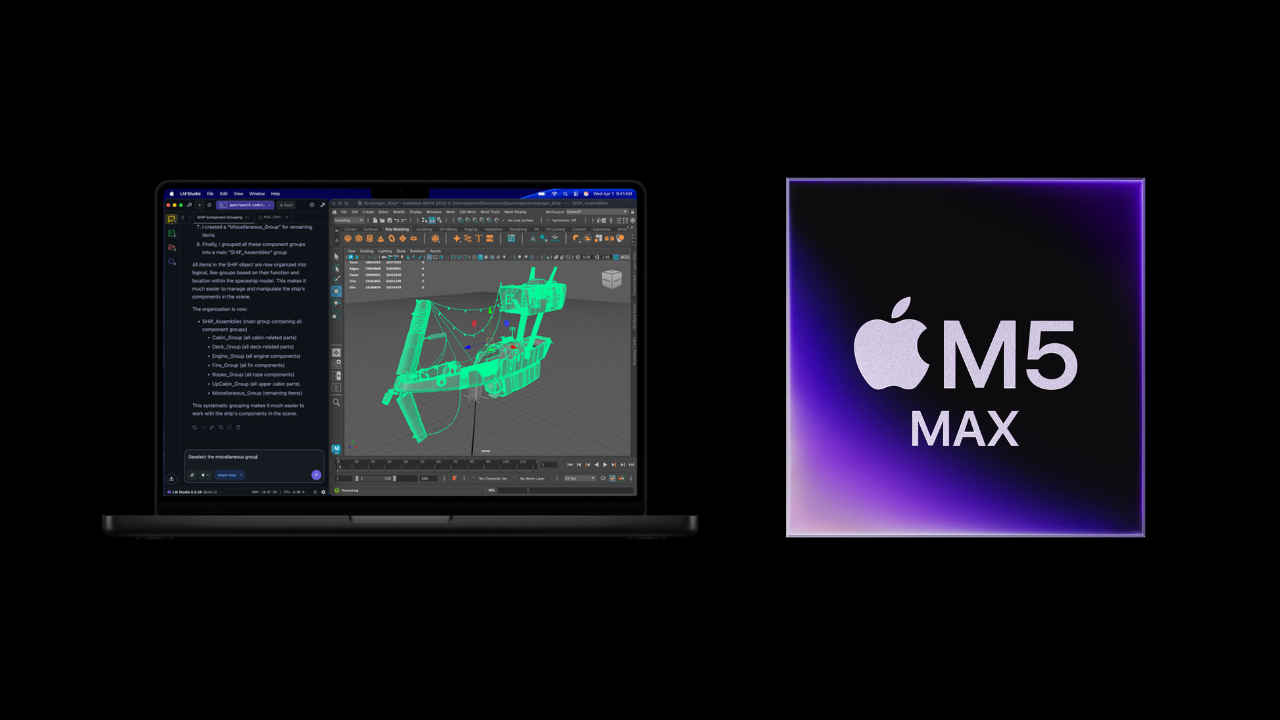

How much power is too much power? This is exactly what you will be left wondering when you take a close look at Apple’s new productivity beast, the M5 Max-powered MacBook Pro. With a starting price of Rs 3,99,900, the laptop has just been launched and it is the most powerful laptop by the Cupertino-based tech giant today. Along with the laptop, the M5 Max chipset has also made its debut and will be a good fit for 3D artists, AI researchers and professionals with heavy-duty needs. If you fit into any of these categories and have been thinking of upgrading, read on. We have done all the homework and broken it all down for you.
 Survey
Also read: Apple launches MacBook Pro with M5 Pro chip: Key features, upgrades and price in India
Apple M5 Max MacBook Pro: What’s new?
Apple’s new MacBook Pro powered by the M5 Max chipset runs on an 18 core CPU made up of six super cores and 12 new performance cores. Apple says these super cores are the fastest CPU cores in the world for single threaded tasks. The new performance cores are designed to handle multithreaded pro workloads more efficiently. Compared to the M4 Max, multithreaded performance is said to be up to 15 percent higher. When compared to M1 Max, the jump is even more.
Now, the aspect that is bound to stand out the most about the M5 Max chipset is how it is built. The chipset is built on Apple’s brand new Fusion Architecture and combines two third generation 3 nanometer dies into a single system. In simple terms, this allows Apple to pack in more CPU power, a larger GPU, faster memory bandwidth and stronger AI acceleration. Compared to the M4 Max generation, Apple has claimed some serious gains in graphics, AI compute and multithreaded performance.
If you thought that CPU has all the gains, you are wrong. The GPU upgrades are also worth a serious look. The M5 Max scales up to a massive 40 core GPU. And each GPU core includes a dedicated Neural Accelerator, which is expected to play a big role in boosting AI performance. Apple has claimed over four times the peak GPU compute for AI compared to the M4 Max, and more than six times compared to M1 Max. For users running large language models locally or working with complex AI pipelines, this leap matters.
In terms of graphics, Apple claims that the M5 Max delivers up to 20% higher performance than M4 Max. In apps that use ray tracing, users can expect to see up to 30% better performance. As for 3D rendering in tools like Cinema 4D or detailed architectural visualisation, faster previews and shorter export times can be expected.
Apple didn’t forget unified memory upgrades as well. The M5 Max supports up to 128GB of unified memory with bandwidth up to 614GB per second. This high bandwidth is critical for handling massive datasets, complex scenes and high token generation in LLM workloads. On top of that, the chip includes a faster 16 core Neural Engine, Apple’s latest Media Engine with hardware accelerated H.264, HEVC and AV1 decode, ProRes encode and decode, and built-in Thunderbolt 5 controllers.
Who is this new MacBook Pro for?
Since the MacBook Pro M5 Max is priced at almost Rs 4 lakh, it certainly isn’t for every kind of user. If your typical work day looks like Google docs and spreadsheets, it might not be wise to spend that much on a new laptop. However if you need a laptop that can do a lot of heavy lifting and often find yourself pushing your system to its limit, this might be a worthy upgrade.
The people who might need this much power are 3D animators rendering detailed environments, AI researchers training and testing models locally, developers compiling massive codebases, and video editors working with multiple high resolution footage.
There is no doubt that the combination of an 18 core CPU, up to 40 core GPU, Neural Accelerators in every GPU core and up to 128GB unified memory makes this one of the most capable pro laptops available right now.
In other words, the M5 Max MacBook Pro is about power. It comes with more cores, more memory bandwidth, and promises better AI performance. And if your work demands maximum compute in a portable form factor, this is the answer.
Also read: Apple iPad Air M4 vs iPad Air M3: What’s new?


