India’s first AI self-driving car tackles potholes, cows, and chaos
Wipro-IISc’s WIRIN redefines autonomous driving for unpredictable Indian roads
WIRIN blends LiDAR, radar, and AI to master India’s traffic
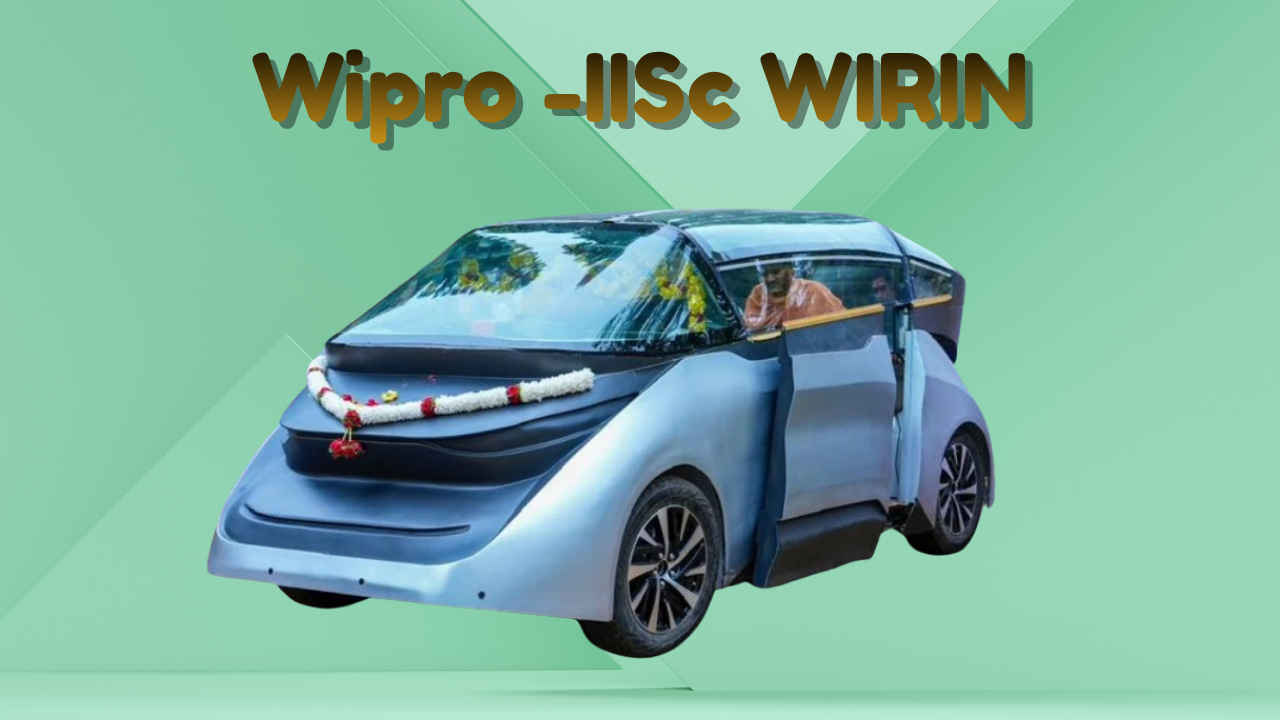
In a significant milestone for India’s technological advancement, a homegrown solution to the world’s toughest autonomous driving challenge has emerged. The vehicle, a fully self-driving prototype named WIRIN (Wipro-IISc Research and Innovation Network), is the result of a six-year research and engineering collaboration between IT major Wipro, the Indian Institute of Science (IISc), and RV College of Engineering.
 Survey
The project is unique because its mission is not to replicate Western self-driving cars, which are designed for structured highways and strict lane discipline. Instead, WIRIN aims to conquer the “great Indian road” – a dynamic ecosystem characterized by chaotic traffic, nonexistent lane markings, unpredictable human behaviour, and infrastructure deficiencies like deep potholes and ubiquitous stray animals.


The key question for the technology sector, however, is not whether it exists, but how good is it?
Also read: Elon Musk’s crazy idea: Turn parked Tesla cars into a connected AI datacenter
It’s custom AI built for India
WIRIN’s success will hinge entirely on its ability to perceive and navigate a world where randomness is the only constant. To achieve this, the team has focused on developing a completely indigenous software stack, known as the AI Algostack, tailored for the Indian context.
The car’s core technology relies on a combination of advanced sensors – including LiDAR, radar, and high-resolution cameras – fused with custom computer vision algorithms. These algorithms are specifically trained on a massive, locally collected dataset to address unique road anomalies. Crucially, the system is designed to detect subtle visual cues like texture changes and shadow variations that characterize potholes, and accurately classify non-traditional road users such as stray cows, dogs, and pedestrians who often disregard traffic rules, enabling it to predict erratic movements and compute safe paths. This emphasis on optimizing algorithms to deliver high-performance autonomy without over-relying on the most expensive sensor hardware promotes a pathway toward a cost-effective, scalable solution for urban and semi-urban settings. Additionally, the system incorporates Vehicle-to-Everything (V2X) communication, positioning it for future integration with smart traffic systems.
Also read: Grokipedia vs Wikipedia: Is Elon Musk’s Free Encyclopedia Better?
From campus to commute
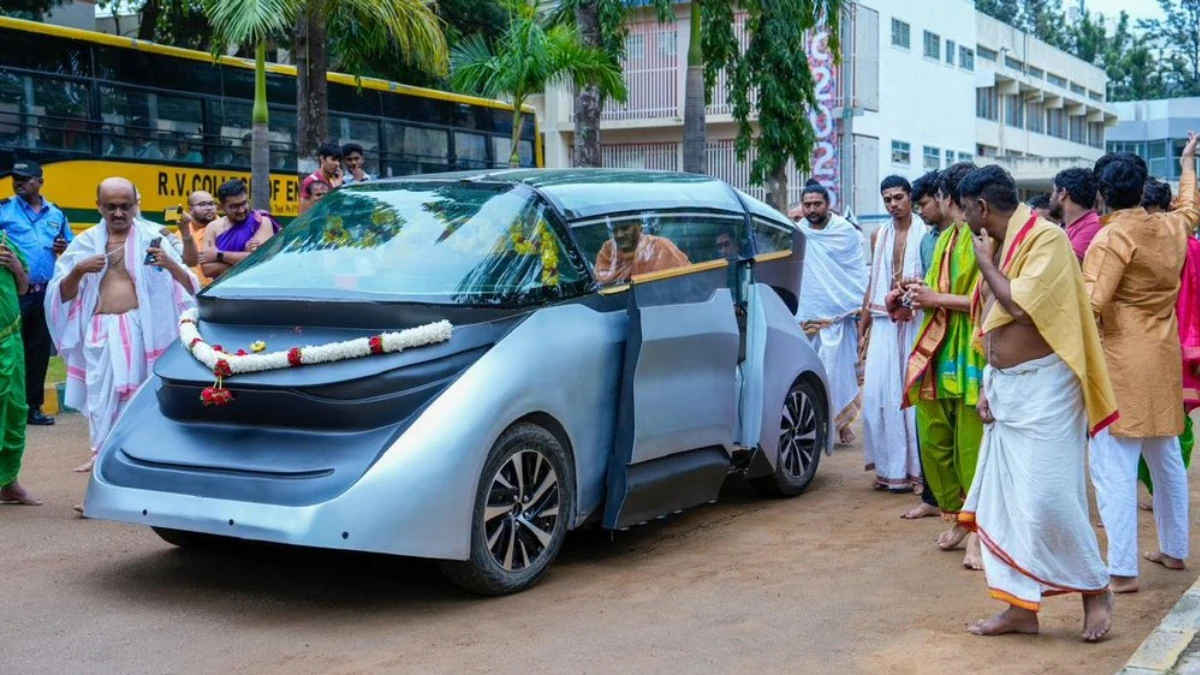
The most widely reported development, a viral video showing a spiritual leader taking a ride in the vehicle, provides a visual proof of concept, but it must be viewed within the right context. The successful demonstration took place entirely within the controlled environment of the RV College of Engineering campus in Bengaluru. This is a critical distinction. Operating smoothly on a mapped, private campus is a significant engineering feat, but it is a world away from navigating the city’s notoriously dense public roads.
The current status of the project is that it is a robust prototype and a Level 4 research vehicle. The technology – the custom AI and sensor fusion built for Indian anomalies like potholes and cows – solves the core perception problem uniquely for the country. However, the system is still in the development stage, currently undergoing detailed road mapping and rigorous simulation testing to validate its safety. It is not yet ready for commercial or public use, as achieving full deployment requires years of further validation on live, public, uncontrolled roads.
A technical victory
WIRIN is not just an incremental improvement; it is a foundational technological victory for India’s engineering prowess. By challenging the assumption that only Western data sets can produce viable autonomous solutions, the Wipro-IISc collaboration has established a domestic blueprint for self-driving technology.
However, the question of “How good is it?” demands a cautious answer. While the technology is conceptually sound and works well in controlled scenarios, the transition to public roads involves overcoming massive hurdles: achieving regulatory approval, building consumer trust, and, most importantly, validating the safety of the AI in billions of possible real-world “edge cases.”
WIRIN is a beacon of indigenous innovation that has started the race. India’s self-driving future is no longer a foreign concept; it’s an Indian engineering problem being solved by Indian minds. But the true test of WIRIN’s goodness will only come when it can safely and reliably navigate a Bengaluru rush hour.
Also read: From Star Wars to Science: Astronomers discover Earth-sized planets with double sunsets
 Follow Us
Vyom Ramani
A journalist with a soft spot for tech, games, and things that go beep. While waiting for a delayed metro or rebooting his brain, you’ll find him solving Rubik’s Cubes, bingeing F1, or hunting for the next great snack. View Full Profile


