Elon Musk likes the idea of turning Tesla's entire vehicle fleet as a distributed AI compute network
Each Tesla car contributes AI inference power when not driving
The fleet could surpass centralized data centers' computing capacity of several gigawatts
By now, we all know that Elon Musk is full of crazy ideas. Reusable self-landing rockets, self-driving cars, underground tunnels for commuting, eventually die on Mars (just not on impact), and then some. And turning idling or parked Tesla cars into a massive hive datacenter for distributed compute is his latest, outrageous brainwave!
 Survey
It all seemingly began with a single tweet from an X user that claimed Elon Musk came up with the idea during Tesla’s Q3 2025 earnings call, where he rambled about making use of all the computing inside all the Tesla vehicles out there in a way that turns them all into one, massive, connected datacenter.


I couldn’t find any evidence of Musk actually saying what the tweet suggested he said, but the fact that Musk himself replied to the tweet with his own positive nod of approval leads me to believe he actually is serious about the idea at least conceptually.
Teslas have a lot of power and compute built-in
Before reading what Elon Musk seemingly proposed, it’s important to understand how an average Tesla is actually a high-performance AI computer on wheels with access to lots of concentrated battery power and cooling.
Also read: Grokipedia vs Wikipedia: Is Elon Musk’s Free Encyclopedia Better?
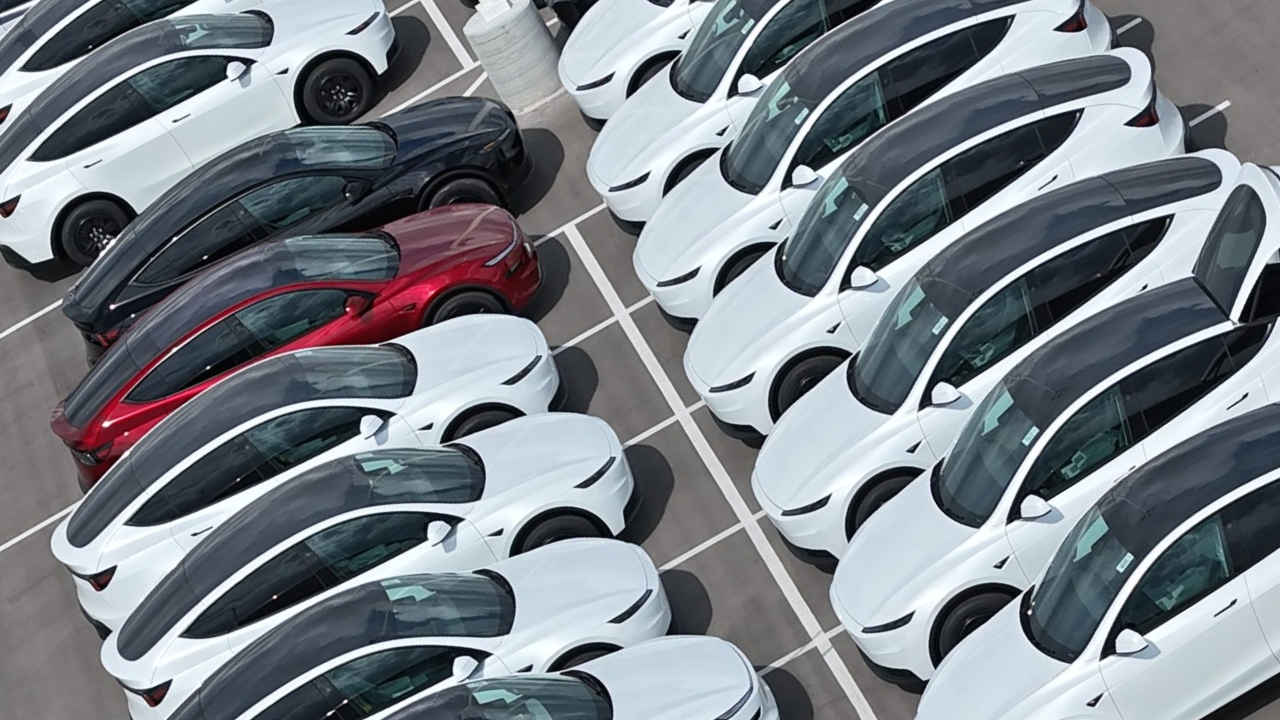
Tesla’s FSD chip’s latest version HW4 offers roughly 350-400 TOPS at 160W of power draw, while the older third-gen FSD chip delivers about 100 TOPS at less than 100W. It’s difficult to do an “apples to apples” comparison, but an NVIDIA RTX 5090 offers over 3000 TOPS but at much higher power draw of 550-600W, while the latest AI PC laptops barely offer between 50-100 TOPS and smartphone chips are even lesser with both mobile form factors primarily prioritising power efficiency above all else.
Also read: AI vision: How Zuckerberg, Musk and Altman see future of AI differently
And unlike your smartphone, laptop or desktop PC, an average Tesla has several thousands times more battery power capacity packed in. Can you see where this is going?
Connect Tesla cars turn into a mobile datacenter
Bottomline here is simple – the average Tesla out there has the capacity to be a powerful AI computer on wheels which is always on and always connected, topped with a massive built-in battery. But obviously every Tesla car is primarily programmed and designed for AI inference workloads related to object detection and autonomous driving. But that’s not to say a Tesla car can’t be nudged to crunch and execute AI tasks of a third-party nature, if needed.
Which is where Elon Musk’s crazy idea comes in. In this concept, each parked Tesla would contribute unused inference capacity (around 1 kilowatt per car), which collectively could possibly reach hundreds of gigawatts if scaled globally. When a Tesla owner goes to office for the day or home for the night and parks his Tesla where it stays put for a few hours on its own, the vehicle’s onboard computer can then run AI inference workloads from a centralised cloud. Just like a server rack does inside a datacenter. Only each Tesla car is a server in this hypothetical, connected, mobile AI datacenter with an active battery power and cooling tech built in. Mind blown?
Not so fast, because obviously this would have to be an opt-in feature, where Tesla customers will have to agree for their cars to essentially “work for third-party”. The tech is obviously there, whether or not there will be user buy-in is another matter altogether.
The idea of distributed computing isn’t new, as projects like SETI@Home (where people donate their PC’s idle CPU time in analyzing radio telescope data) and IBM’s World Community Grid have demonstrated the power of computing pooled from millions of volunteers globally to support scientific research is technologically possible for some time now. Whether or not Tesla’s community and shareholders will approve it is a far cry right now.
While Elon Musk acknowledged in his tweet that this approach could make Tesla’s fleet the world’s largest distributed inference network and called the proposal “legitimately brilliant,” he also did not claim it was something that was in active deployment. He simply said he is “increasingly confident that this idea could work.”
Well, just because something could be done doesn’t exactly mean it should be done – or in this hypothetical case of a Tesla fleet combining to form a mobile AI datacenter, if it will be even allowed to come to pass. But then, if history has told us anything about Elon Musk, it is that he takes crazy risks and you bet against him at your own peril.
Also read: Elon Musk’s crazy vision for Tesla Optimus robots: 5 key takeaways
 Follow Us
Jayesh Shinde
Executive Editor at Digit. Technology journalist since Jan 2008, with stints at Indiatimes.com and PCWorld.in. Enthusiastic dad, reluctant traveler, weekend gamer, LOTR nerd, pseudo bon vivant. View Full Profile


