
AI vision: How Zuckerberg, Musk and Altman see future of AI differently
 Follow Us
Zuckerberg’s AI vision is a vertically integrated fortress, betting on scale and control
Musk’s approach on AI is hinged on openness and community-driven progress
Altman’s AI strategy is of a cautious sprint, balancing rapid iteration with safety
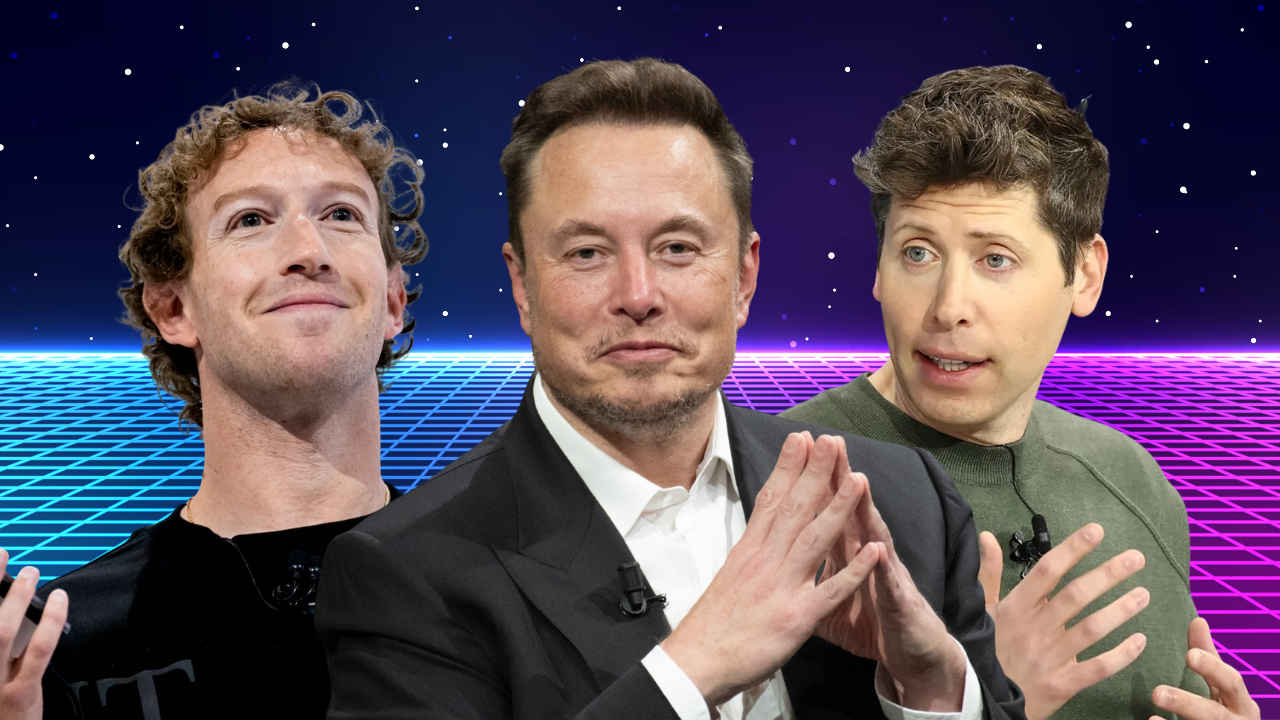

It’s difficult not to draw these parallels, among the loudest voices trying to shape and dominate the world’s AI destiny. It’s clear with the latest moves related to Meta Superintelligence Lab, that Zuckerberg’s playbook is neither Musk’s open-source hardware crusade nor Altman’s phased AGI safety dance.
 Survey
In one corner stands Mark Zuckerberg, champion of “personal superintelligence” and the muscle of Meta’s vast user universe. In another, Elon Musk, evangelist for open-source liberation and the distributed innovators of tomorrow. And casting a measured, safety-first glance at both is Sam Altman, the pragmatist building AI through strategic alliance and phased public rollouts.
Mark Zuckerberg’s fortress of superintelligence
On June 30, 2025, Zuckerberg staked Meta’s claim for “personal superintelligence” by merging FAIR, Llama development, and a fresh next-gen models team under the helm of Alexandr Wang and Nat Friedman. The internal memo that day read almost like a manifesto to build an AI so bound to each user’s digital life that it felt as natural as breathing.
Also read: Meta and Mark Zuckerberg bet big on AI Superintelligence: Here’s how
This isn’t a vanity project for Zuckerberg. Because Meta has pledged $14.3 billion to secure a near-half stake in Wang’s startup and bankroll the acquisition spree known as PlayAI. The mission seems to be to fold AI into every swipe, every chat, every AR shimmer – from News Feed assistants that summarize your weekend photoshoot, to smart glasses that whisper context into your ear in real time. At Meta’s disposal is billions of dollars of capex to build out AI datacenters by investing in compute infrastructure.
And with reports of signing bonuses approaching $100 million, Meta’s peeled away top talent from OpenAI, Google, and Anthropic, all in service of a singular creed – if you control the data and the devices, you control the future of intelligence.
Elon Musk’s open-source rebellion
Now imagine leaning back in a Tesla showroom, where the Dojo supercomputer – recently beefed up by a $500 million investment – is training models on petabytes of self-driving data by day and moonlighting as a rentable AI powerhouse by night. This is xAI’s playground. Musk’s crowning gesture came in the form of Grok-1, a 314 billion-parameter model whose weights were dumped into the public domain like a silver bullet into the wild.
Also read: Community Notes to fact-check: X becoming a playground for AI?
For Musk, the promise of open-source is more than transparency, but a call to arms for “fragmented innovation.” He envisions a global cottage industry of coders, academics, garage tinkerers, and startups using his designs – hardware schematics included – to push AI in directions no single corporation could predict.
And if some of that R&D cycles back into Optimus, Tesla’s humanoid robot, so much the better. After all, each self-driving mile racked up by Tesla’s fleet feeds directly into a feedback loop that could very soon animate a bipedal assistant in our everyday life.
Sam Altman’s balanced AI optimism
In this AI arena, if Zuckerberg is the industrial planner and Musk the frontier anarchist, Altman is the tightrope walker. Under Altman’s guidance, OpenAI’s bedrock partnership with Microsoft has swelled to $13 billion in Azure compute and co-development commitments. But Altman isn’t content to lurch from GPT-4 to GPT-5 in a single bound. Instead, he champions “phased public rollouts,” propelling GPT-4.1 and GPT-4.2 into the wild to harvest real-world usage data and burrow in safety guardrails.
Also read: Sam Altman says OpenAI is better than Meta for two key reasons
Last May, he testified before the U.S. Senate, urging lawmakers to avoid knee-jerk regulation that might cede American AI leadership to overseas rivals. At the same time, OpenAI’s “Preparedness Framework” now boasts formal system cards and a safety committee empowered to impose launch-blocking checks when necessary.
The goal is clear: move quickly enough to innovate, but leave room for reflection – and the occasional course correction – before unleashing a model that could inadvertently turbocharge disinformation or automate the next wave of cyberattacks.
Three AI philosophies
In the end, these three visions form a triangle of power, risk, and reach. Zuckerberg bets on making AI as intimate and indispensable as your social feed. Musk wagers on crowd-sourced brilliance, convinced that pooled knowledge can outstrip any single entity’s efforts. Altman walks the middle path, weaving together massive capital, real-time feedback, and a safety-first ethos to steer the AI ship in untested waters.
Who wins or loses is besides the point. Either way, as these titans press on – each in their own signature style – the next chapter in artificial intelligence promises both dazzling potential and pitfalls worthy of our closest scrutiny.
Also read: India’s AI focus: IBM’s Amith Singhee on building trust into future of AI


