
ASUS TUF Gaming F16 (2025) review: The beautiful, confused beast
 Follow Us

There is a specific feeling you get when you unbox a piece of technology that costs nearly ₹1.7 Lakh. It is a mix of anticipation and expectation, a silent demand that this machine better be worth the dent in your bank account. When I pulled the ASUS TUF Gaming F16 (FX688JPR) out of its packaging, that feeling was validated. For a split second, I forgot that the “TUF” series was originally born as ASUS’s budget-friendly alternative to the ROG lineup. The “Mecha Gray” metal lid was cold to the touch. The chassis felt dense, rigid, and purposeful. It didn’t creak; it didn’t flex. It felt like a weapon.

But premium build quality cannot fix bad physics. A laptop can feel like a tank on the outside, but if the engine chokes when you step on the gas, the illusion shatters.
Also read: Malls to music concerts: I saw how Indian esports is definitely growing
After a week of daily driving this machine – writing on it, editing on it, and pushing it through a gauntlet of gaming benchmarks – I have come to a frustrating conclusion. The TUF F16 is a laptop of immense potential, sabotaged by its own thermal physics. It is a machine that looks like a soldier but struggles to fight the war it was built for.
Design and build: The “stealth” premium
Let’s start with the good, because there is plenty of it. ASUS has nailed the aesthetic here. Gone are the days of aggressive “gamer” accents and cheap plastic vents. The 2025 TUF F16 is understated. The embossed logo on the lid is subtle, and the finish allows it to blend into a coffee shop or a creative meeting without screaming “I play Valorant.”
At 2.2 kg, it is surprisingly portable for a 16-inch performance laptop, noticeably lighter than its direct rival, the Lenovo LOQ 15IRX10, which tips the scales at 2.4 kg. You can feel that difference in your backpack. The hinge is sturdy, allowing for a smooth one-finger open, and the overall construction feels denser than previous TUF generations.
However, there is one baffling design choice that introduces friction before you even press the power button. The unit I received came with a massive 16-Ampere power plug – the large, thick-pinned variety usually reserved for air conditioners and microwaves.
This is a nightmare for portability. Most bedroom setups, college dorms, and coffee shops do not have 16A sockets near the desks. I found myself hunting for a specific adapter just to turn the thing on. For a laptop that is otherwise portable enough to carry anywhere, this plug tethers you to specific heavy-duty wall sockets. It is a small detail that becomes a daily annoyance.
Display

If the power plug annoyed me, the screen won me back immediately. This is where your money is going. While budget kings like the Lenovo LOQ stick to standard 1080p panels, the TUF F16 flaunts a gorgeous 16-inch 2.5K (2560 x 1600) IPS-level display. It features 165 Hz refresh rate to complement this 400 nits screen.
In real-world use, this panel is stunning. When I fired up Dirt 5, the difference in color saturation and sharpness compared to a standard FHD screen was night and day. The mud looked textured, the sky looked deep, and the cars popped against the background. It’s not just for gaming; the 16:10 aspect ratio provides extra vertical real estate, making it a fantastic canvas for video editing timelines or split-screen multitasking.
Also read: GPT-OSS to Gemma 3: Top 5 open-weight models you must try
If you are a creative professional by day and a gamer by night, this screen alone might justify the premium over the competition. It is bright, fast, and vibrant.
Performance: Why the RTX 5070 underperforms
This is the most important section of the review, and unfortunately, it is where the TUF F16 breaks your heart. On paper, this machine should be a monster. It pairs the high-end Intel Core i7-14650HX (16 Cores) with the powerful NVIDIA RTX 5070 (8GB GDDR7). You would expect it to crush everything in its path. And in the 3DMark synthetic benchmarks, it does exactly that.

- Time Spy Extreme: 5,898 (vs. 4,951 on the Lenovo LOQ)
- Fire Strike Extreme: 16,036 (vs. 12,256 on the Lenovo LOQ)
- Port Royal (Ray Tracing): 8,321 (vs. 6,171 on the Lenovo LOQ)
These scores prove that the RTX 5070 is, architecturally, a superior card. It has more raw muscle for ray tracing and rendering. But benchmarks are short sprints. Gaming is a marathon. When I ran sustained gaming tests, the TUF F16 struggled to maintain its lead because it simply couldn’t handle the heat.
The reality check hit hard when I looked at the Gaming FPS. I compared this ₹1.7 Lakh ASUS TUF (RTX 5070) directly against the ₹1.4 Lakh Lenovo LOQ (RTX 5060). Logically, the expensive 5070 should win every time. It didn’t. In fact, it lost in almost every sustained gaming scenario at 1080p High settings.
| Game (1080p High) | ASUS TUF F16 (RTX 5070) | Lenovo LOQ (RTX 5060) | The Result |
| Dirt 5 | 128 FPS | 149 FPS | Lenovo wins (+16%) |
| Shadow of the Tomb Raider | 107.6 FPS | 124 FPS | Lenovo wins (+15%) |
| Valorant | 299.5 FPS | 316 FPS | Lenovo wins (+5%) |
| GTA V | 165 FPS | 178 FPS | Lenovo wins (+7%) |

Blue: Lenovo LOQ, Red: ASUS TUF F16
Why is this happening? The answer lies in Thermal Throttling. During my stress tests, the TUF’s i7-14650HX hit 95°C almost instantly. The cooling system struggles to dissipate this massive heat load, forcing the CPU to downclock aggressively to save itself.
I measured this using Cinebench R23 throttling tests. Over a sustained loop, the ASUS TUF’s score dropped by a massive 1,313 points from its peak. It starts fast, gets hot, and then hits a wall. By comparison, the Lenovo LOQ was rock solid, with it actually performing better by 36 points under throttling.
Essentially, you are paying for an RTX 5070, but the heat soak is throttling the entire system down to RTX 4060 levels of performance in sustained gaming sessions. The raw power is there, but you can’t access it for long.
Also read: Asus Vivobook 16 review: A dependable 16-inch laptop for work and study
To make matters worse, the TUF F16 also loses on storage speed. I tested the 1TB Gen4 SSD using CrystalDiskMark, and it was significantly slower than the drive in the cheaper Lenovo.
- Sequential Read: Lenovo (6,388 MB/s) vs. ASUS (5,077 MB/s)
- Sequential Write: Lenovo (5,515 MB/s) vs. ASUS (3,605 MB/s)
For a laptop that costs this much, having a drive that is nearly 35% slower in write speeds compared to a budget competitor is disappointing. It means large file transfers or game installs will take noticeably longer.
However, the TUF redeems itself slightly in the Memory department. While the read speeds between the two are comparable (~86,000 MB/s), the ASUS TUF F16 offers lower latency (77.9 ns vs. 83 ns on the Lenovo). This tighter timing helps with CPU-bound tasks and 1% low FPS stability, showing that ASUS didn’t cheap out on the RAM sticks, even if they dropped the ball on the SSD.
Thermals and acoustics
There is a silver lining to ASUS’s thermal management strategy: User Comfort. While the internal components are cooking at 95°C, the chassis stays remarkably cool where it matters.

- WASD Keys: 28.4°C (Cool)
- Palm Rest: 26.1°C (Very Cool)
ASUS has engineered the airflow to pull cool air through the keyboard, ensuring your fingers never sweat during intense matches. Unlike the Lenovo LOQ, which gets noticeably warm (hitting 36°C on the WASD keys), the TUF feels great to touch even after an hour of gaming.
The fans are aggressive. Under load, they ramp up to a volume that is impossible to ignore. It’s not a low hum; it’s a high-pitched rush of air. If you are playing a competitive shooter like Valorant or CS2, you absolutely need decent noise-canceling headphones. Without them, the fan noise will drown out subtle audio cues like footsteps. The laptop prioritizes your hands over your ears.
Keyboard, trackpad & IO
The input experience is classic ASUS – solid and reliable. The keyboard has a deep travel distance (1.7mm) that feels satisfying for both typing and gaming. The single-zone RGB lighting is bright, though less customizable than per-key options found on ROG laptops. The trackpad is spacious and smooth, with no wobble or dead zones. It gets the job done for daily tasks.
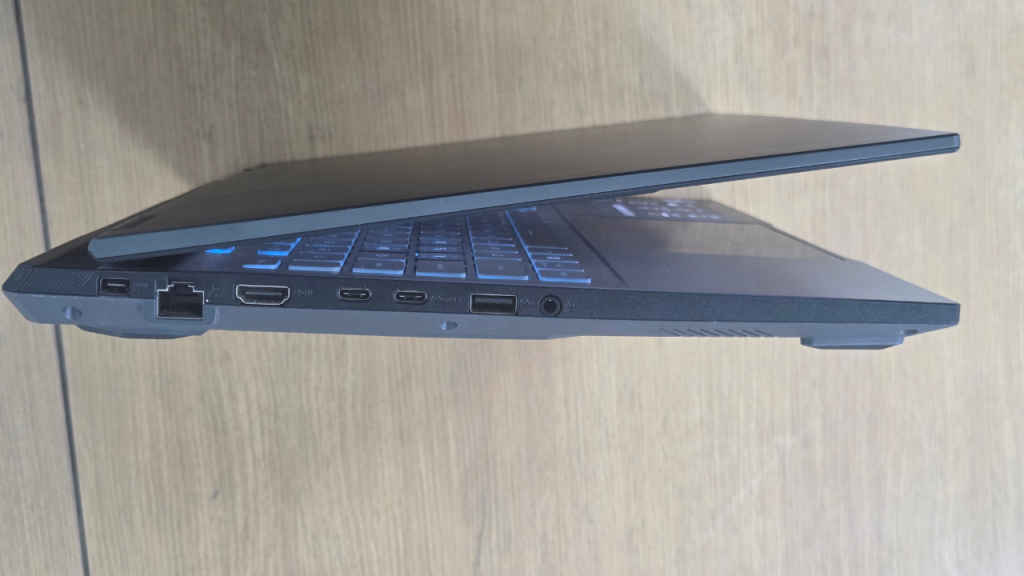
Ports:
- 1x Thunderbolt 4: A massive win for creators who need high-speed transfers.
- 1x USB 3.2 Gen 2 Type-C: Supports DisplayPort and Power Delivery.
- 3x USB 3.2 Gen 1 Type-A: Plenty for your mouse and keyboard.
- HDMI 2.1
- 1x LAN Port
Battery life
Gaming laptops generally have terrible battery life, and the TUF F16 is no exception when gaming. In my test, it lasted just 62 minutes while running a game unplugged.
Even for normal work – writing articles, browsing with tabs open, watching YouTube – the results were mediocre. Even with NVIDIA Advanced Optimus completely shutting off the power-hungry RTX 5070, I struggled to squeeze out just over 3 hours of productivity use.
In 2025, when competing laptops are easily hitting 5-6 hours of video playback, this feels dated. It might survive a quick coffee shop session, but do not make the mistake of leaving that massive power brick at home.
Verdict: The creator’s compromise
The ASUS TUF Gaming F16 (2025) is a confused machine. It takes a budget chassis and stuffs it with high-end components that it cannot fully cool. The result is a laptop that costs ₹1.7 Lakh but often performs worse than competitors costing ₹30,000 less.

You are paying a massive premium for the “RTX 5070” badge, but due to thermal throttling and slower support components (SSD), you aren’t getting the performance you paid for.
Buy this if:
- You prioritize the Display: The 2.5K 165Hz screen is fantastic and miles ahead of the 1080p panels on cheaper laptops.
- You prioritize Touch Comfort: If you hate sweaty fingers, the keyboard cooling design works wonders.
Skip this if you care about Performance per Rupee. The cheaper Lenovo LOQ (RTX 5060) beats this machine in sustained gaming FPS, SSD speed, and thermal stability. Save your money.
Also read: Sennheiser BTD 700 review: Can make wireless listening better, but with caveats
Asus TUF Gaming F16 FX688JPR-QT043WS Laptop (14th Gen Core i7/ 32GB/ 1TB SSD/ Win11/ 8GB RTX 5070 8GB Graphics) Key Specs, Price and Launch Date
| Release Date: | |
| Market Status: | Launched |


