
Why smartphone cameras still cannot beat a mirrorless camera
 Follow Us
No amount of computational photography can compensate for a small sensor.
A smartphone, no matter how capable, cannot adapt like a interchangable mirrorless system.
Computation photography feels fast and satisfying, until you need precise control.
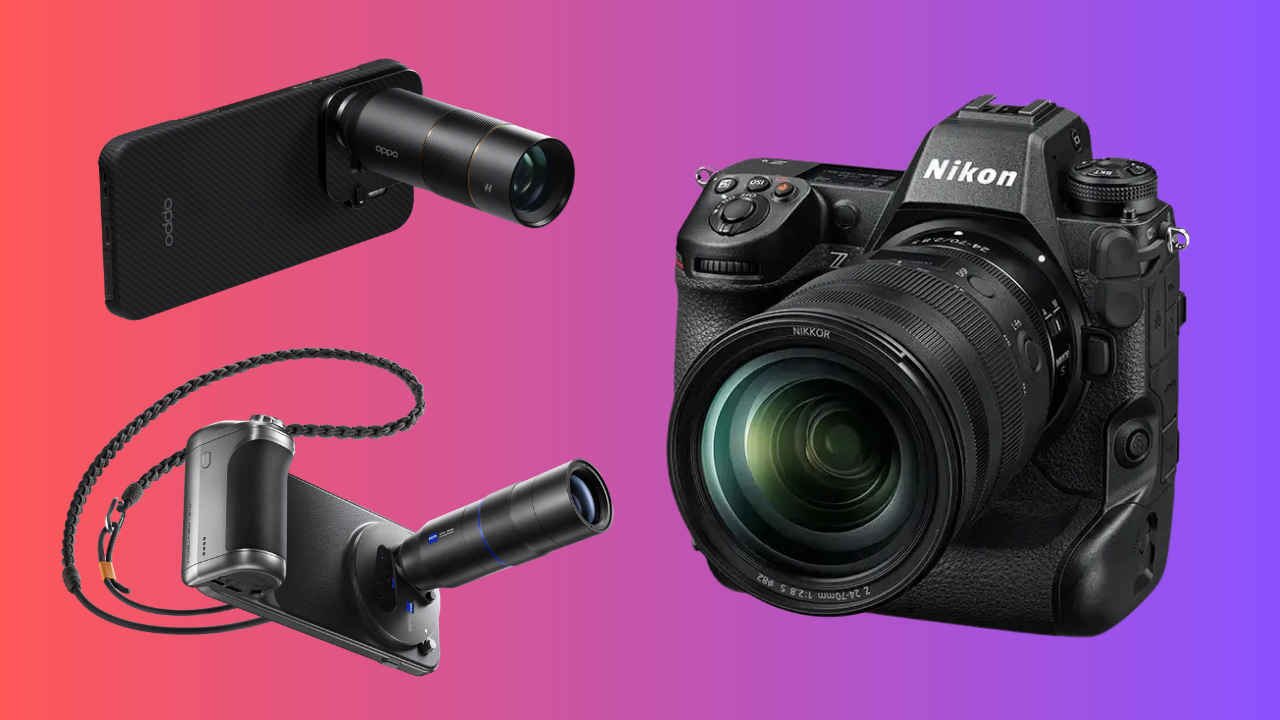

Every year, smartphone makers roll out new devices with improved camera systems, claiming the biggest upgrade in terms of quality. Largely, that remains true, since we are starting to see smartphones with bigger sensors, external lenses, and AI tech powerful enough almost to rewrite reality. However, one of the biggest lies still being sold is “professional camera quality in your pocket”. While smartphone camera quality has improved, there are various reasons why that remains untrue, and you’ll see what phones are still missing once you start shooting with a proper camera. So let me break it down for you and see some major reasons why mirrorless cameras remain in a league of their own.
 Survey
Also Read: Buying your first camera? 5 things you need to keep in mind
Sensor size over everything
Most likely, you’ve heard about it before, but the sensor size is simply unbeaten. Well, no amount of computational photography can fully compensate for a physically small sensor. Even the most advanced flagship phones, be it the latest Vivo X300 Ultra or the Find X9 Ultra, and even the latest iPhones, are still held back by their sensor size. Meaning that they are simply no match for a proper full-frame or even an APS-C mirrorless sensor.
Having a larger sensor is great, since it allows you to capture more light per pixel. And for those wondering how it affects the real-world usage, well, there are various advantages. Having the ability to capture more light allows for less noise in low-light scenes, along with greater dynamic range. Not only that, but the biggest advantage is in terms of the depth of field.
This sensor size is the reason why mirrorless cameras can produce those creamy background blurs, while smartphone portrait modes are still trying to fake it via computational bokeh. While there have been improvements over the past few years, it still struggles, especially around complex areas like hair, glasses, and minor objects.
Lens ecosystem
The debate around lenses has increased over the past few months, and that’s mainly because smartphone makers have started selling additional ‘photography kits’ with their flagships. These kits generally house a smart cover, along with a lens system that can be attached to your smartphone, giving you great optical flexibility. And while they are great for purposes of zooming into subjects, calling it a proper lens system isn’t exactly the right thing.
You see, with a mirrorless system, the concept of lenses is entirely different. While they do offer telephoto and super telephoto zoom lenses, they go much beyond that. You can have fast primes, like a 35mm f/1.4 for street photography or an 85mm f/1.8 for clicking portraits. Heck, they even have macro lenses, tilt-shift lenses and cinema-grade lenses if you want to experiment further. The point is that a smartphone, no matter how capable its built-in lenses are, cannot adapt to a scene the way an interchangeable lens system can.
Control over your work
Computational photography has improved a lot over the past few years, and with AI coming into the picture, the decisions are fast and often satisfying. However, the moment you need precise, repeatable control for a shoot, it starts to show its limitations.
A mirrorless camera gives you direct control over aperture, shutter speed, ISO, and white balance. And while a lot of these things are available in smartphones with their ‘pro-modes’ these days, the advantage cameras carry is that they are all adjustable in real time through dedicated dials and buttons. This allows users to have a much simpler experience, allowing them to control their work without needing to fiddle around with software menus.
In the end, it’s worth saying that phone cameras are definitely extraordinary tools. With the recent advancements brought out to them, they’ve almost become the ideal tool for everyday content creation or casual photography. But until someone figures out how to fit a large sensor and an interchangeable lens mount into such a slim build, it’s safe to say that the mirrorless camera ecosystem isn’t going anywhere.
With that said, I hope this helped you understand why smartphone cameras still cannot beat a mirrorless camera system. For more such informative pieces, keep on reading Digit.in
Also Read: Mirrorless camera: 5 reasons why it still makes sense in 2026


