
Tencent’s Hy3 is free, open and almost as good as GPT-5.5: USA should be worried
 Follow Us

Tencent just released, gratis, an AI that slugs it out with GPT-5.5. And that sentence alone should scare every single one of the labs working on AI in Silicon Valley. On July 6, Tencent unveiled Hy3, the production-level version of its Hunyuan 3.0 model, which is a 295-billion parameter model with 21 billion active parameters that delivers outstanding results in the coding, searching, and scientific reasoning benchmarks and comes close or even beats GPT-5.5 in a couple of categories. The model is fully open-sourced under the Apache 2.0 license. You can download it today, run it, fine-tune it, and package it inside your product at no cost whatsoever.
 Survey
Also read: 5 best AI music generation tools in 2026
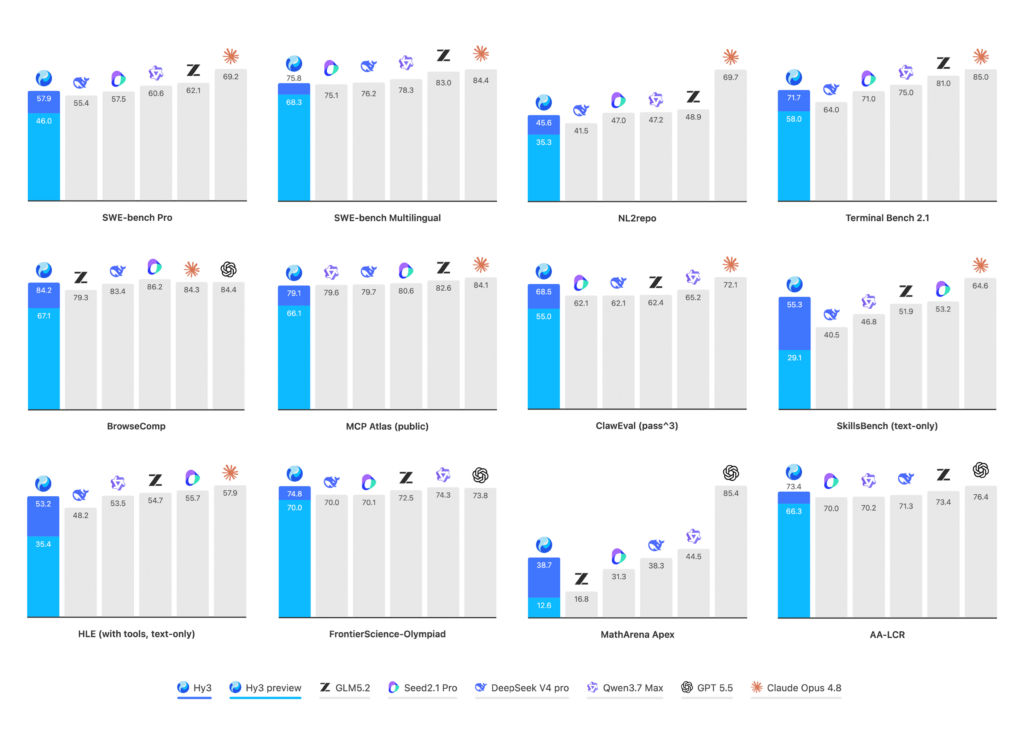
What makes the story even more amazing are the numbers. The GPQA Diamond STEM benchmark gives Hy3 a score of 90.4 compared to GPT-5.5’s 93.6. The BrowseComp score for its search agent is 84.2, equaling GPT-5.5. In the FrontierScience-Olympiad test for scientific research capabilities, Hy3 beats GPT-5.5. Hy3 scores 78.0 on SWE-Bench Verified and 57.9 on SWE-Bench Pro in coding. This is not a toy AI created to make some headlines – it’s a fully functioning competitor to the top closed AI in the West.
Also read: Primebook wants to make the budget laptop feel less broken
This is the part that US-based AI companies need to take note of. The next versions of GPT-5.5, Gemini, and Claude are closed and available behind an API and a subscription, valued at multi-trillion dollar projects. Just yesterday, Tencent made its new product available in the open-source manner, right next to those products. Now, all the developers, startups, and governments of the world have a perfectly legal and free high-performance option that does not use the servers or the terms of service of a US company.
But this isn’t even a laboratory demonstration project. The Hy3 technology has already been implemented in dozens of core Tencent products such as WorkBuddy, Yuanbao, WeChat, and QQ Browser and it is now available to more than one billion customers. The daily consumption of tokens grew by 20 times compared to the April beta launch. In the context of WeChat’s environment, the accuracy of intent recognition for WeChat Official Account AI avatars reached 98.94% while QQ Browser managed to increase the rate of completion of programming tasks by 37.6%.
Speed is also important. The Hy3 preview was announced in April, and in just 74 days the officially released product has changed tremendously owing to improved post-training data and reinforcement learning compute. In just 74 days, from being decent but not among the best, the model surpassed GPT-5.5 in some tests. This was meant to be the timing that the U.S.’s export controls would delay. It is not delaying.
There is an exception worth noting before panic sets in. Tencent’s benchmarks are against DeepSeek-V3 and GLM-4.5, not the more recent DeepSeek-V4 and GLM-5.2, and third party validation of the results is still pending, so consider the claims of surpassing GPT-5.5 benchmarks in the framework of what Tencent itself says about its product, not as independent verification. Chinese labs tend to pick favorable benchmarks.
But even with that asterisk, the strategic landscape remains the same. The United States’ assumption was that denying access to frontier compute would deny access to frontier AI. Hy3 is based on the same concept that DeepSeek proved last year; it is not about having the largest number of parameters, but rather the most efficient. Hy3 outperforms on reasoning and agentic benchmarks by competing with models that have 3-5 times more active parameters.
This is a double-edged sword for India. On one hand, having access to an almost frontier-level model for free would be cheaper for Indian companies and individuals who cannot afford to pay for GPT-5.5 API, but, on the other hand, the next iteration of AI-driven products, such as customer service chatbots and coders assistants will likely run on Chinese cloud and training data. This is a discussion that India needs to have now.
Also read: Nothing Phone 4b in Digit Test Labs: The most interesting phone under Rs 35000?


