
Primebook wants to make the budget laptop feel less broken
 Follow Us
Primebook is betting on Android to solve the performance and battery-life problems of budget Windows laptops.
The company is building PrimeOS as a full software stack with its own app store, browser, Cloud PC layer and AI agent.
Primebook’s next phase includes Gen 3 laptops, a detachable Primebook Duo, deeper retail expansion and a sharper Gen Z-focused brand identity.
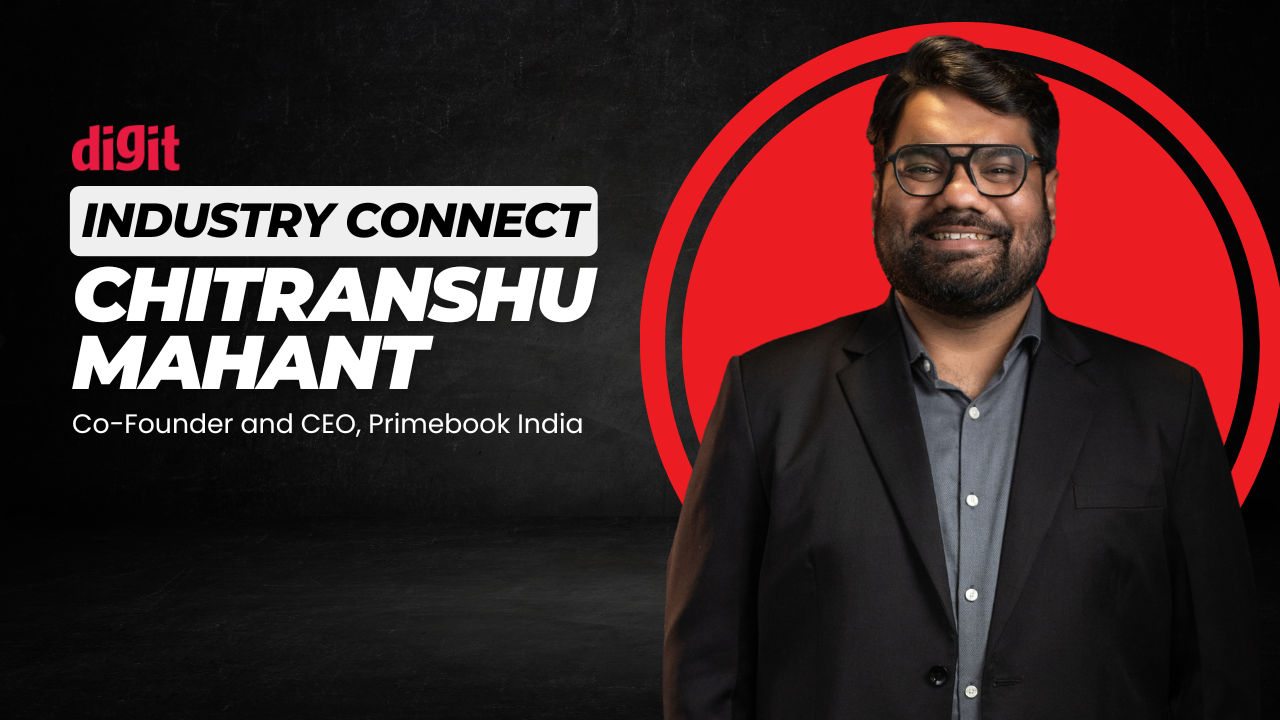

For years, the affordable laptop market has had an odd contradiction at its centre. India is a price-sensitive market, students and first-time PC buyers form a large potential base, and smartphones have proved that volume can come from the lower end of the price ladder. Yet, in laptops, the volume has traditionally skewed upwards. Chitranshu Mahant, Co-Founder and CEO of Primebook, believes the reason is simple: budget laptops have not been good enough.
 Survey
In our conversation, Mahant framed Primebook’s Android laptop bet not as an affordability play, but as an attempt to fix what he sees as a broken entry-level laptop experience. The company’s argument is that many sub-Rs 30,000 Windows laptops, suffer from poor performance, limited battery life and a compromised app experience. “Budget laptops are fundamentally broken,” he said, pointing to slow performance, modest ratings, battery life that can fall from 7-8 hours to 3-4 hours over time, and limited usability beyond browsing or light Word, Excel and PPT workloads.
That is the gap Primebook wants to occupy. Instead of trying to make Windows work better on weak hardware, the company is taking Android, stripping away Google dependency, and turning it into a desktop-style operating system for laptop hardware. It is an unusual pitch in a market where Windows remains the default mental model for a laptop, but Primebook sees that as the point. It wants to build a new category around smartphone-native users who are buying their first serious computing device.
Why Android became the starting point
Mahant said Primebook began its journey in 2018, at a time when the company saw workflows shifting away from laptops and towards smartphones. He argues that this shift partly explains why laptops have seen slow growth over the past decade. Now, however, the arrival of AI-led workflows is changing the equation again. Smartphones, in Primebook’s view, are not always the right form factor for those tasks, especially for first-time laptop users who want a larger screen, keyboard and productivity-friendly environment.
Primebook’s thesis rests on three pillars: performance, battery life and app access. Mahant claims that on similar hardware, PrimeOS is around 1.5 times faster than Windows in the same price bracket. He also claims that a PrimeOS-powered Primebook can deliver 14 hours of video playback at 80 percent brightness in the Rs 25,000 hardware bracket. The third piece is the Android app ecosystem, which gives the machine access to millions of apps that are already familiar to smartphone-first users.
This is also why Linux was not the primary choice, despite its technical proximity to Android. Mahant said Primebook’s target group is made up of Android-native, smartphone-first users in the 15-25 age bracket, and for them, the Android app ecosystem mattered more. Primebook uses Android open source, but does not rely on the Google Play Store or Google Play services. Instead, it has its own store, services and browser.
That’s where Primebook tries to make a distinction. Primebook is not merely selling an Android device with a keyboard. It is trying to own enough of the software layer to control the experience, the app store, the file manager, the browser, and eventually, the AI and cloud layers that sit on top of it.
From OS experiment to own hardware
Primebook did not begin as a hardware company in the conventional sense. Mahant said the company initially tried a Windows-like go-to-market strategy, where it wanted to sell its operating system to Indian brands such as Micromax, Lava and Intex. That route did not work. PrimeOS, however, saw around 2 million downloads in beta over two years, which encouraged the company to move towards its own hardware.
The company then chose what Mahant calls an Apple-like go-to-market strategy: vertical integration, owned hardware and a tighter link between device and operating system. FY23-24 was Primebook’s first financial year selling laptops, during which it sold around 15,000-18,000 units. Mahant said the company has been doubling every year and is now preparing to launch Primebook Generation 3.
That Apple comparison comes up often in Mahant’s framing. But for Primebook, it does not mean premium pricing or a closed ecosystem for its own sake. It means owning the engineering stack step-by-step. The company wants to create what Mahant calls a “sovereign operating system” and an “India-only sovereign OS stack”. He contrasts this with the Xiaomi model, where scale comes from introducing more models. Primebook, he says, wants to grow through vertical integration.
This is an ambitious claim, particularly for a company still operating in the budget and mid-budget laptop space. But the ambition is clear: Primebook does not want to remain just a niche Android laptop maker. It wants PrimeOS to become the foundation of a broader device and services ecosystem.
The Gen Z bet
Primebook’s target audience is sharply defined. Mahant describes it as students and early professionals between 15 and 25 years old, covering school students, college students, job seekers, people in skill development, freelancers, content creators and early professionals. These are users who grew up with smartphones and are now buying their first laptop.
That also explains the price ladder. Primebook is looking at a range from Rs 25,000 to Rs 50,000, with new form factors entering the portfolio. The goal is not to sell the cheapest possible machine, but to deliver a better price-to-performance ratio. Mahant said Primebook initially thought it was solving for affordability, but later realised it was actually solving for value for money. In his view, a Rs 10,000 laptop will deliver a poor experience regardless of the operating system.
This is also where Primebook sees itself as different from older Indian budget PC attempts. When asked about RDP, which once sold low-cost Windows laptops and later moved away from the B2C market, Mahant said RDP and Primebook are “a very different breed altogether”. He described RDP as an OEM working with Windows-based or third-party solutions, while Primebook is building a different category by not relying on Windows.
In other words, Primebook is not trying to sell a cheaper version of the same PC experience. Its claim is that the software model has to change if the hardware cost is constrained.
PrimeX and the cloud PC layer
PrimeOS is not meant to stop at just Android apps. Primebook is adding a Cloud PC layer called PrimeX, designed to give users access to more powerful Windows-based computing when required. Mahant describes it as an application integrated with PrimeOS, where users can subscribe and upgrade their machine through a cloud computer, essentially a virtual machine.
The logic is straightforward. Android can handle the everyday app ecosystem and lightweight computing, while PrimeX can address workloads that require Windows or more compute. This includes professional Windows applications that are not available on Android, such as offline Tally, Android Studio and development tools. The cloud environment runs Windows because Primebook is not yet building a PrimeOS distribution for x86.
The subscription model is flexible, according to Mahant. Compute can be bought on an hourly basis, while storage is typically bought for 30 days. Primebook works with Oracle and Azure to serve customers and positions itself as the middle layer.
Cloud PCs, however, come with practical friction. File transfer is one of them. Mahant acknowledged that moving work to the cloud is a fundamental challenge, and that transfer speed will depend on the user’s internet connection. To reduce the UI friction, Primebook has built a PrimeOS folder inside the Windows file manager, allowing files placed there to be accessed across both environments.
PrimeX is still being improved. Mahant said it was launched around January this year and the company is working to refine the experience.
Prime Agent and the AI workspace
Then there is PrimeAGNT, an AI agent layer that Mahant describes as being deeply integrated into PrimeOS. He compared the idea to OpenClaw, but said Primebook’s implementation can go further because the company controls the operating system. The deeper integration, he argues, allows Primebook to do more than an AI layer running on top of macOS.
Mahant described a workflow where the user swipes with four fingers on the touchpad to enter an AI workspace, gives prompts for tasks such as emails, follow-ups or bundling images into a folder, and then swipes back into the human workspace. PrimeAGNT is still at the proof-of-concept stage, with a beta ongoing.
Notably, Primebook does not frame this around local NPU acceleration. Mahant said Prime Agent has “nothing to do with NPU” in Primebook’s case. That positions Primebook differently from mainstream laptop brands, which are increasingly tying AI features to dedicated NPUs in newer PC platforms.
The broader point is that Primebook is trying to make AI a software-led experience rather than a hardware branding exercise. Whether that approach can scale well, especially as AI workloads get heavier and more privacy-sensitive, will depend on how Primebook executes the final product. But the direction is clear: the company wants the OS to be its main differentiation, not merely the chassis or the SoC.
Hardware strategy: own the design, not the factory
Primebook’s hardware ambitions are also expanding. The company is currently using third-party SoCs, including MediaTek and Qualcomm, but Mahant said the long-term vision includes in-house motherboard design and eventually building an SoC using ARM open source. Manufacturing, however, will remain outsourced. Primebook wants to own design and engineering, not factories.
This reflects the same vertical integration logic that runs through the company’s software strategy. Mahant says Primebook has already built its own browser, app store, file manager, Cloud PC layer and AI layer. The next step is to deepen engineering control over the hardware platform.
The company has around 70 employees, with about 25 engineers, which Mahant estimates as roughly 30 percent of the team going into R&D and engineering.
When it comes to SoC selection, Primebook says it will not use Chinese SoCs and will stick to MediaTek and Qualcomm. Mahant said Qualcomm’s supply side is more restricted, while MediaTek is more open. The company looks at benchmarks such as AnTuTu and Geekbench Pro, then compares them with the target price. He added that Primebook may reduce on something like speaker quality, but not on the SoC.
Mahant also indicated that generation 3 will use more powerful SoCs. With memory and RAM prices increasing, he said there is little point in cutting SoC cost further. In Primebook’s view, performance is a combination of OS and SoC, which is why the company believes Android plus ARM can deliver a better experience in budget hardware than Windows plus x86 at similar price points.
The competitive field
Primebook sees two main competitors in India: budget Windows laptops and Android tablets with keyboards. Mahant said the sub-Rs 30,000 laptop market in India is around 8-10 lakh units annually, with Windows holding the largest share, followed by Chromebooks and then Primebook somewhere around third or fourth.
The tablet threat is perhaps more interesting. Mahant said the major volume in the sub-Rs 30,000 computing segment is coming from tablets because laptops in that price segment are not good enough. He estimated around 30 lakh tablets versus around 10 lakh laptops. Primebook’s answer is to beat tablet-plus-keyboard combinations on UI and UX.
The company also considers refurbished laptops a competitor in some channels, although Mahant argued that quality and reliability remain issues in India. He said there are brands doing quality-checked second-hand laptops, but they do not build their own machines.
JioBook is another obvious comparison. Mahant said Primebook generation 1 and JioBook were the same in terms of configuration, but JioBook failed because of the JioOS experience.
What comes next
Primebook’s next portfolio will include Primebook generation 3, while the generation 2 Pro and Max models will continue. There will also be Primebook generation 3 Pro and Max, along with Primebook Duo, a 2-in-1 detachable computer with three SKUs.
On the sales side, Amazon and Flipkart remain Primebook’s largest channels. Its website contributes a smaller, mostly organic share. Offline, the company is currently focused on regional large-format retailers in the south, including Pai Electronics and Sangeetha Mobiles. Mahant said Primebook wants to go vertically deep in the south for a year before scaling the offline model further.
International expansion is also on the table, but selectively. Primebook is looking at global Amazon markets, including the US. However, the company does not plan to take its laptops to the US and Europe immediately. Instead, it plans to scale the detachable, more premium form factor in those markets, where Chromebooks are a stronger competitor than they are in India.
After-sales support is being built around WhatsApp communication, free pick-up and drop for eligible non-accidental warranty cases, and service-centre repair within two days.
From affordable to aspirational
One of Primebook’s bigger challenges is perception. Brands that begin at the affordable end often become first-time buyer brands, but not aspirational ones. Mahant acknowledges this, and said the company has shifted from solving for affordability to solving for price-to-performance and value for money.
The upcoming Generation 3 launch will also reflect a changed brand identity. Mahant said Primebook now wants to speak the language of 15-25 year-olds rather than follow the enterprise-style communication of established PC brands. He described the new identity as “tech plus street”, borrowing cues from how lifestyle, sneaker and travel brands create a niche in the minds of young buyers.
The company is also raising funds ahead of its Diwali release and is planning expansion around that period, including possibly bringing in a brand ambassador. Primebook’s pitch is therefore larger than an Android laptop. It is an attempt to redefine what an entry-level laptop can be for smartphone-first users in India. The risks are clear: building an app ecosystem is hard, Android on laptops has historically been uneven, cloud PCs depend heavily on connectivity, and AI agents need to prove daily utility beyond demos. But Primebook is trying to solve a real market problem with a differentiated stack rather than another low-cost Windows machine.
If it can make PrimeOS feel familiar, fast and reliable, and if PrimeX and PrimeAGNT become genuinely useful rather than add-ons, Primebook could carve out a meaningful space between tablets and traditional budget laptops. The company’s success will depend less on whether Android belongs on a laptop, and more on whether Primebook can make buyers stop thinking of it as a compromise.


