
Is Dolby Cinema the upgrade Indian moviegoers actually need?
 Follow Us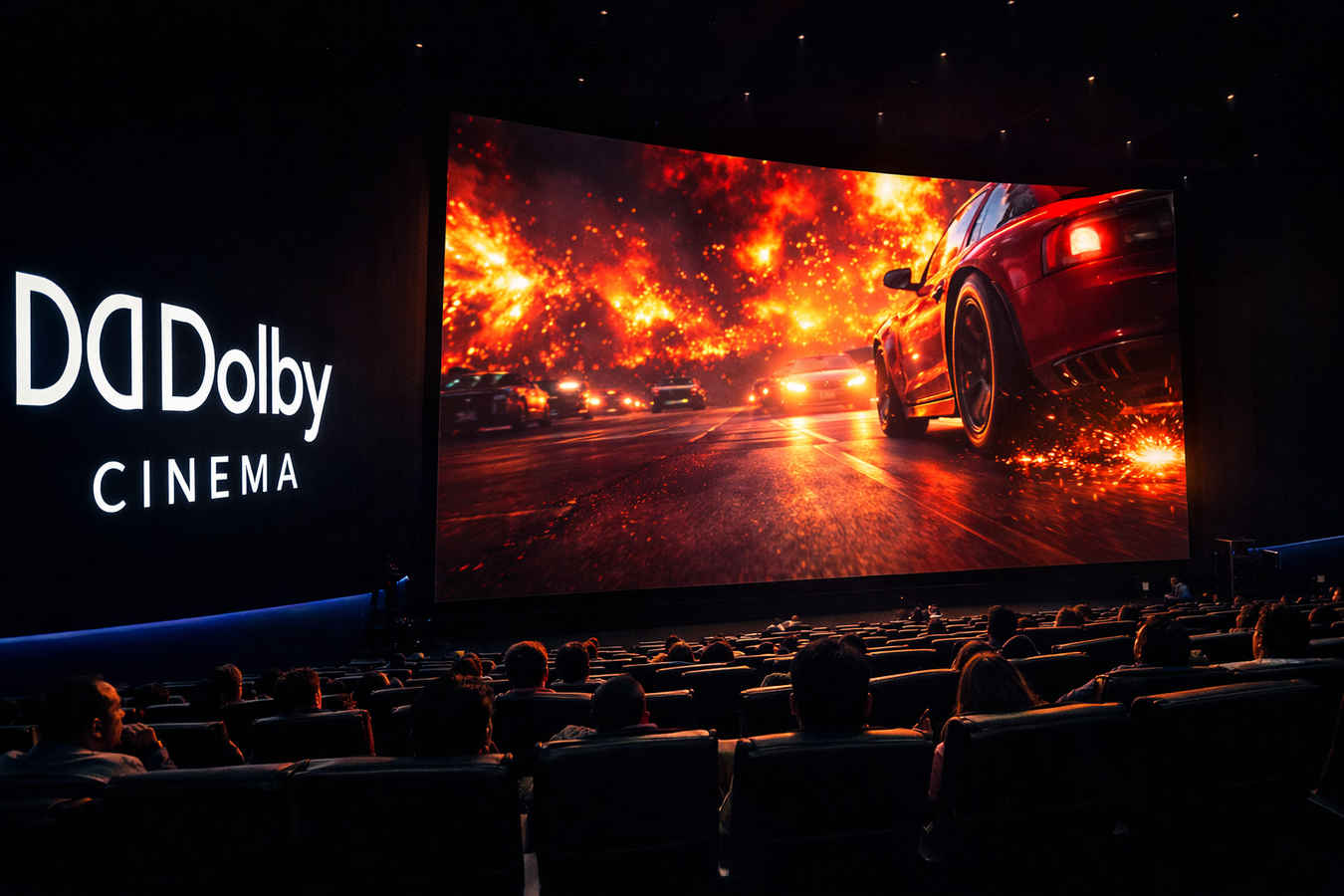

India loves a spectacle and among the sheer number of ways to watch a movie right now, we already have IMAX stretching the canvas, ScreenX wrapping content around our peripheral vision and 4DX turning our seats into amusement park rides. Now, Dolby, after testing the waters with screens in Pune and Bengaluru, has launched its premier format, Dolby Cinema, at Allu Cinemas in Hyderabad.
 Survey
I sat down with Ashim Mathur, Vice President of Marketing for Dolby Laboratories across Asia Pacific, to see what sets their flagship theatre experience apart from the standard multiplex screens. To layer it up, I also spoke to Allu Aravind, the veteran producer and exhibitor who made the call to install this screen and shared the evolution of screens he has witnessed albeit what the future of film viewing means in India.
Before we delve into that, let’s take a step back. The last time I spoke to Mathur, he had told me about Dolby’s mission. “Our mission,” he had said, “is to unlock the power of sight and sound to create spectacular experiences.”
So when I met Mathur again on the sidelines of the new Dolby Cinema screen opening, I wanted to know if this was going to be a tangible upgrade to the movie-watching experience. Because if Dolby was truly “unlocking” something about sight and sound, the proof had to be on that screen.
What Makes Dolby Cinema Different?
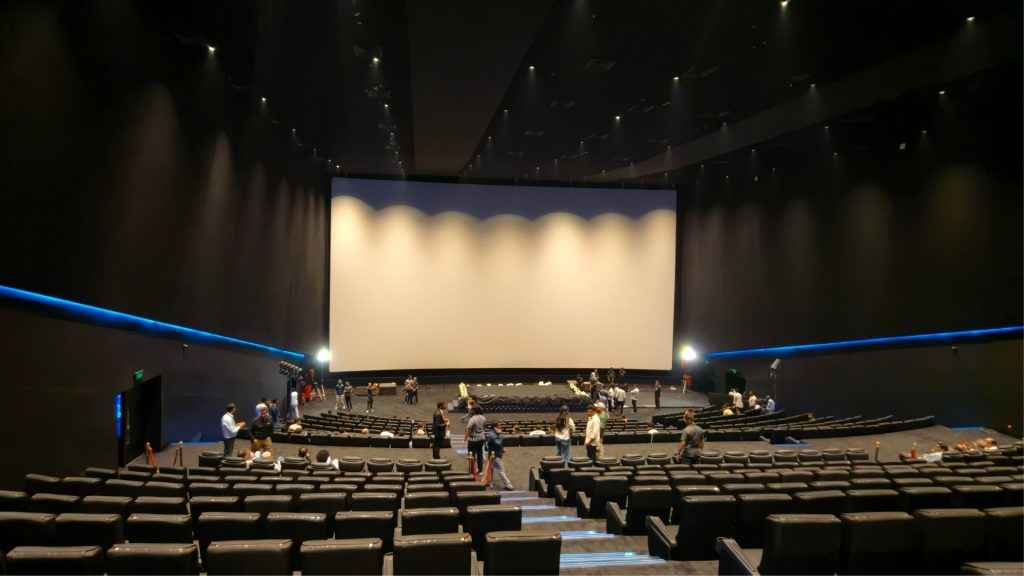
According to Mathur, Hyderabad now features a state-of-the-art Dolby Cinema experience and at 75 feet wide it is India’s largest Dolby Cinema screen with 644 seats housed in a space that’s meant to strip away distractions and max out the audiovisual fidelity.
“When you go to a Dolby Cinema, you see a really different design,” Mathur told me, adding, “Each seat will give you the best experience wherever you are. The way it is designed, the way it is kind of done up, it’s really black. All the speakers are concealed. You don’t see where the speakers are and where the sound is coming from.”
Any fan of The Big Bang Theory will remember Sheldon Cooper’s near-religious relationship with finding the acoustic sweet spot in a theatre because the audio was perfect from precisely that point. For purists, it’s also a real anxiety they carry into every hall they walk into. Am I in the right spot? Is the screen too close? Too far? Will I be hearing the left channel more than the right?
This Dolby Cinema system runs on dual Dolby 6P laser projectors pushing a combined 22,000 watts of output via 72 speakers and supports 3D too. Dolby Vision delivers what the company calls ultra-vivid colour and a full contrast ratio and the demo clips made this viscerally clear. Combine that with the precision object-based audio of Dolby Atmos and the experience is dialled up to a t.
“When it comes with that immersiveness from a viewing perspective coupled with Dolby Atmos,” Mathur notes, “I think that’s where it creates a powerhouse of experience.”
Allu Aravind is unambiguous about why he chose Dolby over every other premium format on the market. “In all the formats what I’ve seen, Dolby Cinema particularly marries the sound and visuals so well, so blended, and it gives really a great experience. That is the reason I chose Dolby.” Coming from someone who’s seen every premium format pitch, that’s not an endorsement for the sake of it.
When the lights went off and the first demo clips began to roll, the imagery felt alive in a way that a regular screen usually doesn’t. The first piece of footage we watched was the 3D trailer of Ramayana. Now, I had seen it maybe a dozen times online ever since it dropped, enough times to know exactly what it looked like.
The combination of Dolby Vision’s contrast and the dual-projector 3D gave each frame a structural depth and when Hans Zimmer and A.R. Rahman’s score kicked in through the Atmos system, the sound didn’t feel like coming from point sources and instead the hall was engulfed with the music.
Then came the Daytona opening scene from F1. Inside the cockpit shots, the sound design was remarkably precise, engine noise humming, track ambience swelling at the right moments. And when the scene shifted to wider racing shots, the soundstage expanded accordingly. That ability to shift perspective visually and sonically is where Dolby’s technology begins to show its muscle.
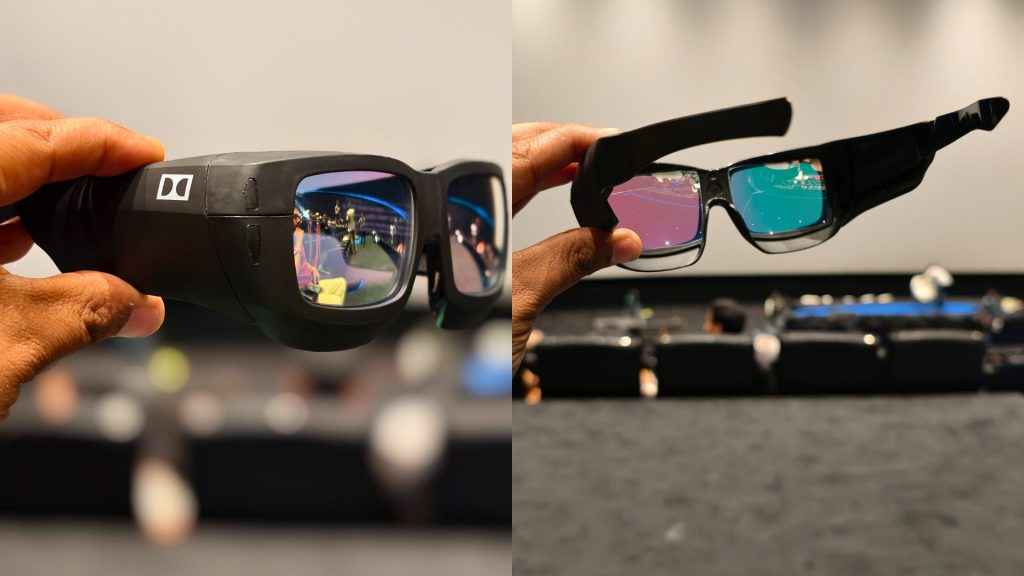
The 3D glasses, which shouldn’t need mentioning but do, were actual glasses with proper frames and not the disposable plastic strips other theatres hand out that reduce every three-dimensional experience to a low-grade headache.
The Living Room Argument
The experience naturally leads us to what all of this means, not just for cinema, but for the broader question of where and how we consume things now. It would be easy to frame Dolby Cinema as a defensive move. A way for theatres to fight back against the living room setups that have genuinely gotten very good, against the 4K television in your drawing room, against the spatial audio in your AirPods, against the very reasonable argument made every Friday night across this country that you could just watch it at home. Ashim rejects that framing entirely.
“It’s not a competition between which is better, home is better or phone is better or cinema is better,” he said. “Each one of them has its own space, each one of them has its own value and its own loyalty in terms of the consumer base. What we try to do at Dolby is make sure that whatever device you are on, whatever service you are on, that experience is the best experience.”
Essentially, Dolby isn’t selling you a format or claiming that the theatrical experience beats the one you get in your living room. “Whether you are watching cinema content or OTT or music or gaming or podcast, there is more and more content coming in Dolby Atmos and Dolby Vision,” he added. “And then on the experience side, whether you are in a cinema, living room, mobile, PC, tablet or automobile, this whole experience is replicated in the best way possible.”
This makes him confident that Dolby will find its loyal audience. “If I like the experience, I’ll go back again to that screen,” he said, adding, “And that’s why we’re very confident that once anybody comes to the screen in Hyderabad, they’re never going to go back to any other. It’s going to get the retention, it’s going to get the loyalty factor back because the experience is so powerful and you want to come back again and again to watch the same way possible.”
Perhaps the most honest articulation of why theatres still matter came from Aravind himself. “A family sitting and having a popcorn and watching a bigger TV, and put it off when a call comes, that is a divided experience. The experience in a cinema is a collective darkroom experience, something happening in front of you and there is no disturbance.” The home setup school of thought assumes an attention and silence that most living rooms simply don’t provide.
But Dolby’s work doesn’t begin with the viewer. It begins much earlier, upstream, with the people making the films and shows that you eventually watch. “We work across the content ecosystem from content creation to distribution to playback,” Mathur said. “When you work with a musician, when you work with an artist, you make sure that the way the song is recorded in the studio is replicated on the other end. That brings the artist closer to the fan and the fan closer to the artist. That bridges the gap between them. It’s an emotional connect.”
Can AI Threaten What Dolby Has Built?
In the smartphone space I cover regularly, AI has attached itself to everything: cameras, editing tools, image upscaling and writing assistants. Even cinema production is experimenting with it, for visual enhancement, audio restoration and post-production workflows. In that context, I asked whether AI complements what Dolby does, or if it risks commoditising the very differentiation that Dolby has spent decades building?
“Storytelling is a very emotional thing, a very passionate thing. No kind of technology is going to change that,” he said, after giving it a thought. “You can’t replace originality, you can’t replace authenticity, you can’t replace your own passion and the drive and the storytelling the way you want to do. We play in that space. We are very confident that whatever we are trying to do is ultimately helping the stories rise and shine the way they should be,” he added.
It is quite unusual for a technology company to argue that technology exists to serve the story, not the other way around. I find that distinction convincing up to a point and that point is probably further away than the current state of AI production tools suggests, but it’s worth monitoring as those tools mature.
Why You Should Still Pay The Premium
I asked Ashim something very obvious, something that you’re already thinking. Your home setup has never been better. There is a large television, a new film on Netflix tonight and your sofa is right there. Why get dressed, drive across the city, pay the premium and sit in a hall with 643 other people?
“There is nothing which can beat the pristine and the big screen size of the cinema,” he said without any hesitation. “You really leave all your headaches and tensions out and come to watch and relax and have a great time. It’s all about fun, it’s all about your family time, your friends. Especially in markets like Hyderabad and down south, they are so passionate about cinema. That passion is driven by the love for cinema, and that love will always drive people back to these screens.”
But Aravind, who has watched exhibition evolve from 35mm to Cinemascope to 70mm to where we are now, is already thinking past Dolby Cinema entirely. “I want to see it growing beyond the eye, beyond 180, make it 360. We have seen the Sphere, something like that will grow. That is the experience I am expecting.”
Three Screens Down, the Rest of India Still Waiting
India has three Dolby Cinema screens now and this one in Hyderabad is the largest. On the topic of adding more cities to the list, Mathur explained how expansion decisions actually work. “It’s dependent on our partners. We don’t choose which market, which city deliberately from our side. It’s our partners’ prerogative and their decision.” Dolby Atmos, he pointed out, also started in single-screen theatres before eventually spreading to the point where PVR now has the largest Atmos footprint in India.
I asked Ashim, perhaps predictably, when Delhi gets one. “Hopefully soon. Nothing to share today. We are in Hyderabad. Let’s enjoy the biryani and the love of the city. And we’ll be in Delhi hopefully soon.” The biryani, for the record, was excellent.
Digit was invited to the Dolby Cinema launch event at Allu Cinemas, Kokapet, Hyderabad.


