
India AI Film Festival 2026: Why the next Indian sci-fi blockbuster will be built on GPUs, not cameras
 Follow Us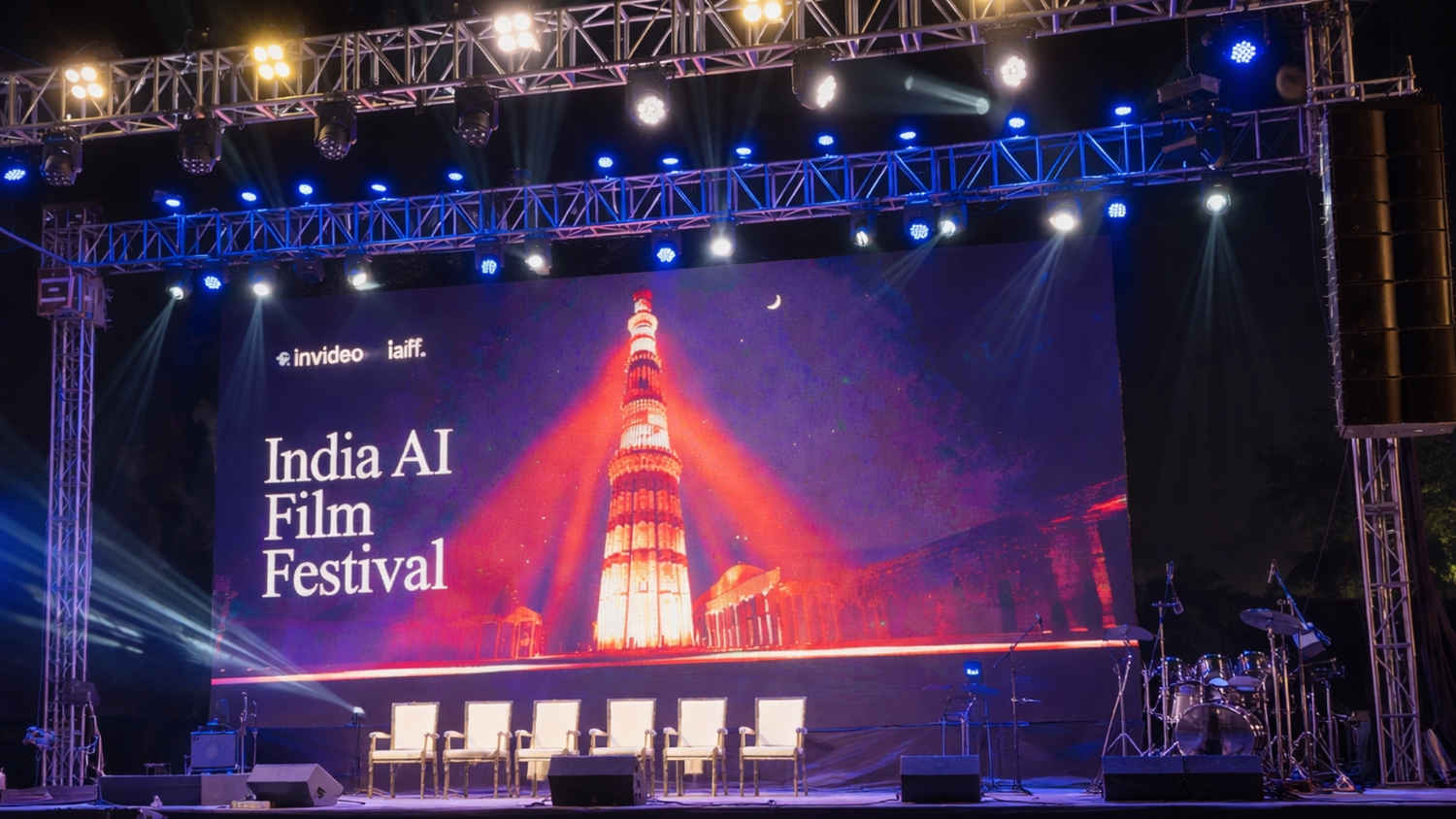

Delhi in February carries a distinct evening chill. A few nights ago, I found myself standing in the shadow of the Qutub Minar, the 12th-century red sandstone and marble minaret cutting into the night sky, a monument built by human hands to outlast every generation that would ever look up at it. There is something almost poetic about that setting. Here, at a place where the ambition of the past was made permanent in stone, we were gathered to talk about a future being built in pixels and probabilistic inference. The 2nd India AI Film Festival, hosted alongside the India AI Impact Summit by Invideo, brought together studio executives, technologists and independent directors to figure out exactly what happens next in video production. The Qutub Minar has stood for eight centuries. The tools being discussed that evening are not yet eight years old.
 Survey
My typical week revolves around the physical constraints of hardware — hours spent digging into smartphone camera samples or verifying the true peak brightness values of a display panel. But when you shift your gaze to generative video, you stop looking for sensor flaws and start hunting for hallucinations. You watch closely to see whether the lighting forgets the sun’s position between cuts. You notice when a character’s jacket inexplicably shifts from leather to denim for a fraction of a second. These are the new tells. And that evening, there were plenty of people in that room who were working very hard to eliminate them.
The Shift From “Look, It’s AI” to “Is It Good?”
Six months ago, generative video was largely a parlour trick where a text prompt would yield three seconds of a warped, morphing face and the internet would briefly marvel at it. The five to six indie short films screened at the India AI Film Festival made one thing abundantly clear: the algorithms are now capable of holding a narrative structure together. The festival organisers recognised this leap by distributing $12,000 in prize money to creators who successfully married the technology with actual storytelling craft.
Director Vignesh Shivan spoke directly to this shift. He is currently in production on Love Insurance Kompany, a Tamil sci-fi film set in the year 2040 and the script for which he began writing back in 2018, long before generative models were accessible to the public. The gap between when he imagined the film and when he could actually start building it is, in itself, a small testament to how rapidly the ground has shifted. He explained how the sudden availability of these tools solved massive pre-production headaches that would have otherwise required significant budget.
“We used to use it for pre-vis, but mostly, you know, these days we just use it,” Shivan told us on the sidelines. “In my movie, I’ve used it to show my Chennai, how it’ll look in 2040, how auto might look, how people might talk, how things might change, how robots can come in.”
He brushed off the prevailing industry panic about job losses by drawing a historical parallel to the widespread adoption of the personal computer. When digital accounting and word processors arrived, people assumed administrative jobs would vanish overnight. Instead, the workforce adapted and the tools simply changed. He argued that the current wave of generative video will follow the exact same adoption curve, eventually becoming an invisible, standard component of the filmmaking process. The only immediate hurdles left to clear are output resolution and shot-to-shot consistency. Once the temporal flickering is solved, the entire production pipeline shifts. This idea of adaptation, of the industry bending rather than breaking, ran as a heavy current throughout the evening.
Yet a common assumption is that anyone with a laptop can suddenly become an auteur and bypass the established studio system entirely. The reality on the ground, discussed at length during the panels, is far more pragmatic and demanding.
Georg Ramme, Managing Director of Promptr Studios, offered the evening’s most sobering reality check. His company recently put out a call for AI artists and received a flood of applications. They quickly discovered that roughly 80 percent of the candidates lacked the fundamental skills required to produce high-level content. That number deserves to sit for a moment. Eight out of ten people who believed they were ready to work professionally with these tools simply were not. The tool itself does not bestow talent. Ramme noted that the people who consistently succeeded in generating professional-grade footage were traditional camera operators, directors of photography and assistant directors.
“In the past, we watched videos where everybody was excited and said, oh, look, this is AI. But this was mostly a lame story. And now we’re coming in a phase where videos is getting more and more professional. We have emotions in it and it’s getting industry standards that are on a higher level,” said Ramme.
The Bridge Between Bedroom and Studio
The earlier wave of AI films survived on novelty. The current wave is being judged on narrative. A machine can render a complex tracking shot through a cyberpunk city in seconds. But the machine does not know why the camera should be tracking in the first place. It does not understand pacing, emotional resonance or visual weight. That gap between generating footage and understanding cinema is precisely where human expertise remains not just relevant, but irreplaceable.
Justin Hackney, CEO of Wonder Studios, positioned his company squarely in that gap. He described Wonder Studios as a necessary bridge between the raw, chaotic output of artificial intelligence and the rigid, established workflows of the traditional film industry. He views the technology as the most significant creative unlock in human history, but only if it is channelled through the hands of people who understand cinematic language. The goal, as he framed it, is not to replace the crew but to accelerate their workflow and to allow them to visualise and execute ideas at a speed that was simply not possible before.
“I want to be a bridge between the technology, the creatives, and the industry. Because when the industry sees that these tools are helping the creatives, suddenly they understand, wow, this is probably good for us,” he said. Later, when asked to distil AI’s impact on storytelling into a single line, Hackney did not hedge: “Without a doubt, these tools, AI, is the biggest unlock for creativity that we’ve ever experienced as a species.”
The Numbers Behind the Vision
The true value proposition of AI filmmaking ultimately comes down to scale and economics. The cost of bringing an idea to the screen has always been the primary barrier to entry in the entertainment business, and nowhere is that friction felt more acutely than in markets where production budgets are calculated in rupees rather than dollars. Vikram Malhotra, Founder and CEO of Abundantia Entertainment, put it plainly.
“Commercial viability is key to anything that we do. It’s called the film’s business for a reason,” he said.
When asked what he would create if economic constraints disappeared, Malhotra answered without a second thought: “Build a science fiction universe out of India, and not one that’s traditionally anchored in mythology or culture, but genuine, true, out there, world-class science fiction.” It is a revealing answer because it tells you exactly what the constraint has always been. The imagination was never the problem. The render farm was. Generative video effectively flattens this cost curve, allowing regional filmmakers to attempt heavy world-building without needing to secure hundreds of visual effects artists for scenes that, until recently, would have consumed an entire post-production budget.
To prove that this was not just theoretical optimism, Abundantia Entertainment and InVideo officially announced aiON, a Rs 100 crore AI-driven film studio at the event. The joint venture intends to produce five full-length commercial feature films over the next three years. A hundred crore rupees is a conviction bet and it signals clearly that major financial players are prepared to back synthetic media all the way to a feature-length audience.
Invideo CEO Sanket Shah cut straight through the hype, “100% of the films will be hybrid,” he stated plainly, dismissing the idea of a purely AI film industry operating in isolation. His argument was straightforward: the fundamental job of a film is to entertain. The audience does not care if a scene was shot on an Arri Alexa, an iPhone or generated entirely on a GPU cluster. They only care if the scene makes them feel something.
Pradeep Gupta, VP for Solutions Architecture and Customer Engineering at Nvidia, provided the necessary technical context for all of these ambitions. Every frame generated, every model fine-tuned, every iteration of a pre-vis sequence runs on compute. That is the actual bottleneck and not creativity, not talent, not even capital.
“AI always needs a lot of computing infrastructure and the tokens. If you can bring this cost down to a level where each and everyone in this crowd and everywhere can go and create something that substantial without putting a lot of money, I think that’s what technology is trying to enable. There is a creativity which exists all over. You don’t have to worry about how you will bring that creativity into the light. That’s exactly what we at Nvidia think.” He paused, then added: “It’s really about enabling the world to do something which people has never thought before.”
What the Night Actually Proved
Despite the heavy focus on the future, the festival remained grounded in the actual art produced by its attendees. The award ceremony highlighted creators who prioritised emotional impact over technical showmanship. Portrait No. 72 (Veo) by Darryll Rapacon won Best Overall Film. Anhad (ComfyUI, InVideo, Higgsfield, ChatGPT, Kling) by Bharat took Best Storytelling. Unmasked (Kling, Veo, Hailuo, Runway, ElevenLabs, Suno) by M S N Karthik was awarded Best Editing.
Notice what those categories reward. Not prompts, not model selections, not render times, but storytelling and craft, the same things that have always mattered.
And yet, we have to talk about the actual viewing experience. As polished as these submissions were, the origin of the footage was always apparent to anyone paying close attention. The tells are baked into the texture. There is a strange, frictionless quality to human movement. An actor’s eye contact drifts a millimetre off-axis. Shadows forget their light source for a fraction of a second. Cuts often lack the heavy, physical momentum you feel when a massive cinema camera shifts its weight. The footage feels genuinely cinematic while simultaneously refusing to disappear into the background the way real photography does.
Recognising these flaws does not diminish the work on display. It simply marks where the work is. You can generate a photorealistic landscape with a single prompt. You can map a digital face onto a character and alter their dialogue to match any language on the planet. You can build an entire science fiction universe for a fraction of what it would have cost three years ago. But if the characters in that universe do not have anything compelling to say, the audience will look away and they will do so just as quickly as they would from any badly written film, AI-generated or otherwise.
Centuries ago, someone looked at a minaret and built one that would outlast every technology used to construct it. That evening in Delhi, standing in its shadow, a room full of people were trying to figure out how to do the same thing with a story. The tools are new. The problem is ancient. The machine handles the pixels. The human still has to provide the soul.
Read More: India AI Impact Summit 2026: Here are the biggest investment announcements by tech giants


