India AI Impact Summit 2026: Why India’s global south AI Summit changes everything
 Follow Us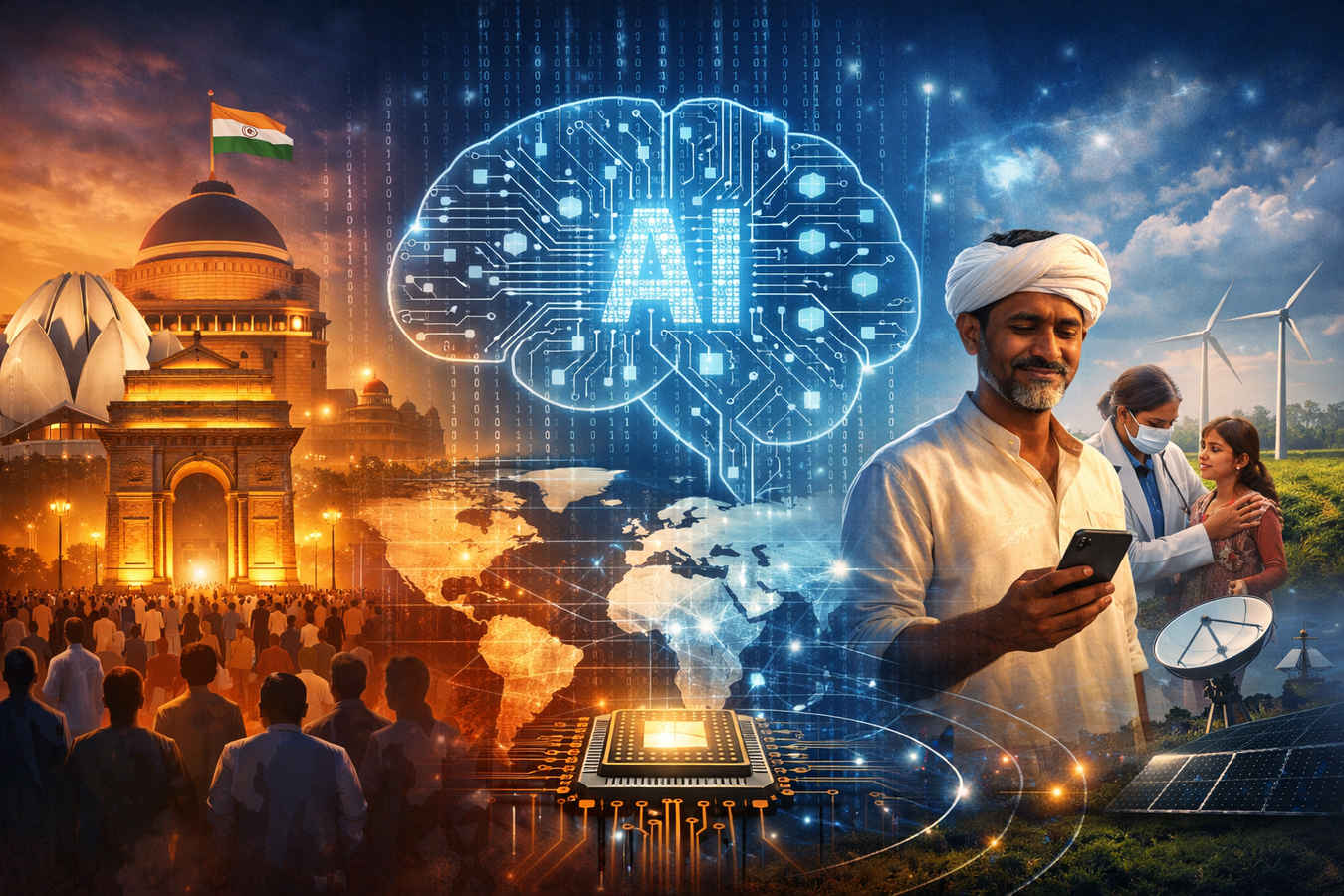

Global leaders, big tech chiefs and policy architects are en route Delhi and the national capital is ready to host them from February 16th to 20th. This is not a diplomatic delegation nor a tycoon’s wedding. This is a platform to define the coming decade, courtesy of AI.
 Survey
For the past few years, the global conversation on Artificial Intelligence has unfolded in polished halls across London, Washington and Brussels. The debates have largely centred on safety. Tech CEOs talk about guardrails for systems that do not yet exist. Policymakers ask what happens if machines outthink us.
It is a valid concern. But it is also a debate shaped by countries where the basics already work.
By hosting the India AI Impact Summit in the Global South, India is forcing a pivot. The focus shifts from what AI might do to us in the future to what AI must do for us right now. It is about whether AI can help a farmer in Vidarbha decide when to sow. Whether a diagnostic tool can run on a low-end smartphone in a clinic that loses power three times a day. Whether governance can become more transparent for 1.4 billion people.
That is why the world is not just visiting Delhi this week. The world is paying attention.
Also Read: India AI Impact Summit: 5 major announcements you shouldn’t miss
From Existential Risk to Everyday Impact
This is not a summit about who builds the biggest model. It is about who deploys AI at a population scale.
Prabhu Ram, VP at CyberMedia Research, puts it bluntly: “While the Global North remains focused on AI safety and regulation, India is reframing the global conversation around utility.”
“The ‘People, Planet, Progress’ framing positions AI as Digital Public Infrastructure, shifting the debate from frontier risk to real-world outcomes in multilingual, resource-constrained environments,” he adds.
The framing matters. It positions AI not as a premium product to be sold, but as infrastructure. India has already proven this approach with Aadhaar for identity and UPI for payments. Now, the ambition is to extend that model toward “AI as a Public Good.”
Yogesh Brar, independent tech analyst and market insights expert, calls the summit a pragmatic pivot. “By hosting the first summit of this scale in the Global South, India is attempting to re-center the narrative on AI utility and deployment-led outcomes, rather than the North’s focus on existential risk.”
This does not mean India dismisses safety. It means the risks being discussed are different. Not just hypothetical superintelligence, but deepfakes, misinformation, bias in local language systems, uneven access and energy consumption.
A Market, A Democracy or Both
Leaders from across Europe, Latin America, Africa and Asia are attending. Sam Altman, Satya Nadella, and a delegation of over 100 US companies are here because the user base is here.
In his recent column, Sam Altman wrote: “AI will help define India’s future and India will help define AI’s future.” He pointed out that India has the second-largest user base for ChatGPT globally. He also wrote that “access is the admission ticket.” But access without agency is meaningless.
The US delegation, led by USISPF, recognises that India is moving from experimentation to execution. The conversation is no longer about testing AI in isolated pilots. It is about embedding it into workflows, public systems and businesses.
The Language Problem Silicon Valley Never Solved
Tarun Pathak of Counterpoint Research argues that India has the ingredients to lead AI application at scale: “a young, connected and ambitious population” combined with a digital-first mindset.
For him, the focus is not on model supremacy but on enabling a startup ecosystem that solves local needs, particularly through multilingual and multimodal systems.
Most Large Language Models are fluent in English and confident in everything else. They are trained on Western data, which carries Western biases and context.
The summit showcases models such as BharatGen and Sarvam-1, which are not simply translated versions of Western systems. They are built from the ground up on Indian languages.
Rishi Bal, CEO of BharatGen, makes it clear: “India’s AI progress must be built on language access and contextual understanding.” These systems are designed for deployment across citizen services, finance, healthcare and education. In that sense, multilingual AI is not a feature. It is the foundation.
Tarun Pathak calls India the ultimate testing ground. If you can build an AI that navigates linguistic diversity where dialects shift every 100 kilometres, you build something robust enough for the rest of the world.
Sovereignty Has a Compute Problem
India’s sovereign AI push includes subsidised GPUs at roughly one dollar per hour. Tens of thousands are available. But as Abhishek Singh, CEO of the IndiaAI Mission, acknowledges, 40,000 GPUs are not enough when global companies operate clusters with more than half a million GPUs.
The halving of compute subsidies in the 2026 Budget has raised questions about the gap between policy intent and hardware autonomy.
Yogesh Brar notes a “persistent gap between policy intent and hardware autonomy.” India still relies heavily on imported GPUs and global chip ecosystems.
Tarun Pathak frames it differently. He sees a systematic plan toward ICT self-sufficiency. Domestic chip design initiatives under the semiconductor mission, projected expansion of data centre capacity from 960 MW to 9.2 GW by 2030 and the development of an India AI Stack signal long-term intent.
You will hear a lot about the Stack. It consists of five layers:
- Applications that people use directly
- Models that power those applications
- Compute infrastructure that trains and runs them
- Data centres and networks that connect everything
- Energy that keeps the system running
If one layer weakens, the system stalls.
As Arun Jain, Chairman of Intellect Design Arena, puts it: “AI capability is no longer the constraint; reliability is. Enterprises do not hesitate because AI is weak; they hesitate because AI must earn the right to act.”
That may define the next phase of global AI more than any benchmark score.
Why Open Source Matters Now
The summit has also drawn strong advocacy for open source AI.
Mark Surman, President of Mozilla, said: “Open source AI is your path to both economic and digital sovereignty.” Raffi Krikorian, Mozilla’s CTO, emphasised decentralisation and plurality across languages and cultures.
If AI is to operate within democratic safeguards at the population scale, centralisation carries risks. Openness becomes not an ideological stance, but a structural safeguard.
Nabiha Syed of the Mozilla Foundation added that imagination and creativity are not luxuries. They are safeguards. As AI reshapes culture, efficiency cannot be the only metric. Human stakes must remain central.
Beyond the Optics
This summit is an assertion of status. India is no longer just the back office of the world, nor simply a market to be harvested. It is attempting to influence how AI is defined for the billions who live outside the West.
The challenges are massive: energy, chips and the sheer chaos of implementation. But as Yogesh Brar cautions, success will not be measured by investment announcements or footfall. It will be measured by whether AI deployments translate into measurable gains for underserved populations.
If the India AI Impact Summit succeeds, that future will not be defined solely by the biggest models or the fastest chips. It will be defined by whether AI can function as public infrastructure, inclusive, multilingual, energy-aware and deployable at a population scale.


