
Computex 2026: 5 major announcements you should not miss
 Follow Us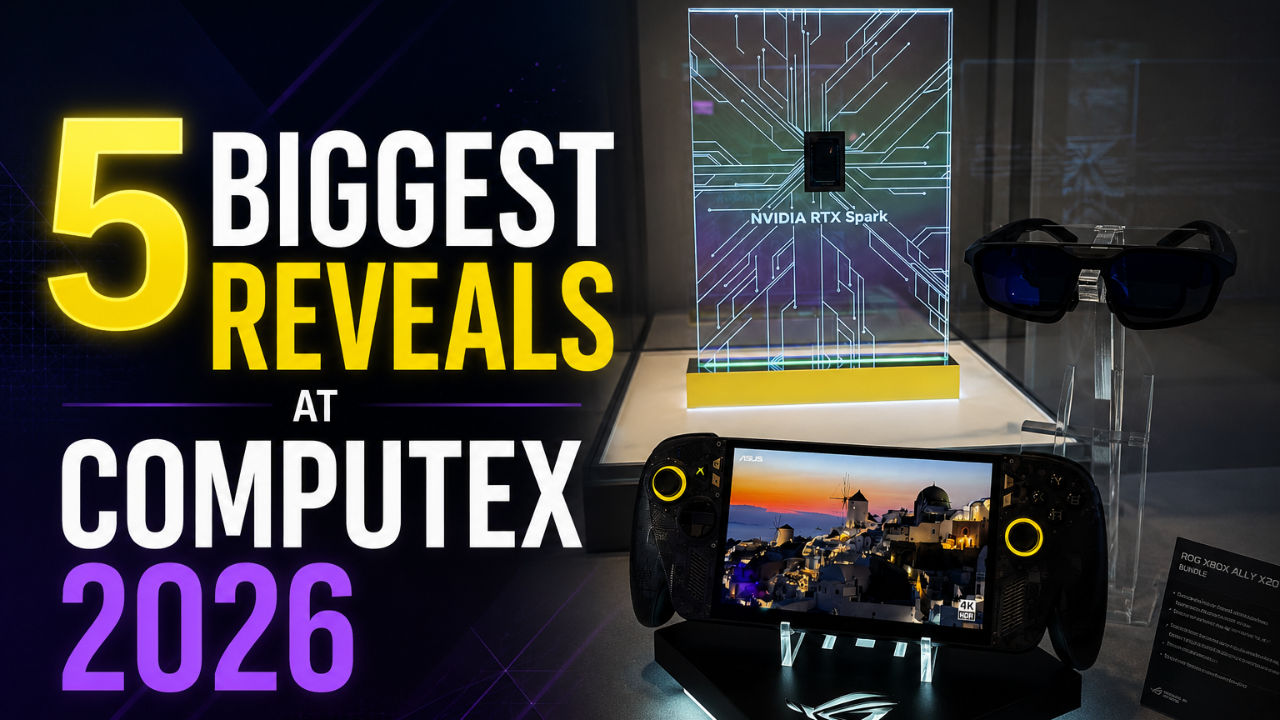

Stop, take a moment, and think about the times when every other tech conference was about power and speed. Benchmark numbers, ‘world’s fastest’ claims and ‘first in the world’ flex were all that dominated the floors of tech showcases like Computex. But when I walked the floors on Computex 2026 this year, a shift was quite evident. Now yes, powerful GPUs and fastest processors are still a pretty big deal. But brands aren’t stopping just there.
 Survey
NVIDIA is working on turning your laptops into AI assistants. Meanwhile, Asus believes that creator machines should handle giant AI models right on the device. And then there are Intel and AMD trying to shake things up on the gaming side of things. Clearly, there is a lot happening. So without making you wait any further, here are the five announcements from Computex 2026 that you just cannot miss. Read on.
Also read: Computex 2026: MSI showcases new gaming laptops, Claw 8 EX handheld and more
1. NVIDIA RTX Spark will change laptops forever
Nvidia CEO Jensen Huang is no less than a superstar in the world of tech. So when he walked on to deliver his keynote, the crowd was roaring with excitement already. And his announcement led to even greater cheers from the hall. Say hello to Nvidia RTX Spark, the chipset that stole the show on day 1 of Computex 2026.
Nvidia says that the RTX Spark can deliver up to 1 petaflop of AI performance inside a thin-and-light laptop while supporting up to 128GB of unified memory. And that means you can get some serious performance in a device that you can take just about anywhere.
For years, creators and developers have depended on cloud services to run advanced AI workloads. Whether it was generating AI images, experimenting with large language models, or creating videos, a lot of that work happened on remote servers. RTX Spark aims to bring those capabilities directly onto your laptop.
NVIDIA is also working closely with Microsoft on AI agents. The idea is that instead of manually jumping between applications and performing repetitive tasks, users can simply ask their PCs to do the work for them. That could mean searching through files, generating content, managing workflows across apps, or helping creators automate routine tasks.
Moreover, RTX Spark is also not limited to just productivity-based tasks. During a hands-on session with Nvidia at Computex, I got a chance to play Alan Wake 2 and Pragmata on one of the new RTX Spark-powered laptops. The experience honestly felt surreal.
Both these games were running on Microsoft Surface Ultra devices which are super thin and light. In all honesty, these aren’t really the kind of laptops that come to mind when you think of AAA gaming. But there they were, shining in all their glory and running the two games perfectly.
Yet Alan Wake 2 looked stunning, complete with beautiful lighting, reflections, and atmosphere, while Pragmata ran smoothly without any stutters or frame drops.
Seeing the devices in action made me feel that us gamers might not have to choose between portability and performance in the future. And that’s just something we’ve all waited for, for years. Right?
2. Handheld gaming in the spotlight
A long time ago, before smartphones existed, the idea of carrying a telephone in your pocket felt like something out of a science fiction movie. And today, a cellphone is perhaps one of the most basic gadgets that everyone owns. And walking through the halls of Computex 2026, I couldn’t help but wonder if we will be talking about handheld gaming devices the same way a couple of years down the lane. As more and more brands make gaming handhelds, we can expect major breakthroughs in future. And Intel seems to be keen on leading the charge.
At Computex 2026, the company unveiled its new Arc G-Series processors, a family of chips built specifically for gaming handhelds. Unlike traditional laptop processors that are adapted for smaller devices, the Arc G-Series has been designed from the ground up with handheld gaming in mind. Intel says the platform combines strong gaming performance with better power efficiency, allowing players to enjoy modern AAA titles without constantly worrying about finding the nearest charger.
The chips also bring features that have become increasingly important for modern gaming. Technologies like real-time ray tracing and XeSS 3 AI upscaling aim to improve visual quality and frame rates, while Xbox Mode creates a more console-like experience on Windows 11. Intel is also introducing features such as precompiled shaders that can help games launch faster and run more smoothly.
And the first devices powered by these chips have already arrived. Acer showcased the Predator Atlas 8, which combines the Arc G3 Extreme platform with an 8-inch 120Hz display, up to 24GB RAM, and an 80Wh battery. MSI followed with the Claw 8 EX AI+, another handheld designed around Intel’s new platform and equipped with 32GB RAM and Arc B390 graphics.
Now Intel wasn’t the only company trying to push handheld gaming forward. Asus unveiled the ROG Xbox Ally X20 Bundle powered by AMD’s Ryzen AI Z2 Extreme processor. And this isn’t just an ordinary handheld. Asus went a step further and bundled the handheld with AR glasses that create a giant virtual display wherever you play.
3. Gaming monitors are becoming faster and more immersive
Gaming monitors have improved steadily over the last decade, but Computex 2026 showed that manufacturers are no longer satisfied with simply increasing refresh rates or improving colour accuracy.
Asus unveiled the ROG Strix OLED XG259QWPG Ace, which the company says, is the world’s first OLED esports monitor.
The most attention-grabbing specification here is a 540Hz refresh rate paired with a 0.02ms response time. Traditionally, esports monitors capable of achieving these speeds relied on TN panels that sacrificed image quality in favour of performance. ASUS is attempting to change that by combining esports-grade speed with OLED image quality.
The result is a display that offers deep blacks, vibrant colours, and exceptional contrast while still delivering the responsiveness competitive players expect.
Now if Asus focused on competitive gaming, Acer focused on immersion.
The company showcased the Predator XB273K 3D, a glasses-free 3D gaming monitor that uses eye tracking and AI-powered processing to convert standard 2D content into 3D visuals in real time.
The monitor combines a 4K resolution with a 180Hz refresh rate and can create a surprisingly convincing sense of depth without requiring any special glasses. And as someone who has always wished to live inside those virtual worlds, this monitor seemed like a boon.
4. ASUS ProArt laptops
Asus unveiled the new ProArt laptops, consisting of the Pro Art P16 and ProArt P14. These two creator-focused laptops are powered by the NVIDIA RTX Spark chipset. Yes, the same one that the world has been talking about ever since it was unveiled.
The laptops combine RTX Spark’s AI capabilities with creator-focused software such as MuseTree and StoryCube, allowing users to generate images, edit content, and manage creative workflows more efficiently.
And there is a lot of AI performance packed into these machines. Asus claims these laptops can deliver up to 1 petaflop of AI performance while supporting up to 128GB unified memory. For creators working with AI image generation, video production, or large language models, that is huge.
Coming to the laptops’ design, you get these clean and premium looking devices in two colourways. As for the display, Asus has equipped the laptops with Lumina Pro OLED displays featuring up to 1,600 nits HDR brightness, 120Hz refresh rate, and anti-reflection coatings.
5. AMD’s promise to gamers
AMD introduced the Ryzen 7 7700X3D processor and the Radeon RX 9070 GRE graphics card to power all your gaming needs. The Ryzen 7 7700X3D brings AMD’s popular 3D V-Cache technology to a more accessible price segment, while the Radeon RX 9070 GRE targets gamers looking for strong 1440p gaming performance without paying flagship prices.
In addition to this, the brand also celebrated ten years of the AM4 platform by launching the Ryzen 7 5800X3D 10th Anniversary Edition chipset.
But AMD’s biggest announcement was not a processor or graphics card, it was the brand’s commitment to continue supporting the AM5 platform through 2029.
That promise means users investing in an AM5 motherboard today should be able to upgrade to future Ryzen processors for years without replacing their entire platform. In a market where building a gaming PC is becoming super expensive, platform longevity matters more than ever.
AMD’s message is simple. Buy once, upgrade gradually, and avoid rebuilding your PC every few years. And for PC gamers and builders out there, this could easily be one of the most important announcements.
So, Computex 2026 was packed with flashy products, powerful hardware, and ambitious ideas. But more importantly, it felt like a show where companies finally started thinking beyond traditional upgrades.
Whether it was AI-powered laptops, handheld gaming PCs, OLED esports monitors, glasses-free 3D displays, or long-term platform support, the focus was not simply on making computers faster. It was about making them smarter, more versatile, and more immersive.
And looking at all these announcements together, the next few years of computing are going to be very interesting indeed.
Also read: Computex 2026: Asus unveils Pro Art laptops powered by Nvidia RTX Spark chip


