
GeForce NOW India launched at Rs 333 per month: surprisingly polished, aggressively priced
 Follow Us
Mumbai-based infrastructure helps GeForce NOW deliver 4 to 5 ms latency in India.
The Rs 1999 Ultimate 90-day pass undercuts Xbox Game Pass Ultimate by a wide margin.
Install-to-Play and stable 4K streaming make the service feel more practical than expected.
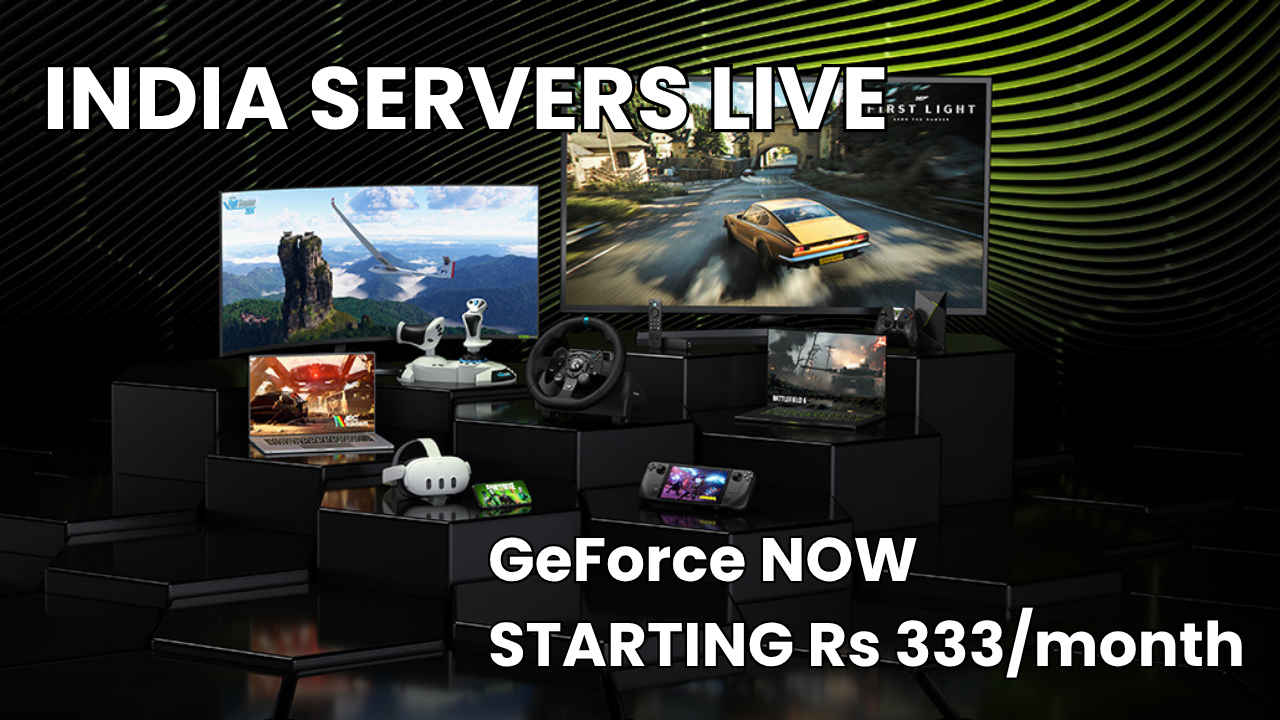

Cloud gaming in India has always sounded better on paper than it did in practice. Latency was the obvious hurdle, broadband consistency was the other, and then there was the simple question of whether anyone would actually pay for a service that streamed games rather than installing them locally. NVIDIA’s India beta for GeForce NOW has a lot to say.
 Survey
This is not just another remote-play workaround or a compromised browser-based experience. GeForce NOW in its Ultimate form is pitched as a high-end gaming PC in the cloud, complete with RTX 5080-class server hardware, support for up to 5K 120 FPS streaming, competitive modes up to 1080p 360 FPS, Cinematic Quality Streaming, and Install-to-Play support for a much broader catalogue of games. NVIDIA also positions it as an open platform that works with existing libraries across Steam, Epic Games Store, Xbox, Ubisoft, Battle.net, GOG and EA, rather than a closed subscription catalogue. We had the opportunity to test out GeForce Now right before launch, here’s what we felt.
Test setup
The service was tested on a desktop equipped with an AMD Ryzen 7 9800X3D, RTX 5090, 48GB of DDR5-6000 memory, and a Kingston FURY Renegade G5 SSD, connected over Realtek 2.5 GbE. The broadband connection was a 300 Mbps Reliance line. Testing was also carried out over Wi-Fi, alongside checks on the Linux client and Android APK, though the main experience centred on the Windows desktop client with an Ultimate account.
That matters because GeForce NOW’s best features are currently aimed at native clients. NVIDIA makes clear that the flagship RTX 5080-tier feature set is tied primarily to the Windows PC and macOS apps, even though the service itself spans a much wider spread of hardware and clients.
Setup is easy, once the account behaves
The initial login process had a few hiccups, and Steam in particular needed repeated logins during testing. Once past that, though, the experience settled down quickly. Store integration mostly behaved as expected, and the overall feel was close to using a regular Windows gaming PC remotely rather than trying to bend a cloud gaming service into shape.
Steam sync worked, provided the profile was left public. Games that relied on their own launchers opened those launchers just as they would on a local machine, which is both a strength and a minor nuisance. It makes the platform feel familiar, but it also means the occasional old-school PC launcher friction comes along for the ride. Some issues were noticed when pulling down existing save files from Steam’s servers, although newly created saves synced normally after that.
Mumbai servers make a huge difference
The biggest reason GeForce NOW feels genuinely viable in India is simple: the servers are here. In testing, latency sat at around 4-to-5 milliseconds, which is excellent by any standard and frankly a little startling for a cloud gaming service. Packet loss was negligible, and route tracing pointed towards Yotta-owned infrastructure outside Mumbai on the final hops. That lines up neatly with the real-world experience because the connection felt unusually direct and stable. The built-in GeForce NOW network test recommends concern only once latency climbs beyond 40 ms. This setup was nowhere near that threshold.

Bandwidth use was also more sensible than the marketing around ultra-high-end cloud gaming might suggest. Idle bandwidth consumption hovered around 11 Mbps, while moving rapidly through a game pushed that up to roughly 50 Mbps.
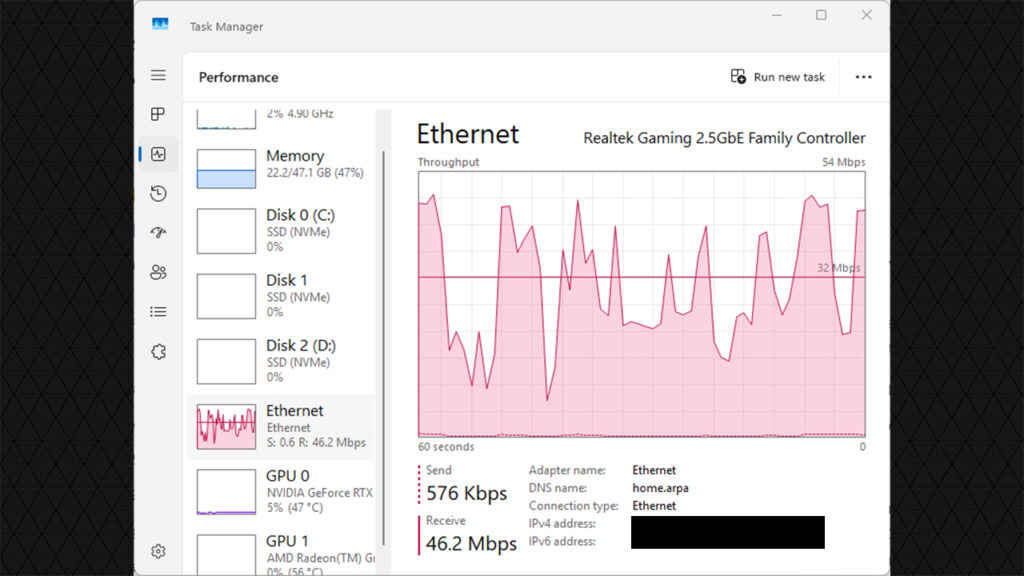
That means a solid 100 Mbps home plan should be more than comfortable for most use cases, and even a base 30 Mbps plan could be workable with some compromises. The one catch is that GeForce NOW does not like idle users lingering too long. Stay still for too long and the session will eventually boot you out.
Streaming quality is not all-or-nothing
NVIDIA gives users several profiles to work with: Balanced, Data Saver, Competitive, Cinematic, and Custom. The default is to let GeForce NOW decide the right mix, but the profiles are transparent enough that it is easy to see what changes when switching between them.
Competitive mode is the clearest example. It drops resolution to 1920×1080, raises the frame-rate cap to 360, disables V-Sync, keeps NVIDIA Reflex on, and drops colour depth to 8-bit. L4S stays on throughout, and most profiles prioritise latency through auto-adjust, with Cinematic standing out as the one that tilts more heavily towards image quality.
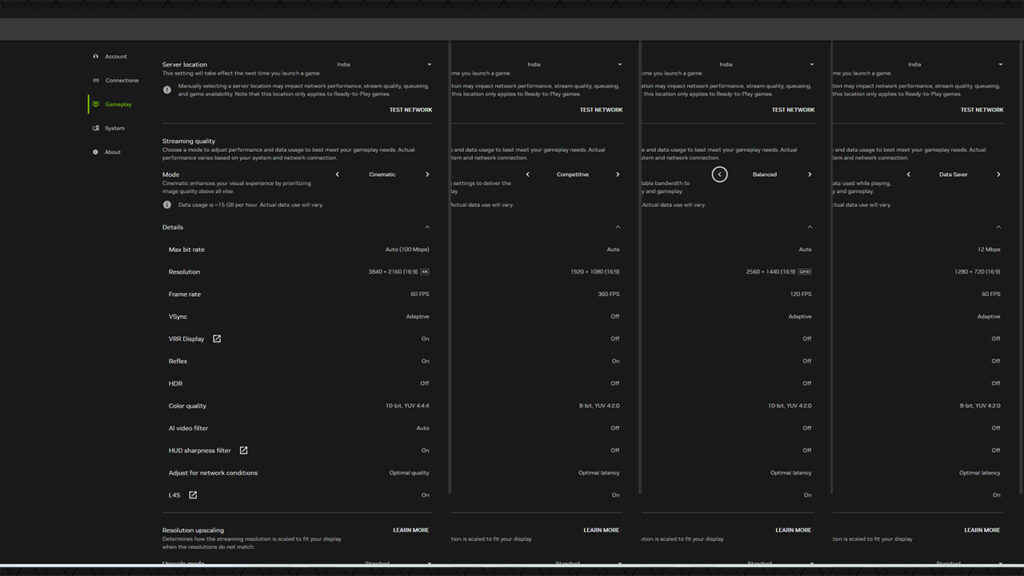
Cinematic is plainly the best-looking mode. On a larger display, the uplift is visible enough to matter, particularly in texture clarity and overall sharpness. On smaller screens, though, the drop when switching to Balanced or Competitive is less obvious than one might expect. That is useful because it means the user does not always have to burn bandwidth and headroom chasing the prettiest preset if the display itself is the limiting factor.
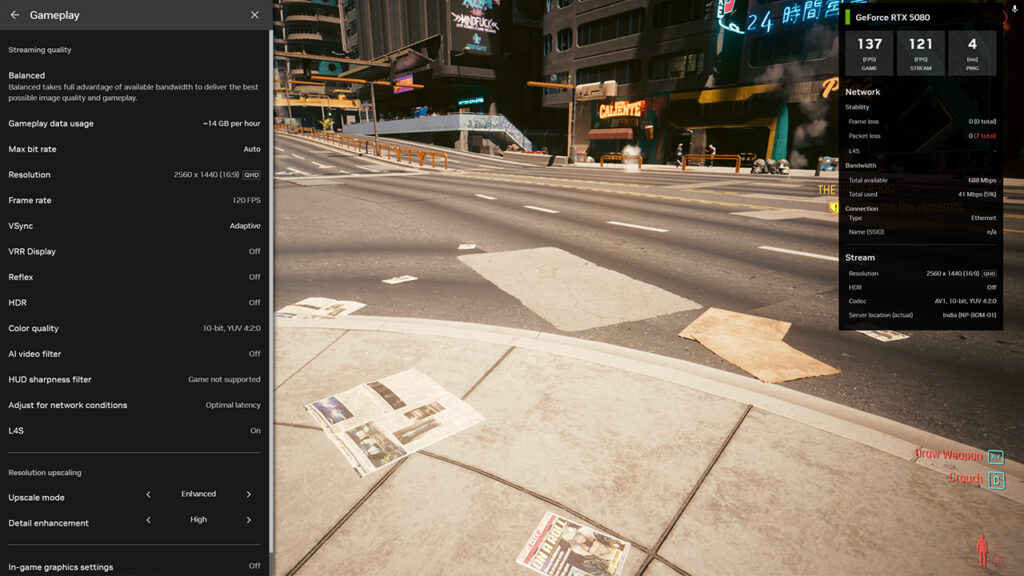
NVIDIA describes Cinematic Quality Streaming as the mode that prioritises image quality and adds support for higher-fidelity streaming features such as YUV 4:4:4, AI filtering, sharper HUD rendering and up to 100 Mbps bitrate, depending on the device.
4K streaming works, and it feels normal
4K streaming was enabled in the Cinematic profile and, in practice, it worked exactly as hoped. The stream held at 4K, image quality was excellent, and the whole thing felt far more normal than cloud gaming often does. There was no constant awareness of looking at a stream rather than a local feed. That alone is a strong endorsement.
Perhaps more importantly, saves persisted as though the game were running on a local PC. That is a subtle point, but a crucial one. Any cloud service that wants to become part of a regular gaming routine needs to disappear into the background, and GeForce NOW came closer to doing that than expected.
Install-to-Play is more than a gimmick
Install-to-Play sounds odd at first because cloud gaming is supposed to remove the need to install anything. In practice, it is one of the more interesting additions here. NVIDIA says Install-to-Play expands the service with another 2,000-plus titles beyond the usual ready-to-play catalogue, and it mirrors the experience of downloading a game to local storage in the cloud.
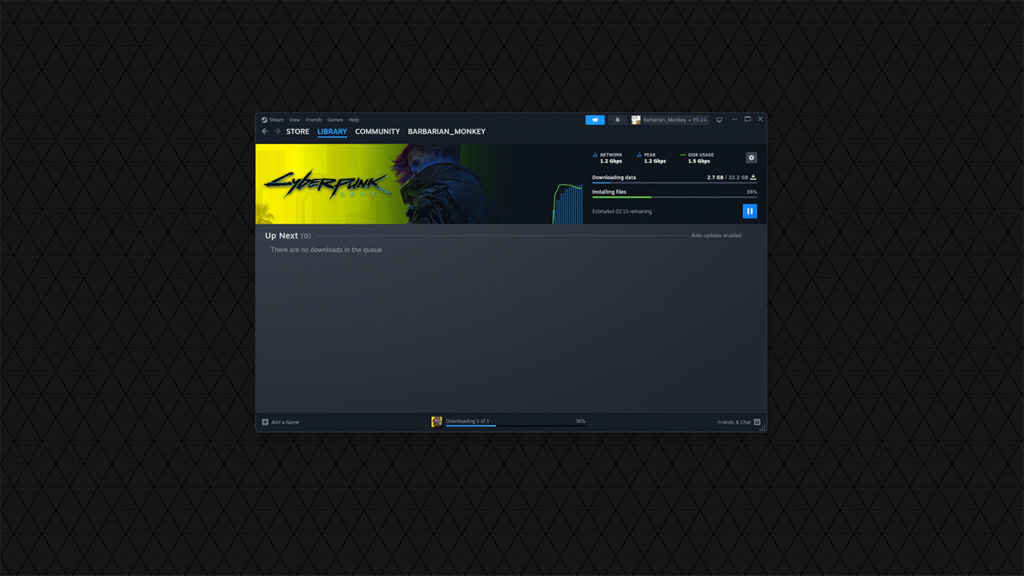
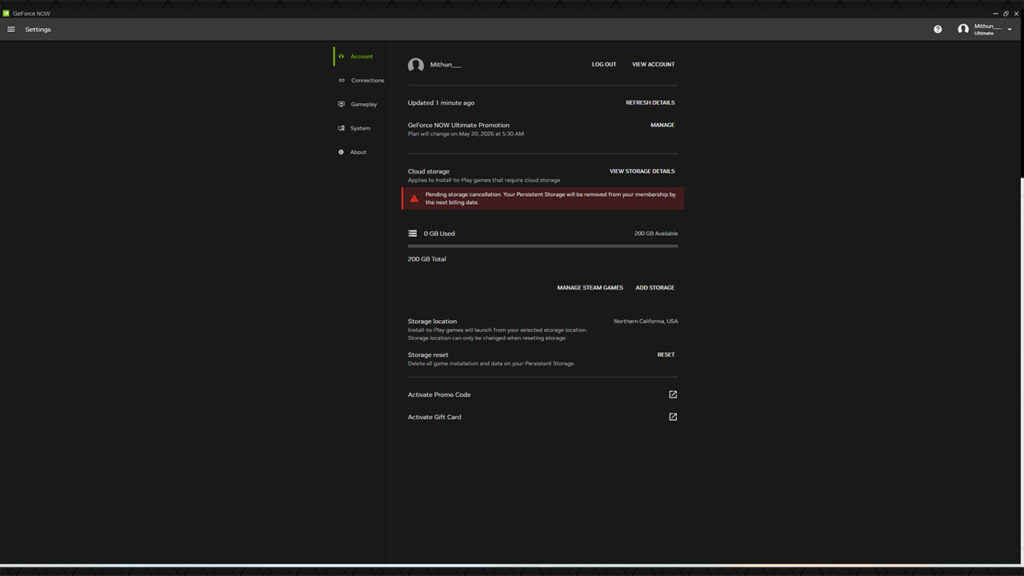
That broad description matched what showed up in testing. Cyberpunk 2077 took a little over two minutes to download, with Steam transfers touching roughly 1.2 Gbps. On the Ultimate tier, users get 200GB for Install-to-Play games, and the feature makes immediate sense for premium members who want access to a bigger slice of their Steam library rather than just the pre-positioned titles. It is a nice feature, and more importantly, it feels useful rather than experimental.
Stability is not a problem here
A lot of cloud services look impressive for ten minutes and then start wobbling once the session stretches out. That did not happen here. Over three hours of continuous gameplay, the connection remained extremely stable. There were no reconnections, no visible quality drops, and no creeping sense that the session was becoming less dependable over time.
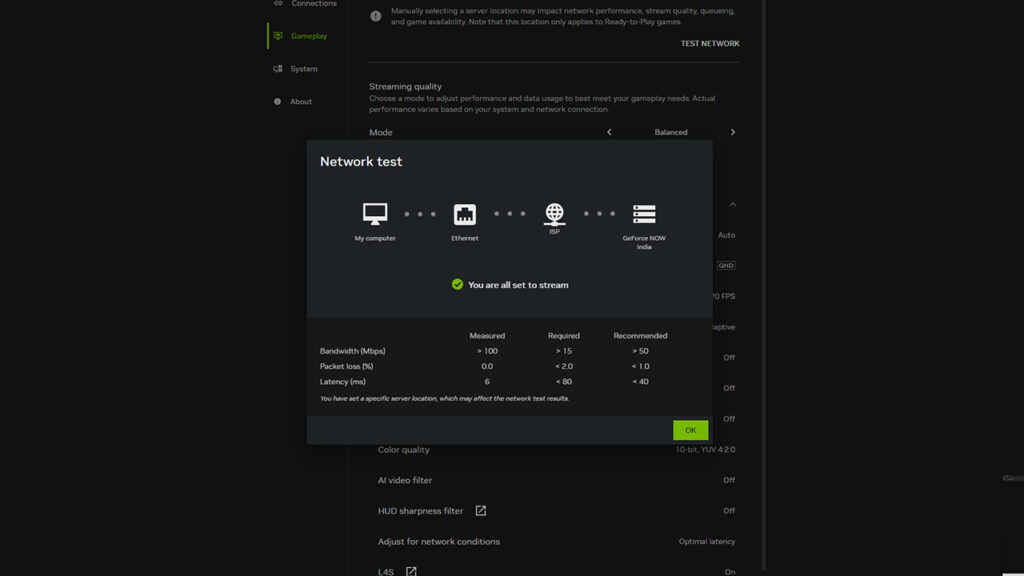
That sort of long-session consistency is arguably more important than top-line 360 FPS claims because it is what determines whether people will trust the service for actual use rather than one-off demos.
The India angle is what makes this compelling
This is where the service becomes genuinely interesting. On a good connection, both Ethernet and Wi-Fi delivered the same latency figures. That clearly depends on router quality and physical proximity, but in a strong home setup it means users do not necessarily need to be hard-wired all the time to get a premium experience.
More broadly, the economics are better than expected. A popular ISP such as Reliance’s lower-end plans may be a little tight for the full-fat GeForce NOW experience, but a 100 Mbps plan in the ₹699 range is enough to make the service feel realistic rather than indulgent. Most major ISPs now offer similar mid-tier broadband packages, which means the barrier to entry is not as severe as it might have been even a couple of years ago.
GeForce NOW versus Xbox Cloud Gaming
GeForce NOW’s India beta pricing is its sharpest surprise. The ₹999 Performance 90-day pass works out to roughly ₹333 per month, while the ₹1,999 Ultimate 90-day pass comes to around ₹666 per month. That makes it dramatically cheaper than Xbox Game Pass Ultimate at ₹1,389 per month.
| Service | India price | Effective monthly cost | What you get |
| GeForce NOW Performance beta pass | Rs 999 / 90 days | ~ Rs 333 | Cloud streaming access, user-owned games |
| GeForce NOW Ultimate beta pass | Rs 1,999 / 90 days | ~ Rs 666 | Higher-end cloud streaming, RTX 5080-class features where supported, user-owned games |
| GeForce NOW persistent storage add-on | Rs 299 / 90 days | ~ Rs 100 | 200GB persistent storage add-on |
| Xbox Game Pass Ultimate | Rs 1,389 / month | Rs 1,389 | Cloud gaming plus a bundled content library |
But this is not a like-for-like contest. Xbox’s cloud pitch wraps streaming together with a subscription library, while GeForce NOW is fundamentally a cloud PC service built around games users already own across storefronts such as Steam, Epic, Xbox, Ubisoft and others. So GeForce NOW wins on introductory pricing, while Xbox still holds the simpler bundled-content advantage. NVIDIA’s own positioning reflects that distinction, framing GeForce NOW as an open platform that connects to the user’s existing game libraries.
Verdict
GeForce NOW’s India beta is far better than it has any right to be this early. The local server footprint makes a huge difference, latency is excellent, image quality is strong, long-session stability is impressive, and Install-to-Play adds genuine flexibility. There are still rough edges around login behaviour and occasional Steam-related friction, but the underlying service already feels mature.
More importantly, the pricing is unusually aggressive. At roughly ₹666 per month for the Ultimate beta pass, GeForce NOW becomes a very serious option for anyone who already owns a decent PC game library and wants to play across weaker hardware without buying an expensive gaming rig. It does not replace Xbox Game Pass Ultimate because the value proposition is completely different, but it does carve out a very credible lane of its own. For India, that may be enough. For PC players with solid broadband and an existing library, GeForce NOW is is genuinely impressive.


