Big Tech trims workforce while pouring billions into AI infrastructure
Layoffs justify record-breaking data center investments across Amazon, Meta, and more
The AI revolution grows richer in compute, poorer in people

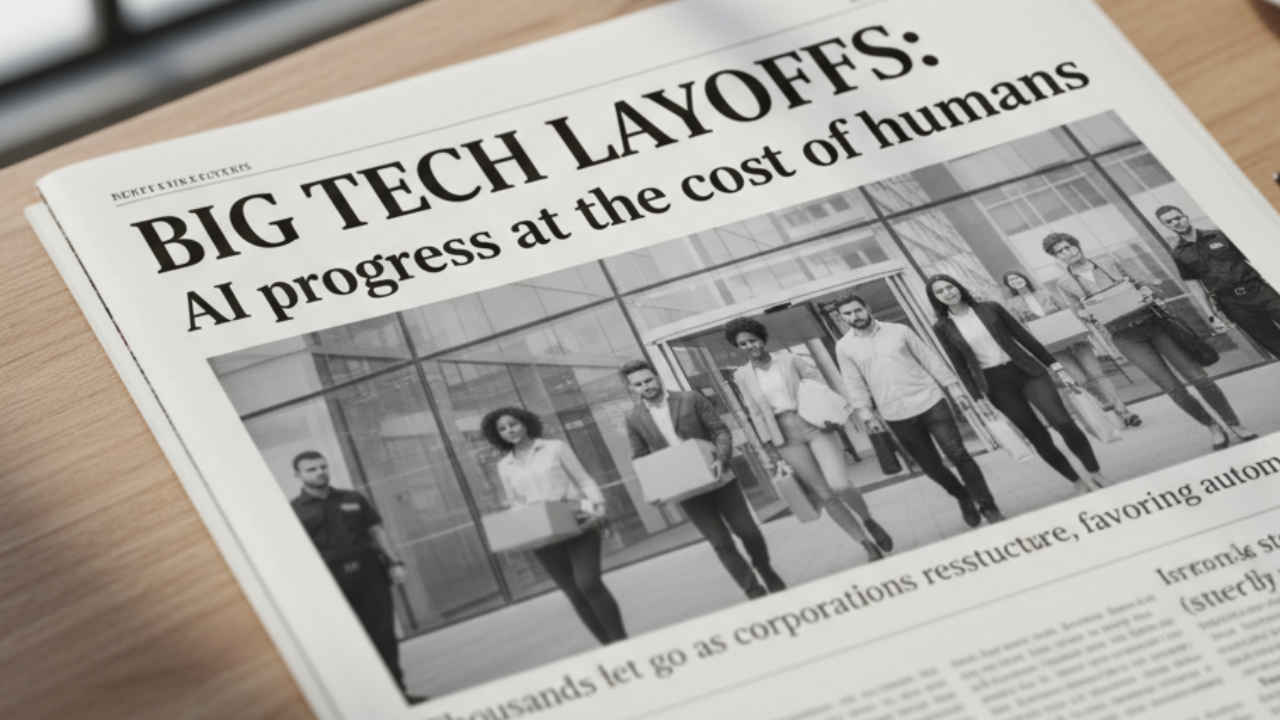
Beyond glittering product launches, a pattern has emerged in US-based big tech companies for 2025. For all the talk about innovation and efficiency, the real story this year has been one of subtraction. Tens of thousands of human jobs have vanished from balance sheets. And in their place, billions of dollars have quietly been put aside for AI investment.
 Survey
Take Amazon. The company recently confirmed plans to cut “approximately 14,000 roles,” saying it needs to be “organised more leanly” to seize the opportunity provided by AI. Beth Galetti, senior vice president at Amazon, told staff the move would make the company “even stronger” by shifting resources “to ensure we’re investing in our biggest bets and what matters most to our customers’ current and future needs.”


In a slight contrast, Microsoft insists that efficiency gains from AI were “not a predominant factor” in its 15,000 layoffs. “The notion that AI productivity boosts have somehow already led to this, I don’t think that’s the story in this instance,” said Brad Smith, Microsoft’s vice chair and president, earlier in July 2025. Yet in the same breath, Smith acknowledged that surging capital expenditure – $80 billion in its last fiscal year – has “created pressure to rein in operating costs, which in the tech sector are more about the number of employees than anything else.”
Also read: Big tech layoffs amidst top AI talent hunt: Tech job market gone crazy?
At Google, the numbers are starker. The company has eliminated 35% of managers overseeing small teams, as CEO Sundar Pichai pushes the company “to be more efficient as we scale up so we don’t solve everything with headcount.” It underscores quite prominently that Google’s relentless march to stay competitive with AI-first rivals like OpenAI isn’t just about speed – it’s about streamlining the human factor.
Intel CEO Lip-Bu Tan has called the 24,000 job losses – about 22% of its workforce – part of a strategy “to right-size the company to align with current demand trends and improve efficiency.” The pivot, he insists, is toward AI chips and infrastructure, with “no blank checks” in spending. The company has paused several factory projects, channeling resources into AI and high-performance computing instead.
Then there’s Meta, where Mark Zuckerberg’s “year of efficiency” has become an era unto itself. Meta announced 3,600 job cuts, roughly 5% of its global workforce, while nearly doubling AI-related spending this year. Zuckerberg calls it “performance-based,” the company’s way of raising the bar. Meta’s AI “superclusters” are under construction, as it prepares for what he calls “the era of personal superintelligence.”
Across the board, big tech’s logic couldn’t be more similar. AI is expensive, and people are expendable. Training large language models and building datacenters isn’t a side project anymore – it’s the new industrial revolution, complete with its own human displacement narrative.

Big tech’s capital spending has exploded into a kind of arms race in steel, silicon, and power all through 2025. Amazon is pouring tens of billions into AI datacenters this year alone, including $11 billion in Indiana and $10 billion in North Carolina, while Meta’s $65 billion infrastructure blitz will house 1.3 million NVIDIA GPUs in facilities with the power draw of two nuclear plants. Google’s $15 billion AI hub in Vishakhapatnam in India is part of an $85 billion global outlay, and Microsoft’s $80 billion push through 2028 aims to double its datacenter footprint. Intel, meanwhile, is retooling its factories to serve this same demand.
It’s tempting to see this as simple economic calculus, where big tech companies worth hundreds of billions of dollars (some even trillions) are trading salaries for more servers, and office cubicles for enhanced cooling towers. Thanks to 2025’s reality check, the tech industry that once sold us dreams of empowerment now measures progress in megawatts and GPUs. In a world where the cloud keeps expanding while payrolls shrink, AI’s biggest beneficiaries may be the companies that own the land, the power, and the silicon.
Also read: Meta AI layoffs: Big tech’s hell bent on chasing AI dream at human cost
 Follow Us
Jayesh Shinde
Executive Editor at Digit. Technology journalist since Jan 2008, with stints at Indiatimes.com and PCWorld.in. Enthusiastic dad, reluctant traveler, weekend gamer, LOTR nerd, pseudo bon vivant. View Full Profile


