

Intel Core Ultra 7 270K Plus Desktop Processor Review
 Follow Us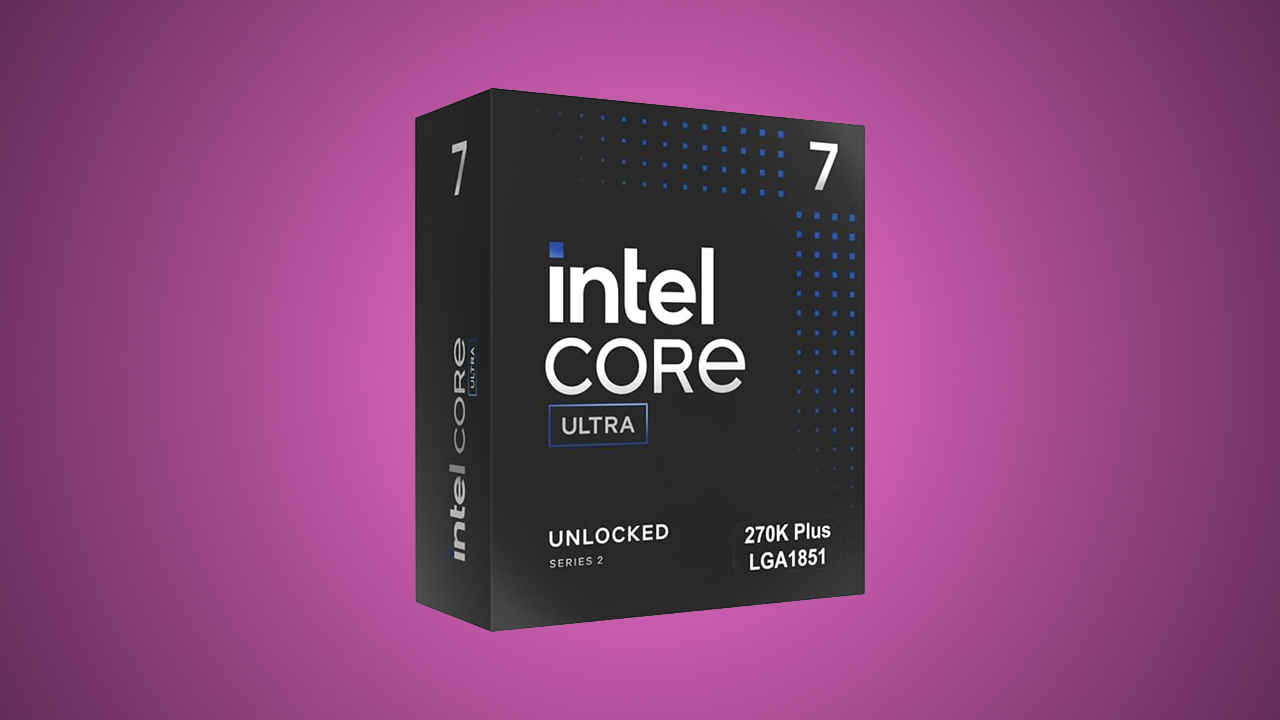

The Intel Core Ultra 7 270K Plus might have come out of the blue, but it feels like the desktop Arrow Lake part that should have arrived first. It’s not exactly the clean-sheet rethink of Intel’s mainstream performance formula but it certainly does come across as a more assertive version of it. The Core Ultra 7 270K Plus brings the core count up to 24 with an 8-Performance plus 16-Efficiency core layout, keeps boost clocks high, and leans on platform refinements such as faster die-to-die communication and Intel’s new Binary Optimization Tool to shore up gaming and responsiveness. From our testing, the 270K Plus is clearly competitive in productivity, and far more convincing than the first wave of desktop Core Ultra chips, even if it still does not flatten AMD’s best X3D parts in every gaming scenario. However, when you put the pricing and performance together, you’ve got an underdog in the making.
Intel Core Ultra 7 270K Plus Specifications
The Intel Core Ultra 7 270K Plus is part of the desktop Arrow Lake refresh part launched on 23, March 2026. It packs 24 cores and 24 threads, split between 8 Performance cores and 16 Efficient cores, with a maximum turbo frequency of 5.5 GHz. The P-cores top out at 5.4 GHz, while the E-cores reach 4.7 GHz. Cache allocation is healthy too, with 36 MB of Intel Smart Cache and 40 MB of total L2 cache. Base power is rated at 125 W, while maximum turbo power reaches 250 W, which immediately tells you this is not a timid mid-range part.
| Intel Core Ultra 7 270K Plus Specifications | |||
| Intel | Intel | Intel | |
| Model | Core Ultra 9 285K | Core Ultra 7 270K Plus | Core Ultra 5 250K Plus |
| Price | 58900 | 30000 | 20000 |
| Socket | LGA 1851 | LGA 1851 | LGA 1851 |
| Codename | Arrow Lake-S | Arrow Lake-R | Arrow Lake-R |
| Foundry | TSMC | TSMC | TSMC |
| Core Process | 3 nm | 3 nm | 3 nm |
| Core Architecture | Lion Cove & Skymont | Lion Cove & Skymont | Lion Cove & Skymont |
| Die Size | 243 mm² | 243 mm² | 243 mm² |
| tCaseMax | 105°C | 105°C | 105°C |
| Launch Date | 24-Oct-2024 | 23-Mar-2026 | 23-Mar-2026 |
| Cores | 24 | 24 | 18 |
| – Big Cores | 8 | 8 | 6 |
| – Small Cores | 16 | 16 | 12 |
| Threads | 24 | 24 | 18 |
| Integrated Graphics | 1 | 1 | 1 |
| Integrated Graphics | Intel Xe-2 64EU | Intel Xe-2 64EU | Intel Xe-2 64EU |
| Integrated Graphics Cores | 4 | 4 | 4 |
| IG Base Frequency | 300 MHz | 300 MHz | 300 MHz |
| IG Turbo Frequency | 2000 MHz | 2000 MHz | 2000 MHz |
| Cache L1 | 112 | 192 | 192 |
| Cache L2 | 3 | 3 | 3 |
| Cache L3 | 36 | 36 | 30 |
| Big Core Base Frequency | 3.7 | 3.7 | 4.2 |
| Big Core Turbo Clock | 5.7 | 5.5 | 5.3 |
| Small Core Base Frequency | 3.2 | 3.2 | 3.3 |
| Small Core Turbo Clock | 4.6 | 4.7 | 4.6 |
| Max Memory Capacity | 192 | 256 | 256 |
| Rated Memory Clock Speed | 6400 | 7200 | 7200 |
| TDP | 125 | 250 | 125 |
Memory support goes up to DDR5-7200, the CPU exposes 24 PCIe lanes across PCIe 5.0 and 4.0, and it continues to use the LGA1851 platform. There is integrated graphics on board, plus a 13 TOPS Intel AI Boost NPU, while total platform AI throughput is rated at 36 TOPS. On sheer specification density, this is closer to an enthusiast chip wearing a slightly more sensible price tag.
Intel Core Ultra 7 270K Plus Test Rig
The review unit was tested on Gigabyte’s Z890 AORUS PRO ICE motherboard with 64GB of G.Skill Trident Z5 memory running at 7200 MT/s in a 2x 32 GB configuration. Storage duties were handled by a Kingston Renegade PCIe Gen 4.0 SSD, while cooling came from the Corsair iCUE Link Titan X360 RX LCD, which is a sensible pairing for a desktop processor that can pull up to 250W at full tilt. Power was supplied by the Cooler Master MWE Gold 850 V2. It is a well-balanced, modern test platform that gives the 270K Plus the kind of memory bandwidth and thermal headroom it needs to show what it can do without obvious platform bottlenecks getting in the way. Here’s the full specs:
- CPU: Intel Core Ultra 7 270K Plus
- Motherboard: Z890 AORUS PRO ICE
- RAM: 2x G.Skill Trident Z5 32 GB 7200 MT/s
- SSD: Kingston Renegade PCIe Gen 4.0 SSD
- Cooler: Corsair iCUE Link Titan X360 RX LCD
- PSU: Cooler Master MWE Gold 850 V2
Intel Core Ultra 7 270K Plus Performance
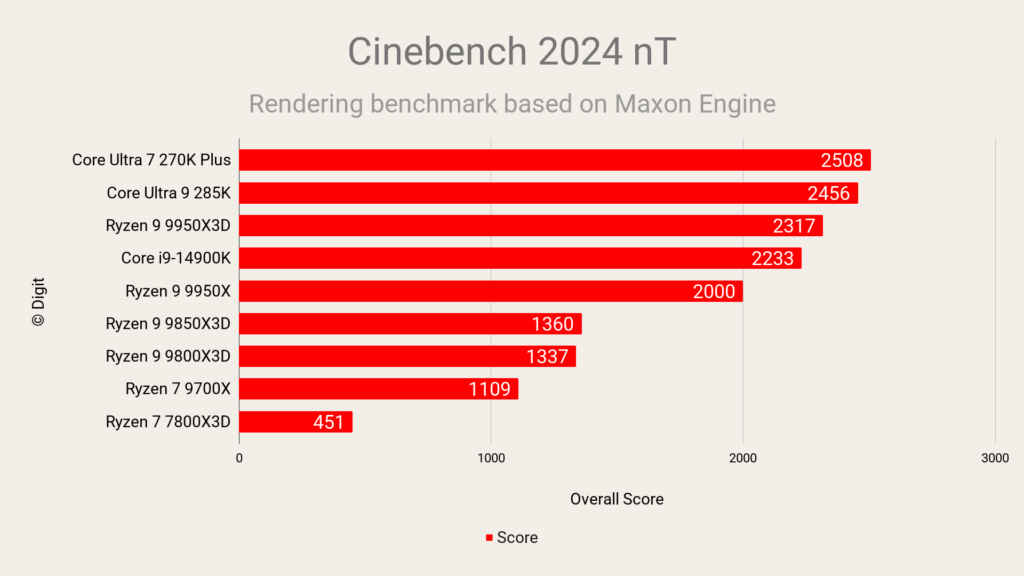
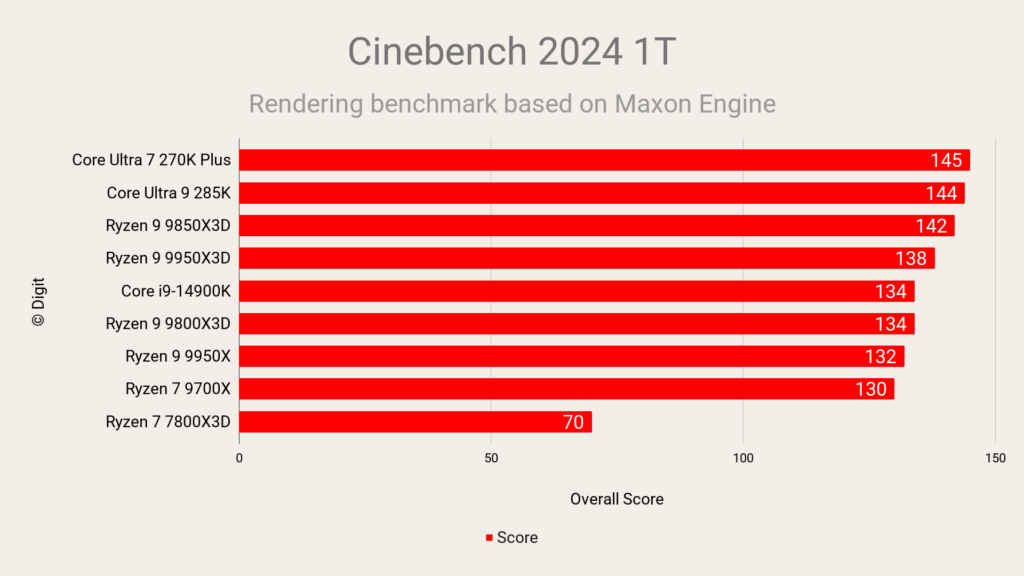
Cinebench 2024
Cinebench 2024 is based on Maxon’s Cinema 4D software, designed to evaluate a processor’s performance in rendering complex 3D scenes. It tests both single-core and multi-core capabilities, highlighting how efficiently a CPU handles multi-threaded tasks common in professional rendering workflows. The benchmark utilizes modern instruction sets and large datasets, providing an up-to-date assessment of CPU performance in contemporary applications.
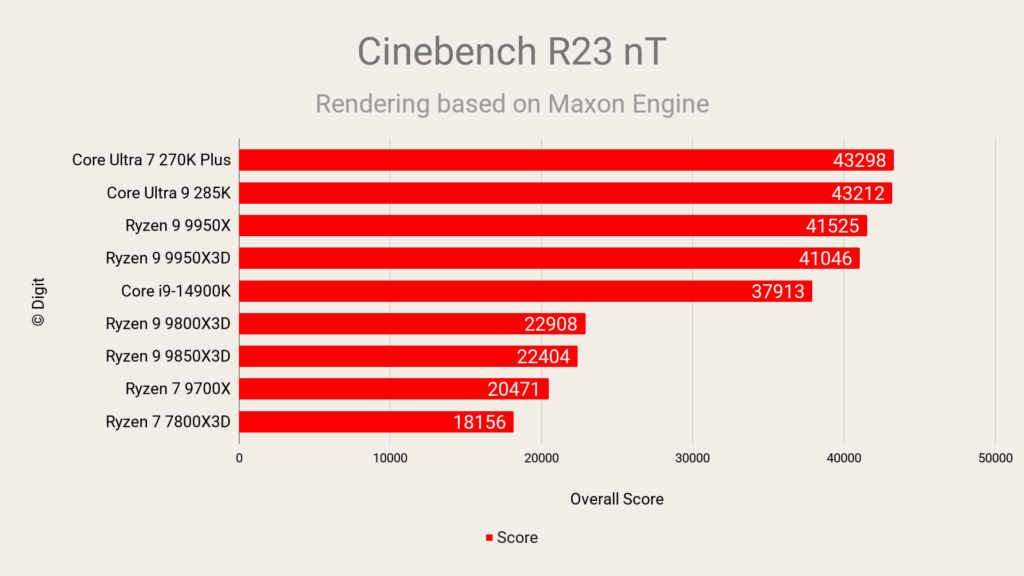
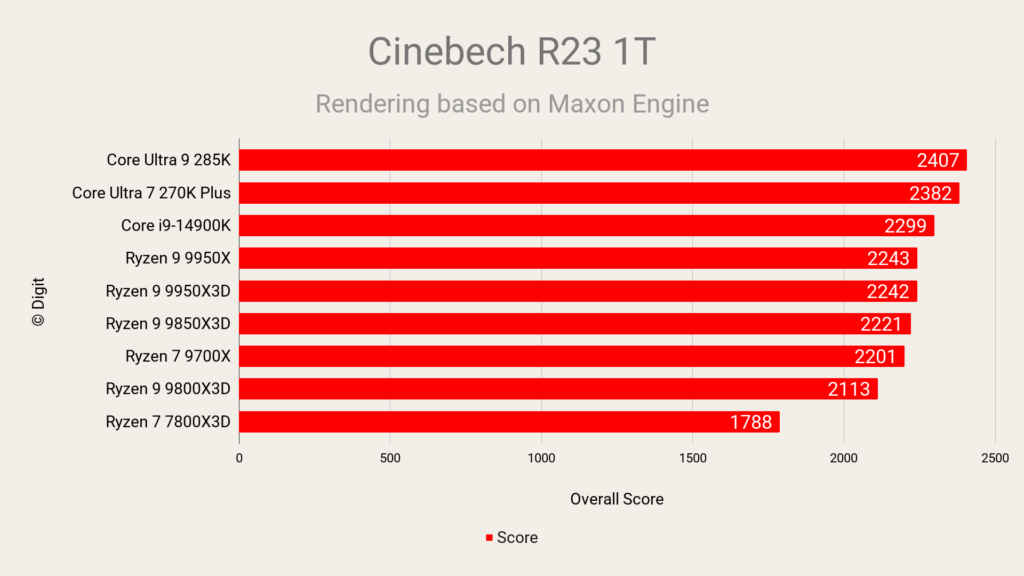
Cinebench R23
Cinebench R23 is the older version based on the same Cinema 4D engine and it too measures a processor’s ability to render photorealistic 3D scenes. Though replaced by Cinebench 2024, we retain it to compare against processors launched a few years prior. It also focuses on both single-threaded and multi-threaded performance, simulating real-world tasks relevant to content creators and professionals in 3D rendering.
Blender
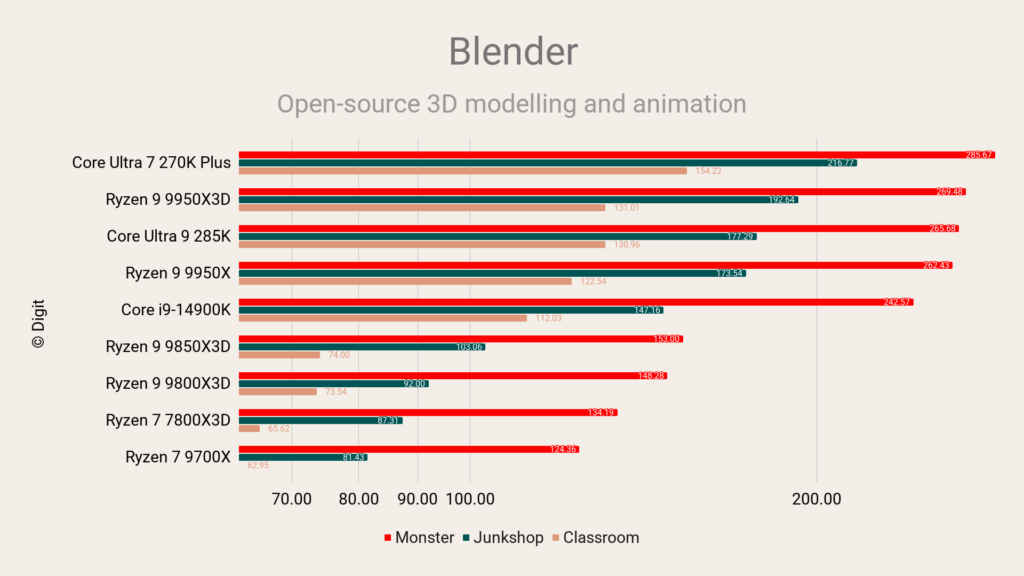
The Blender Benchmark assesses a processor’s performance by rendering scenes using Blender, a popular open-source 3D creation suite. It evaluates both CPU and GPU capabilities in handling complex rendering tasks. This benchmark provides insights into how well a processor performs in real-world 3D modeling, animation, and rendering scenarios. An interesting aspect is that it highlights the efficiency of different CPU architectures in multi-threaded workloads, as Blender can effectively utilize multiple cores. It’s particularly useful for professionals and enthusiasts relying on Blender, indicating how hardware upgrades might impact workflow efficiency and rendering times.
V-Ray
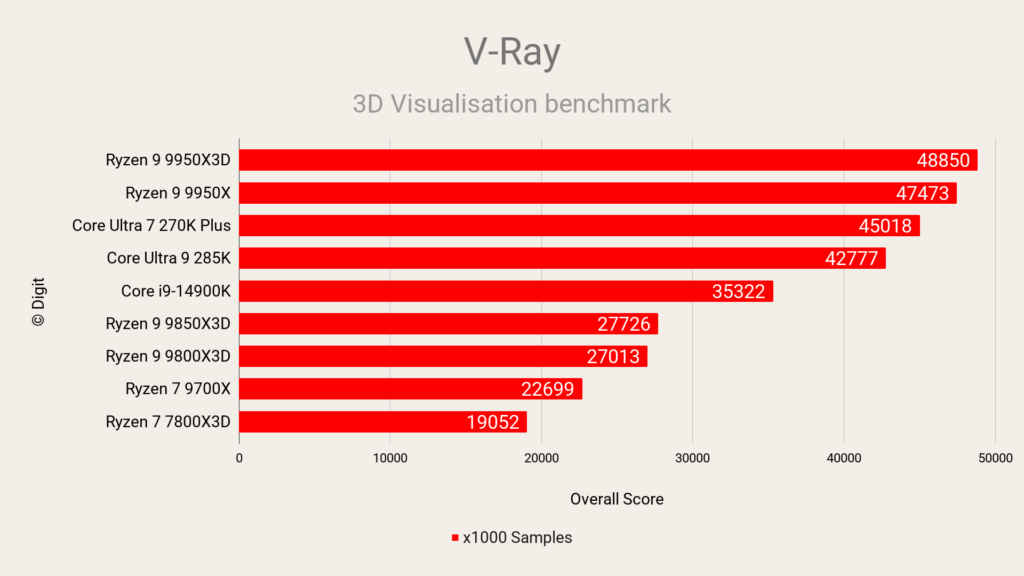
V-Ray is another benchmark that measures a processor’s performance in rendering but it uses the V-Ray engine, widely used in visual effects, architecture, and design industries. It tests both CPU and GPU rendering capabilities, focusing on multi-threaded performance and handling complex calculations involved in ray tracing. CPUs with higher core counts and multi-threading technology tend to excel here as V-Ray efficiently utilises available threads.
WinRAR
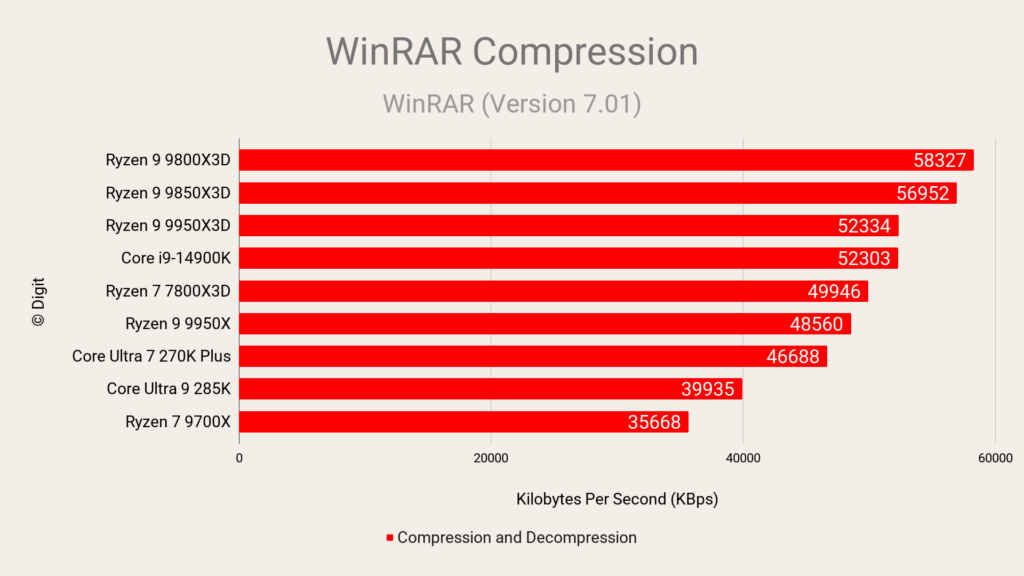
WinRAR Benchmark evaluates a processor’s performance in data compression and decompression tasks, common in file archiving and management. It tests single-threaded performance, memory bandwidth, and latency, as these factors influence compression speed. While WinRAR isn’t fully optimized for multi-core CPUs, processors with higher Instructions Per Cycle (IPC) and clock speeds perform better. For more modern algorithms, we use 7-Zip.
AIDA64
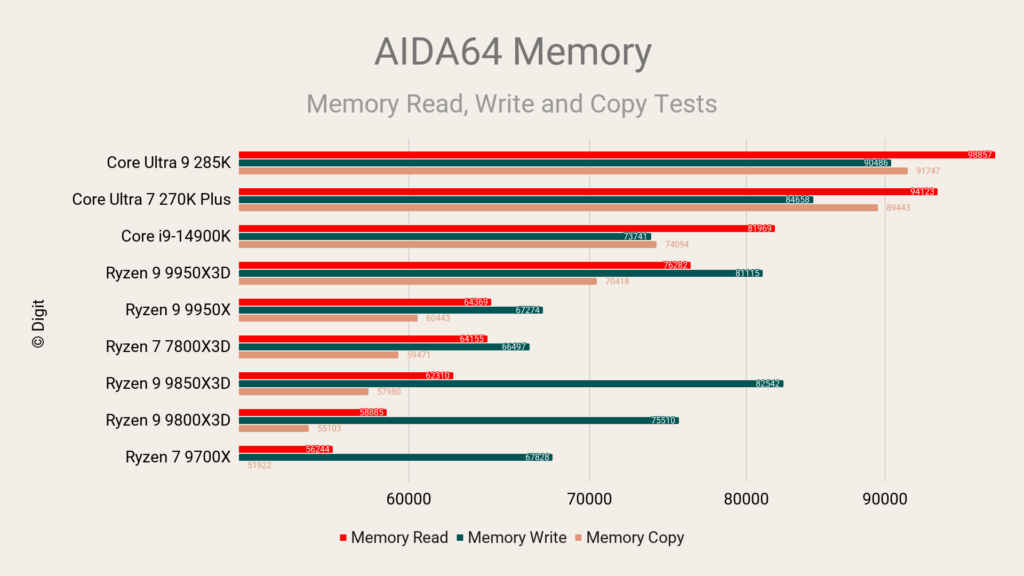
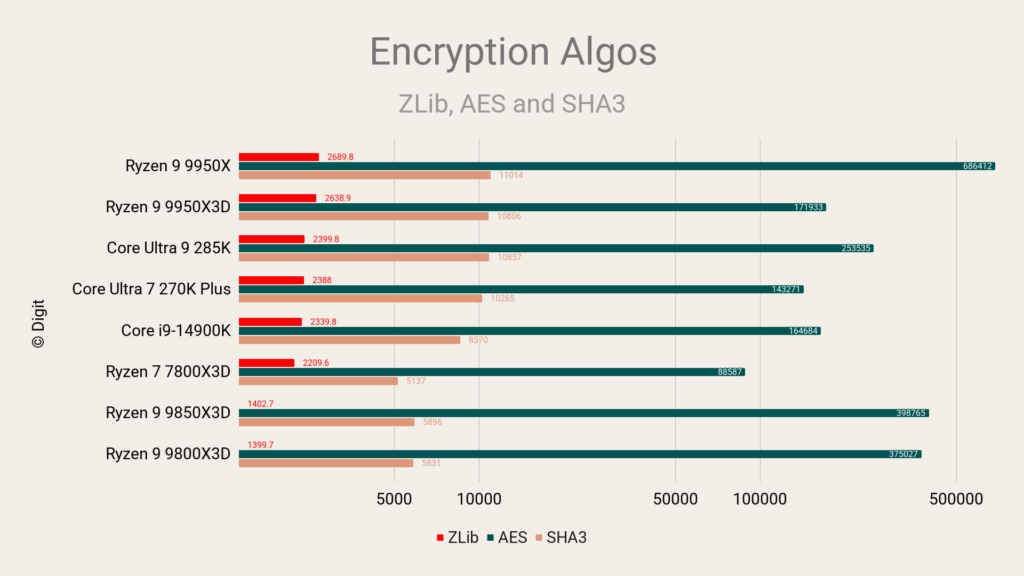
AIDA64 Memory Benchmark measures the memory bandwidth and latency of a system, highlighting how quickly data transfers between the CPU and RAM. It tests read, write, and copy speeds, providing insights into the efficiency of the memory subsystem, including RAM speed, timings, and memory controller performance. AIDA64 also has benchmarks to evaluate how well a processor can handle AES, ZLib and SHA3 encryption and decryption tasks.
y-cruncher
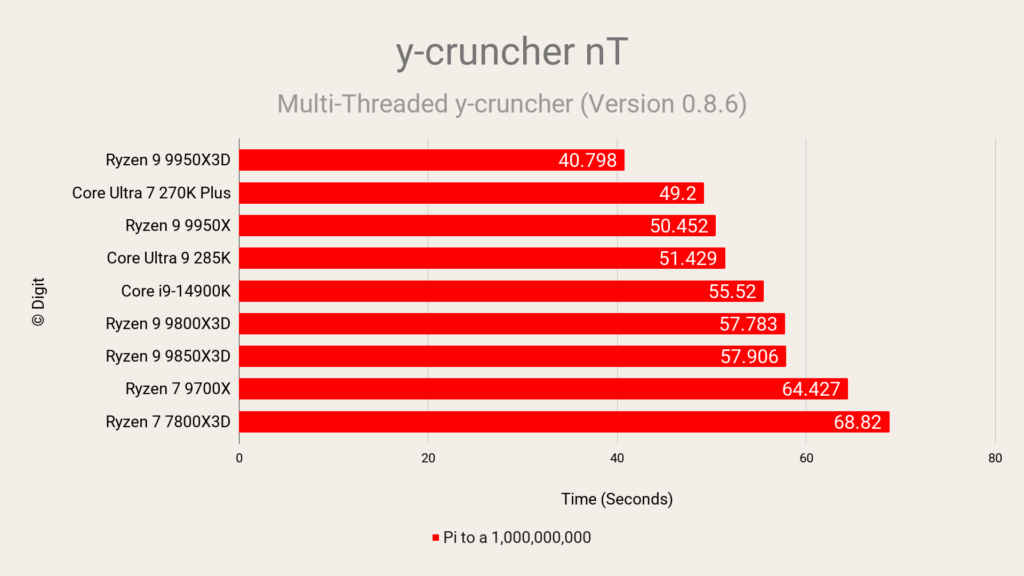
The y-cruncher benchmark computes mathematical constants like Pi to a high number of digits—in this case, 2.5 billion—testing a processor’s multi-threaded performance and memory subsystem under heavy computational load. It stresses the CPU’s integer and floating-point units, cache hierarchy, and memory bandwidth. It’s particularly useful for evaluating system stability under sustained heavy workloads, making it valuable for users who are overclocking their systems.
Procyon Office
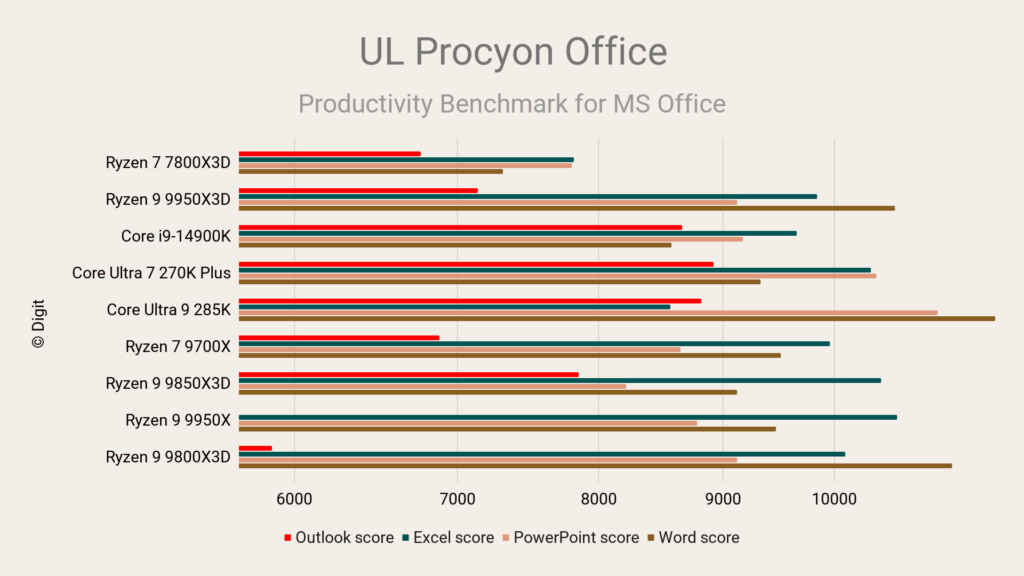
The Procyon Office Benchmark measures a processor’s performance in real-world office applications like the Microsoft Office suite, testing tasks such as document editing, spreadsheet calculations, and presentation creation. It focuses on both single-threaded and multi-threaded performance, providing insights into how a CPU handles everyday productivity tasks.
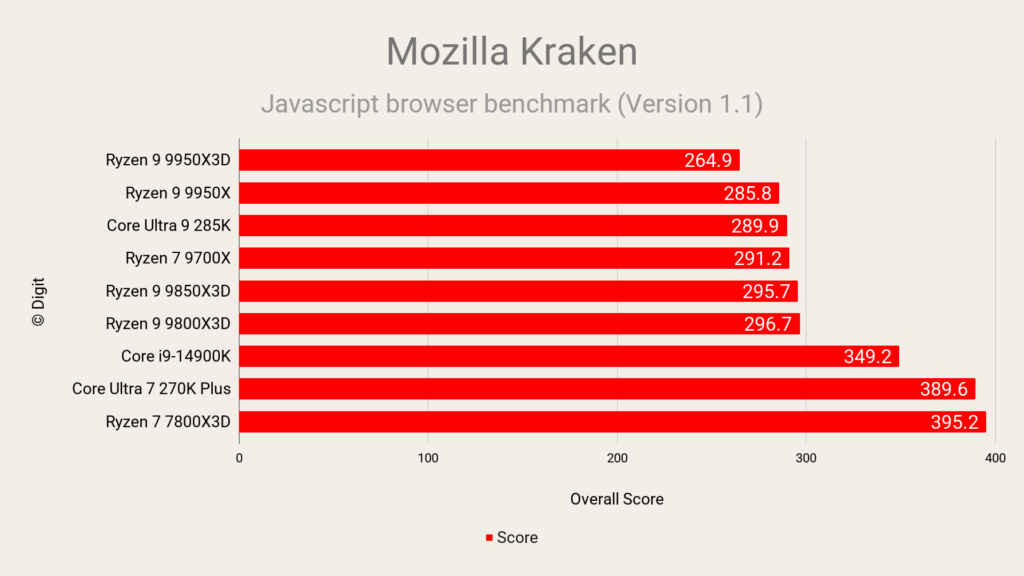
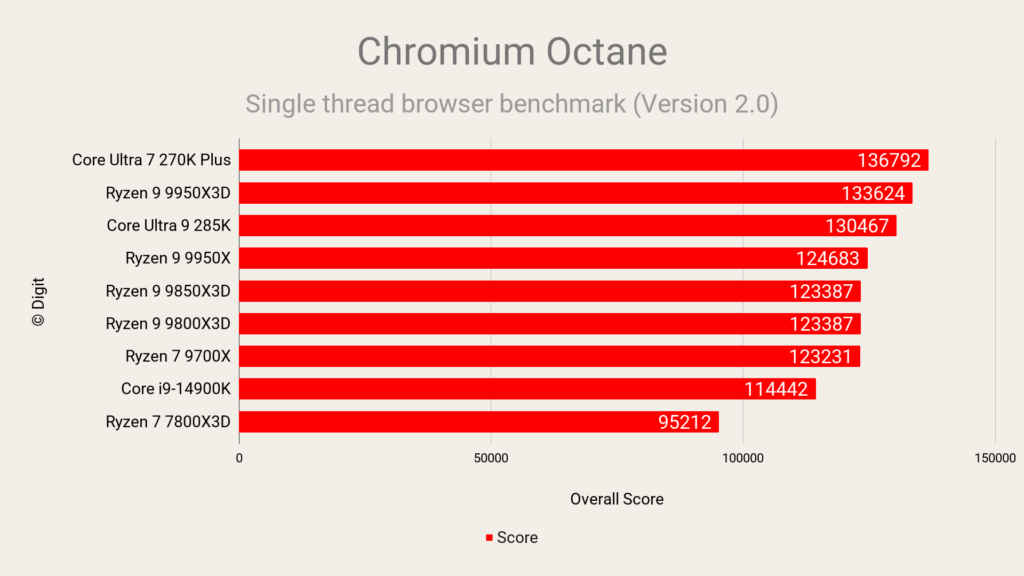
Mozilla Kraken & Google Octane
Mozilla Kraken and Google Octane are JavaScript benchmarks evaluating a processor’s performance in executing complex web-based scripts, reflecting real-world web application usage. It tests single-threaded performance and the efficiency of a CPU’s instruction pipelines in handling dynamic scripting languages.
Procyon AI Computer Vision
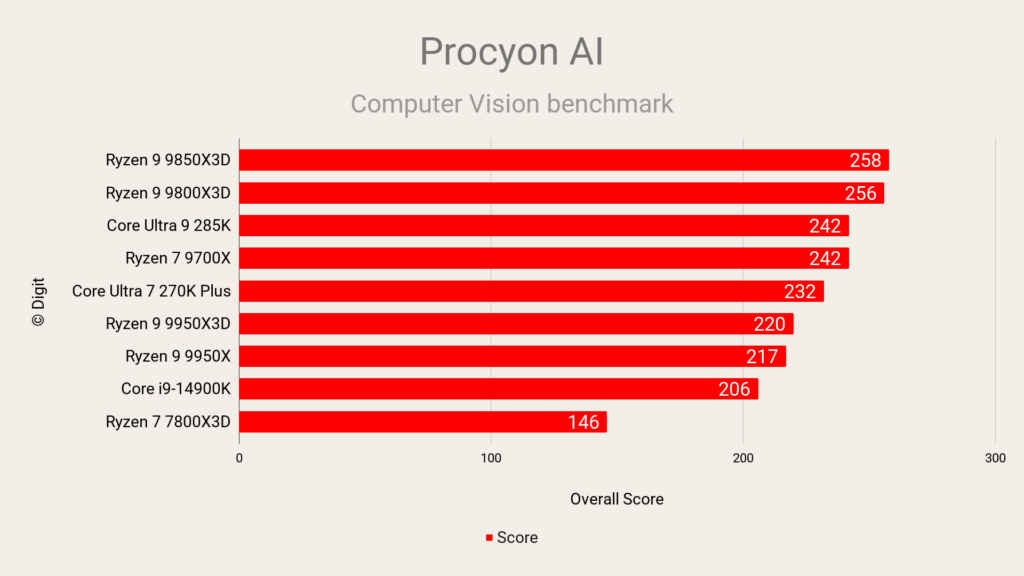
The UL Procyon AI Computer Vision benchmark measures the performance of AI inference engines to understand how well processors can handle machine-vision tasks using popular neural networks.
3DMark Time Spy (iGPU)
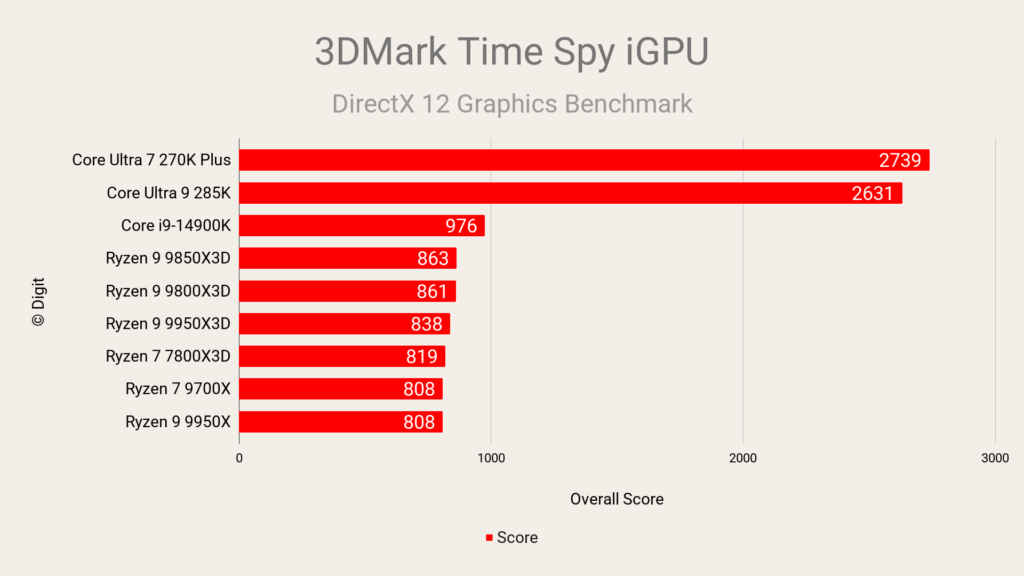
3DMark Time Spy is a DirectX 12 benchmark evaluating graphics performance. We use it primarily to test the relative performance of the iGPU to discrete GPUs and where iGPUs stand amongst their peers. With both companies improving their integrated graphics stack, it allows us to measure how well the iGPU performs and if it can handle popular eSports titles.
Intel Core Ultra 7 270K Plus Thermals and Power
Thermally, the Core Ultra 7 270K Plus behaved better than its power envelope might suggest. In this setup, CPU package temperature averaged 57°C and peaked at 80°C, which is a tidy result for a desktop chip rated to turbo up to 250W.
Power figures were more revealing. Average package power came in at 230W, with a peak of 250W, effectively brushing right up against Intel’s official turbo ceiling. That tells the story of this processor rather neatly. The 270K Plus is willing to spend power to hold performance, and it expects the rest of the platform to keep up. The upside is that thermals remain manageable with a competent 360 mm liquid cooler. The downside is obvious too: this is not a chip for bargain cooling or casual airflow planning. It runs under control, but it absolutely likes to eat. Intel officially rates the part at 125 W base and 250 W maximum turbo power, and these readings line up very closely with that behaviour.
Verdict
The Intel Core Ultra 7 270K Plus lands as a much more convincing desktop Core Ultra processor than the 265K ever was. It looks stronger on paper, feels better balanced in the current desktop market, and brings the sort of multi-threaded weight and platform features that make sense in a premium mainstream build. It fixes several of the earlier chip’s weak spots, especially in productivity and in gaming uplift versus the original Arrow Lake desktop parts, though AMD’s X3D lineup still keeps a grip on the outright gaming crown in a fair number of titles. That said, this test unit’s thermal and power behaviour shows that Intel has achieved its gains by letting the chip run hard and demanding proper cooling. For builders who want a modern Intel desktop processor with high core counts, fast DDR5 support, integrated graphics, NPU capability and plenty of headroom for serious work, the 270K Plus is easy to take seriously. It is not flawless, but it is finally compelling.


