
Portable AC vs Desert vs Tower Air Coolers: Which one takes less electricity and is more practical for your home
 Follow Us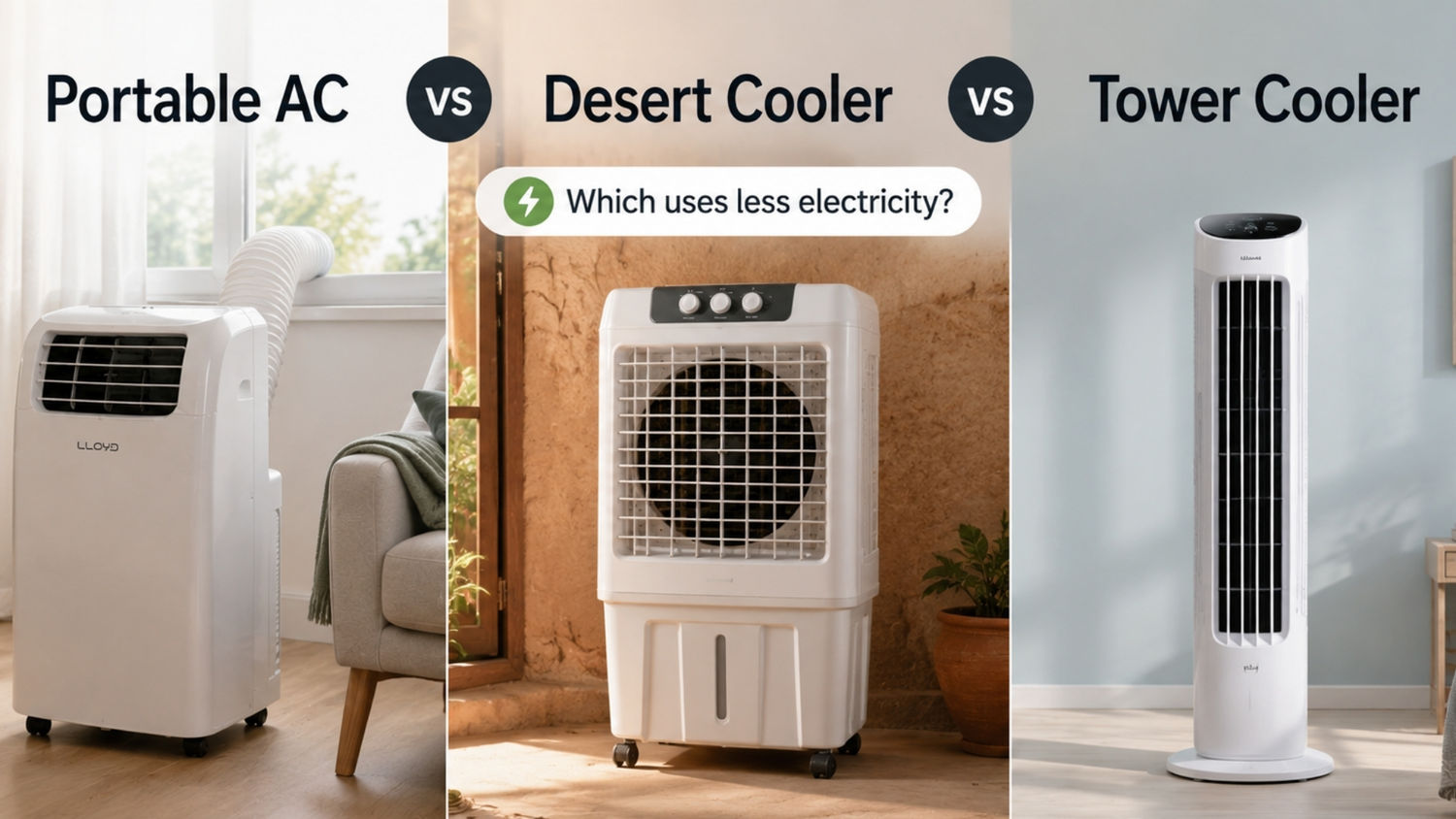

India’s summer season is growing more intense every year and the electricity bills are climbing ever so steadily, especially for homes that are running cooling appliances for several hours a day. If you are someone who cannot or does not want to install an air conditioner (AC) be it a split or window unit, there are other alternatives available in the market. Specifically, there are three options: portable AC, desert air coolers and tower air coolers.
 Survey
All three work differently, suit different room types and climates and cater to different budget segments. The confusion arises because the cheapest appliance to buy is not always the cheapest to run and the most powerful option is not always the most practical for the space you have. The right choice also depends as much on your local climate as your budget. So let’s talk about power consumption, cooling performance, climate suitability and price so you can make a well-informed decision.
Portable AC vs desert cooler vs tower cooler: How do they work
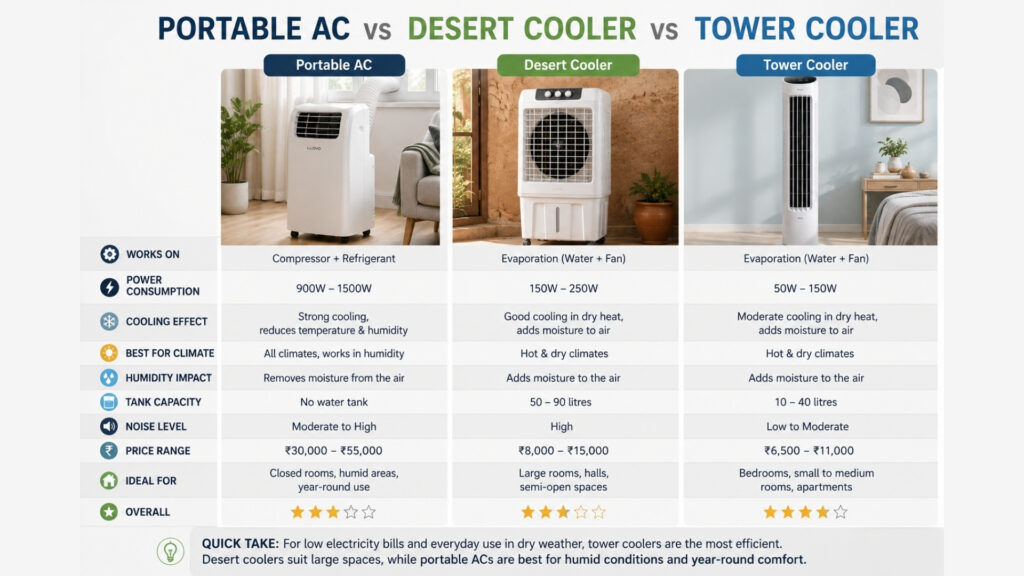
A portable AC uses a compressor and refrigerant to extract heat from the room and expel it outside through an exhaust duct. It actively reduces temperature and controls humidity regardless of outdoor conditions.
Desert and tower air coolers work on an entirely different principle. They pull warm air across water-soaked pads, cooling it through evaporation before circulating it into the room. This process adds moisture to the air which is an advantage in dry, hot conditions and a significant drawback when humidity is already high.
Power consumption
A portable AC typically draws 900 W–1,500 W, while a desert air cooler uses 150 W–250 W and a tower air cooler uses just 50 W–150 W, consuming around 80–90% less electricity than a portable AC under comparable conditions.
So a desert and a tower cooler have a direct and significant impact on your electricity bill over a month of daily use.
Portable AC vs desert cooler vs tower cooler: Cooling and price
Air coolers are effective only in hot, dry conditions. Across much of northern and central India during the dry summer months, both tower and desert coolers perform well and use a fraction of the electricity a portable AC would.
In humid conditions and the monsoon season, coolers add moisture to already-humid air, making the room feel considerably worse rather than better. A portable AC is the only practical option when humidity is high, since it removes moisture from the air while cooling it.
Tower air coolers are the most practical for standard indoor use. They are compact, fit easily into a corner and are designed for bedrooms and small to medium living spaces. The prices typically range from Rs 6,500–11,000.
Desert air coolers suit large rooms, halls or semi-open spaces where there is continuous fresh air circulation. Their large water tanks (50–90 litres) and considerable footprint make them impractical for most urban apartments. The prices range from Rs 8,000–15,000.
Portable ACs are the most expensive option at Rs 30,000–55,000 upfront, with significantly higher running costs over a full cooling season.
Which one should you buy?
For most urban apartments during dry summer months, a tower air cooler is the practical first choice. It has low running costs, a compact design and an accessible purchase price. A desert cooler works well in larger, well-ventilated spaces, but its bulk and water requirements make it unsuitable for most small rooms.
A portable AC makes sense only when cooling is needed in a closed room during humid weather or when consistent cooling is required regardless of outdoor conditions and a fixed AC is not an option. For dry-season cooling in a typical room, the running cost difference over the summer makes it difficult to justify.
Also Read: Split vs window vs portable AC: Which one consumes more electricity and why


