
DITAA 2026: We are at least 10 years away from being real innovators, says India’s appliance industry executives
 Follow Us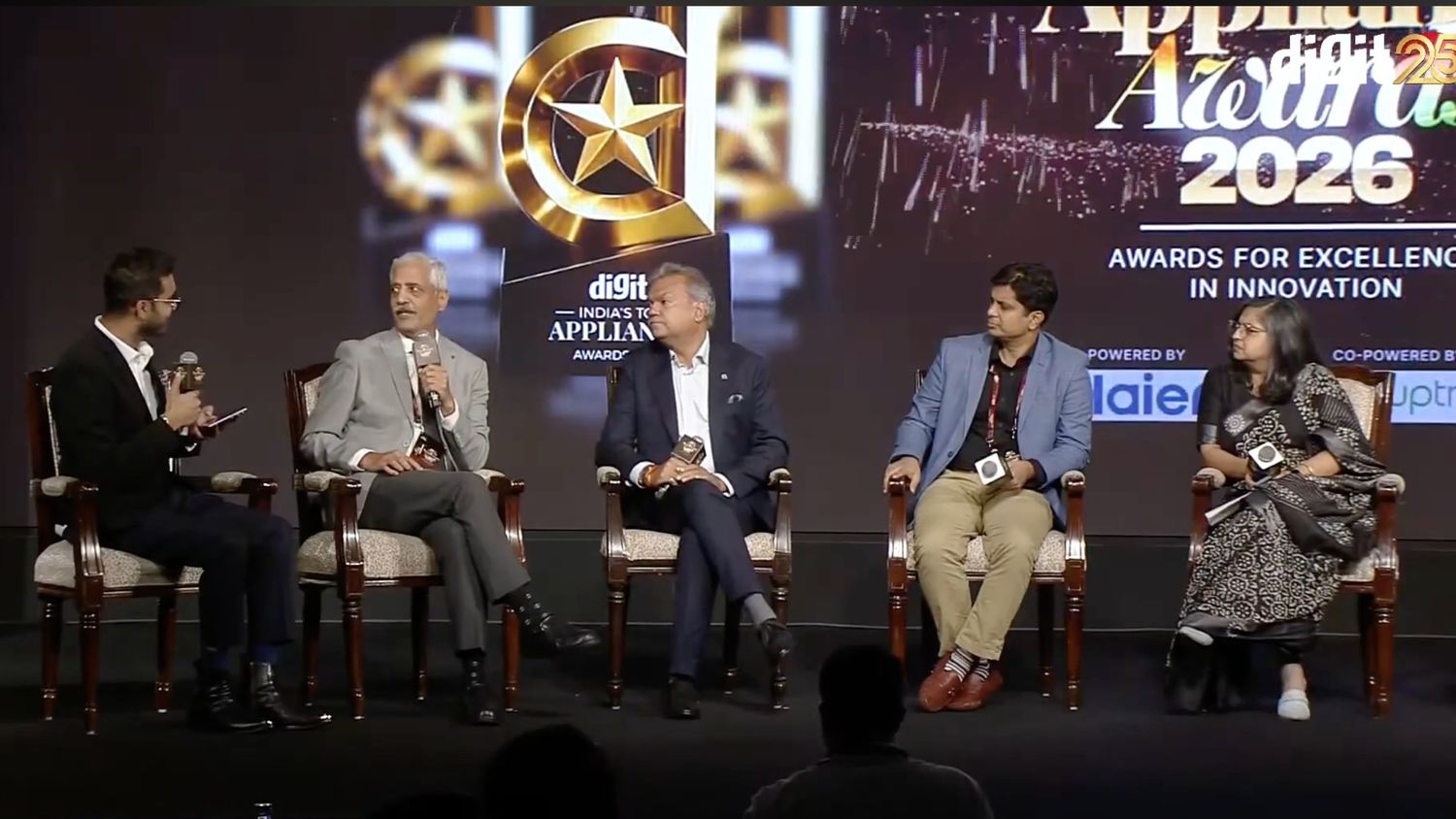

At the Digit India’s Top Appliance Awards 2026 industry leaders gathered on the sidelines to debate a question that sits at the heart of India’s manufacturing ambitions: can the country move beyond being the world’s production floor to becoming a genuine source of global innovation? The conversation brought together executives from across the consumer electronics and appliances ecosystem and what emerged was a picture that was honest about how far India has come and equally realistic about how far it still needs to go.
 Survey
From assembly to design
Swati Samaddar, Head of Government Affairs and Public Policy at CP Plus challenged the conventional framing of India’s manufacturing story. “The biggest opportunity currently in India is not make in India, but design in India, design for India and design for the world,” she said. Her argument was that India’s scale and demographic complexity give it a unique advantage: conditions that resemble the global south more than any advanced economy, which makes it an ideal laboratory for products that could travel. “India has to move from assembling to designing, writing the code for the software which is running each and every appliance, as well as ensuring they are tested for India and for the world.”
Sanjay Jain, Director at ElanPro made the same point through the lens of industrial evolution. “Manufacturing has really taken a big leap in India. Probably the next thing should be the innovation. That will put India on the global stage. We should not be only making, but we should be leading the world in innovation. With all the technology which is available, with Indian engineers, we have some of the top engineers globally leading the tech companies. All that should come into manufacturing also.”
The gap that nobody is filling
Rajeev Singh, Managing Director of BenQ India and South Asia, zeroed in on a very specific structural gap that the broader Make in India narrative tends to overlook. “In the overall ecosystem, one thing is completely missing, which is the display fab manufacturing. Because display is now an integral part of almost all the devices. And not having a display fab in India, that means a good part of every product still has to be imported into India. That’s the one big thing which is yet to happen.”
It is an astute observation that India has made significant strides in mobile assembly, television manufacturing and component sourcing, but the absence of a domestic display fabrication ecosystem means that the most visible and value-intensive component of nearly every screen-based product continues to be imported. Until that changes, a meaningful portion of the value chain for consumer electronics will remain offshore.
Quality, standards and what BIS is getting right
The panel also pushed back on the assumption that scale comes at the cost of quality. Samaddar pointed to the surveillance camera segment, where regulatory intervention has driven both quality and market share in the same direction. “In India, quality is maintained by multiple agencies, but the biggest agency we know of is BIS. With the nodal ministry, the Ministry of Electronics and IT, they have ensured not only do the brands manufacture in India, they manufacture as per the technical norms and the cyber secure requirements which are necessary for such a sensitive product.” The result, she noted, is that Indian companies now hold more than 50% market share in the surveillance camera segment, with even global brands entering the market and certifying locally. “Quality is determined by what you can deliver with standards and by following the regulations. And consumers follow.”
Singh added that BenQ’s own approach to localisation is guided by consumer insight rather than a blanket component-sourcing mandate. “We don’t believe that when you do make in India, you should make each and every part in India. You should really leverage on the things which are good in India. More importantly, when you have a product which is designed for India. We have certain product categories which have come into being because of consumer research in India. They were launched first in India and then globally and they have been a big hit.”
The supply chain reality
When it came to global supply chains, Jain described the experience from the commercial refrigeration industry, where the compressor, the most critical component, is still almost entirely imported. “It has been a nightmare, actually, for the last couple of months. Post-COVID things have really taken a big hit. The reliance which was there earlier has started reducing, but it continues to hurt us. Maybe in the next two or three years, India will be self-reliant, particularly on the compressor side.”
Samaddar broadened the picture saying “Global supply chains went through multiple upheavals right from COVID. There was the semiconductor supply chain crisis. Then the critical mineral crisis. And now we are dealing with the memory crisis, along with SoC. The memory crisis is such that it is affecting each and every appliance in the consumer segment.” Her prescription is to diversify supply chains geographically and begin designing in-house so that supplier selection is not inherited from whoever designed the product elsewhere. “If you bring in the design from outside, you will bring in suppliers which are set in stone in that design. If you design here, you define who should be your supplier. Once you start designing in-house, you design with the supplie,” she added.
Singh echoed this sentiment highlighting, “We have changed our stocking policy and our forecasting, because both have really helped us to mitigate the kind of risks which are very, very uncertain. You just cannot predict what is going to hit you next.”
Circularity as a competitive edge, not a compliance exercise
Mayank Sinha, Business Head at Selsmart, who operates in the recycling and take-back space offered a view of the manufacturing conversation pointing as to what happens to products after the consumer is done with them.
Sinha’s argument was that circularity is becoming a solid sales enabler, not merely an environmental imperative. “Brands are now embracing circularity and I don’t say it in terms of a fancy word. They have understood that if there is a business model where you can build exchanges, you can build take-back by providing an attractive value and you can go to a home and pick it up, the customer is embracing it and brands are embracing it.” He noted that Selsmart has partnered with around ten brands over the past year and that the model has worked in ways even its creators found counterintuitive. “In South India, many cities, places in Kerala, it’s very counterintuitive: when we reduce our prices a bit of what we are purchasing, it actually sometimes the sales have gone up. What we have noticed is that consumers are looking for convenience. They are looking for someone to plug the whole ecosystem of not only buying, but quickly someone coming and picking up.”
On the manufacturing angle specifically, Sinha pointed to advances in materials recovery as a reason to bring recycling formally into the supply chain conversation. “Companies like us are able to extract 27 metals at 99.9% purity, which means that they can be reused in original manufacturing. If that link is there and the processes you have are mirrored to what a manufacturer needs, then those materials become valuable.”
How far is India from real innovation?
The panel’s most unvarnished moment came when Jain was asked directly whether India has reached the point where companies are evaluated for innovation rather than just production capacity. “In certain categories, yes. Overall, it is still a long way. The first thing which you start doing is assembling. Then you start trying to do some localisation and move into complete manufacturing. We have done the same. And then you start innovating, designing. In my line, commercial refrigeration, we are doing a lot of backward engineering still because the globe is much, much ahead of us, be it in refrigerant or compressor and other things. In my wisdom, in my views, we are still at least 10 years away from being real innovators and designers overall in the appliances segment.”
Ten years is a long time in technology, but the fact that senior industry figures are naming a timeline suggests the conversation has matured past the point where manufacturing volume is treated as an end in itself. The harder question, which will be answered by investment decisions, regulatory frameworks and design capability over the next decade, is whether it can get there.
Also Read: DITAA 2026: Digit India’s Top Appliance Awards 2026 winners announced, check the complete list


