

NVIDIA powers the agentic era: The Nemotron 3 debut explained
 Follow Us
NVIDIA Nemotron 3 powers agentic AI with open weight models
Nemotron 3 Nano Super Ultra enable multi agent enterprise workflows
Open weight NVIDIA Nemotron models drive sovereign AI agentic systems
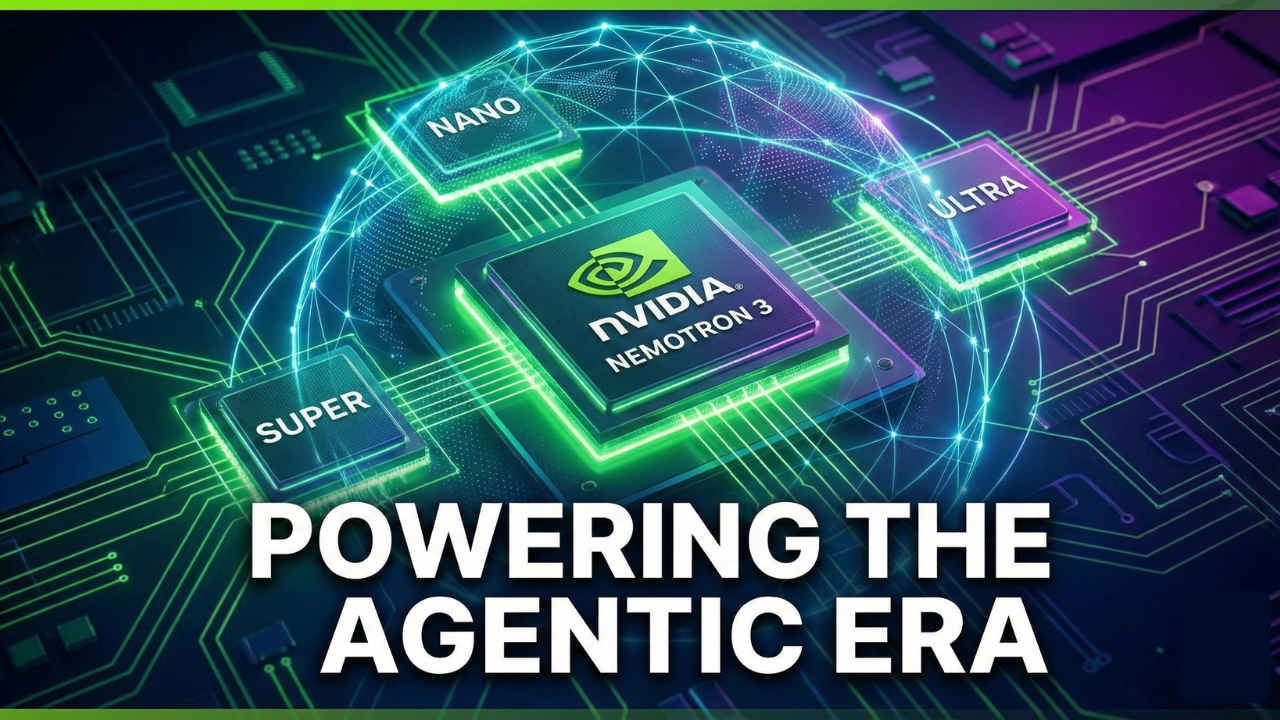

The era of the solitary chatbot is fading. As 2025 draws to a close, the artificial intelligence industry is pivoting aggressively toward “agentic AI” – systems where multiple specialized AI agents collaborate to solve complex problems. Leading this charge is NVIDIA, which has just unveiled its Nemotron 3 family of open models, a release that promises to reshape how enterprises build and deploy these digital workforces.
 Survey
Also read: Sergey Brin admits Google “messed up” and didn’t take LLMs seriously
The Rise of Open Weight Models
The release of Nemotron 3 underscores a vital shift toward “open weight” models, a category that offers a middle ground between closed proprietary systems and fully open-source software. In an open weight model, the developer releases the trained neural network weights – allowing the public to download, run, and fine-tune the model on their own hardware – while often keeping the training data and deeper methodologies proprietary. This approach has exploded in popularity throughout 2024 and 2025. Google championed this early with its Gemma family, lightweight models derived from its Gemini research that allowed developers to build efficient apps on consumer hardware. Similarly, OpenAI entered the fray in August 2025 with gpt-oss, a family of open-weight reasoning models that gave enterprises the ability to run GPT-class reasoning on their own infrastructure, bypassing API dependencies for sensitive tasks. NVIDIA is now taking this concept further by optimizing open weights specifically for multi-agent workflows.
The Triad of Intelligence: Nano, Super, and Ultra
At the heart of the announcement are three distinct models, each sized for a specific role in an AI agent’s workflow. All three utilize a breakthrough “hybrid latent mixture-of-experts” (MoE) architecture, a design that allows the models to boast massive parameter counts while only “activating” a small fraction of them for any given task. This ensures the models remain computationally efficient without sacrificing their intellectual depth.
Nemotron 3 Nano is the fleet-footed scout of the family. Available immediately, this 30-billion-parameter model is optimized for edge computing and high-frequency tasks like software debugging and information retrieval. Despite its size, it activates only about 3 billion parameters per token. NVIDIA claims it delivers four times the throughput of its predecessor, Nemotron 2 Nano, and fits comfortably within a 1-million-token context window. For developers, this means the ability to run capable agents locally or at the edge with minimal latency.
Also read: AI-controlled robot shoots human after prompt manipulation, raising serious safety risks
Nemotron 3 Super, scheduled for the first half of 2026, is the reliable middle manager. With approximately 100 billion parameters (10 billion active), it strikes a balance between speed and depth. It is engineered for high-accuracy reasoning in collaborative environments where multiple agents need to communicate and hand off tasks without losing context or hallucinating details.
Nemotron 3 Ultra represents the heavy artillery. Also arriving in 2026, this 500-billion-parameter giant (50 billion active) serves as the “reasoning engine” for the most complex strategic planning and deep research tasks. It is designed to sit at the center of an agentic workflow, directing the smaller Nano and Super models and handling problems that require long-horizon thinking.
A New Foundation for Sovereign AI
NVIDIA’s strategy extends beyond just model weights. By releasing the Nemotron 3 family alongside open-source tools like NeMo Gym and NeMo RL, the company is providing the “gymnasium” where these agents can be trained and refined. This is particularly critical for “sovereign AI” initiatives, where nations and large corporations seek to build AI systems that align with local regulations, languages, and values, something impossible to achieve with a black-box model hosted on a foreign cloud. With early adopters like Accenture, Siemens, and CrowdStrike already integrating these models, Nemotron 3 is poised to become the standard reference architecture for the next generation of AI: a generation where models don’t just talk to humans, but to each other.
Also read: Samsung SATA SSD production halt explained: Why storage prices are rising


