
How WeatherNext 2 works: Google DeepMind’s AI model for faster, more accurate forecasts
 Follow Us
AI-powered WeatherNext 2 delivers faster, more accurate global weather forecasts
DeepMind’s WeatherNext 2 transforms forecasting with rapid, high-resolution predictions
Google’s advanced WeatherNext 2 model improves reliability of extreme weather monitoring

Weather forecasting influences decisions across every part of modern life – flight operations, agriculture, retail planning, energy management and public safety. Yet the tools behind these forecasts haven’t always been fast or flexible enough to keep up with the world’s increasingly unpredictable climate patterns. Traditional numerical weather prediction models simulate the laws of physics across the atmosphere, but doing so requires supercomputers and hours of processing. In moments where minutes matter, that delay can be crucial.
Google DeepMind’s WeatherNext 2 proposes a new solution. It uses artificial intelligence to deliver global forecasts in less than a minute, while offering more detail and scenario diversity than many conventional systems. This explainer breaks down how it works and why it’s considered one of the most significant steps forward in AI-driven meteorology.
 Survey
Also read: Grok 4.1 explained: What’s new, better, and why it matters for you
Why older forecasting models struggle
Physics-based forecasting remains the gold standard because it mimics real atmospheric behaviour. But this precision comes with a cost. These models are computationally intensive, generate results slowly and make it difficult to run large ensembles, multiple versions of the same forecast that represent uncertainty. Ensembles are vital for predicting extreme weather, but many regions simply don’t have the computing resources to generate them frequently.
AI-based models flip this approach. Instead of simulating the atmosphere from scratch, they learn patterns from decades of global weather data. Once trained, they can produce forecasts quickly while still capturing complex interactions within the climate system.
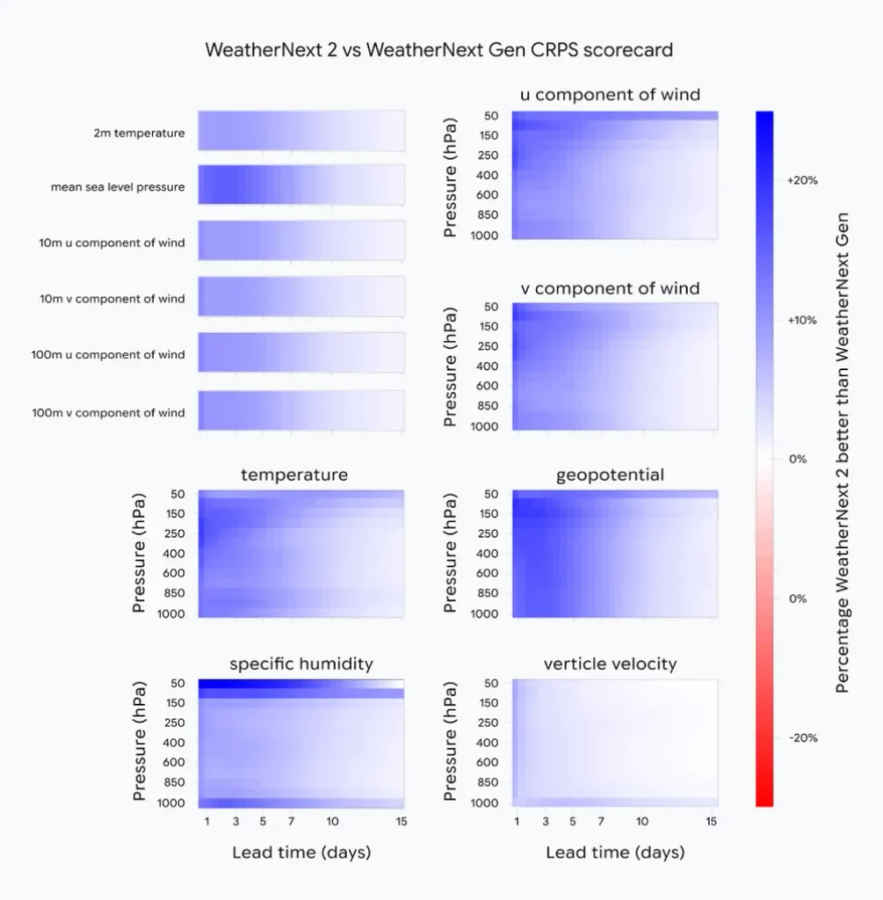
WeatherNext 2 significantly upgrades DeepMind’s earlier models in three crucial ways:
Faster predictions: The system can generate global forecasts in under a minute, making rapid updates and high-frequency insights possible.
Higher accuracy: Google reports that WeatherNext 2 outperforms the previous version across almost all evaluated variables – temperature, wind, humidity and rainfall – up to 15 days out.
Also read: Inside ChatGPT: OpenAI’s new LLM reveals secret of AI’s inner working
Multiple scenarios, not just one: WeatherNext 2 excels at creating hundreds of plausible outcomes from a single atmospheric snapshot. This ensemble-style forecasting is extremely valuable for disaster planning and risk assessment.
How WeatherNext 2 works
The system is built on a large neural network trained with historical weather patterns, satellite data and outputs from traditional forecasting systems.
1. It starts with current atmospheric conditions
WeatherNext 2 takes the latest global data grids, representing variables like pressure, wind and moisture, and sets them as the initial state.
2. It uses a generative architecture
A major innovation is its “Functional Generative Network.” By adding controlled randomness during prediction, the model can output many different but physically coherent future states. This allows forecasters to explore uncertainty, which is a natural part of weather prediction.
3. It learns global relationships through transformer-based AI
Inspired by the same architecture used in large language models, WeatherNext 2 uses transformer components to understand long-range patterns and interactions across the globe. This helps capture complex systems such as monsoons, jet streams and atmospheric waves.
4. It delivers hourly forecasts
The model can provide predictions at hourly resolution for up to 15 days, offering a fine-grained view of weather evolution.
The limitations
AI forecasts depend on the data they are trained on. Gaps, errors or biases can influence predictions, and very localised phenomena still require specialised regional models. For now, AI works best alongside physics-based systems, not as a replacement.
WeatherNext 2 represents a major step toward more democratic, faster and more reliable forecasting. As extreme weather becomes more frequent, tools like this could help communities prepare earlier and respond more effectively, marking a significant evolution in how the world understands and anticipates the atmosphere.
Also read: Meta chief AI scientist Yann LeCun thinks LLMs are a waste of time


