Grok 4.1 brings smarter reasoning, fewer errors, and improved emotional understanding
xAI’s latest model upgrade boosts creativity, stability, and real-world usability
New Grok update improves context memory, collaboration, and overall conversational performance
xAI’s Grok 4.1 arrives at a moment when users are no longer impressed by raw model size or benchmark bragging rights. What they want now is simple: an AI that works, consistently, without friction. That’s the gap Grok 4.1 tries to close.
 Survey
Instead of building a dramatically bigger model, xAI refined the architecture from the inside, overhauling reinforcement learning systems and tightening the way Grok handles logic, reasoning, and step-by-step tasks. The result is an AI that stays on track more reliably and produces fewer of the “hallucinations” that often break trust in conversational systems.


While previous Grok versions were quick but prone to drifting, 4.1 keeps a tighter narrative thread across even long, multi-layered conversations. In practical terms, users don’t need to correct or re-explain as much. Grok simply holds the context better, responds more coherently, and adapts faster when the conversation shifts.
This is a clear sign that xAI is prioritising stability and usability, two things that matter far more in daily use than flashy benchmark numbers.
Also read: RIP em dashes: ChatGPT just made AI writing harder to spot
Emotional intelligence comes to the forefront
Perhaps the biggest conceptual leap in Grok 4.1 is its upgraded emotional modelling. While AI systems have long attempted to mimic empathy, Grok 4.1 aims for something closer to emotional accuracy.
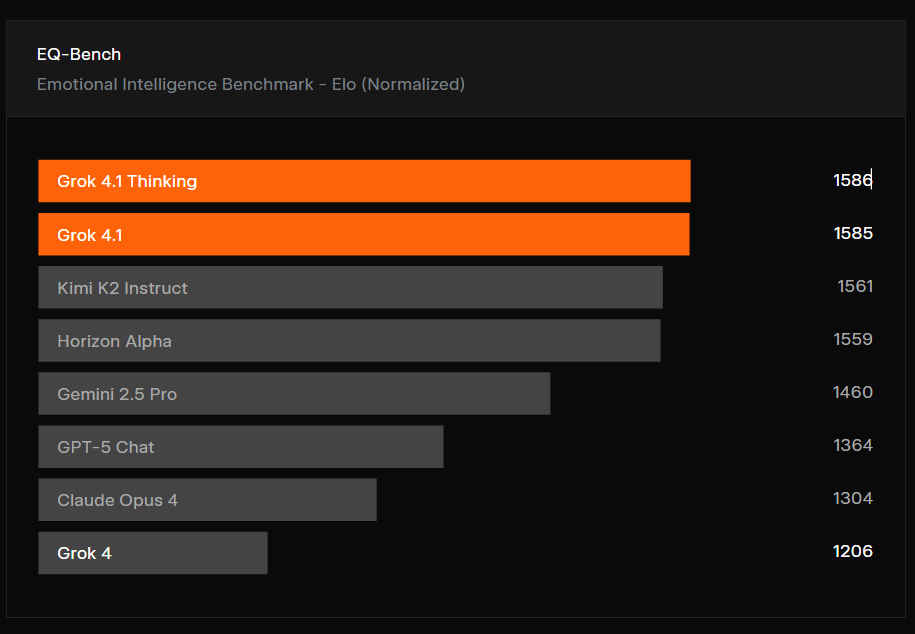
The model is now better at interpreting subtle cues – hesitation, frustration, excitement, sarcasm – and responding in ways that feel more natural without being overly performative. Instead of sounding neutral or mechanical, its tone shifts depending on the user’s mood and intent.
This is particularly useful in long-form collaboration. Whether you’re brainstorming a screenplay, venting about a rough day, or negotiating a complex professional decision, Grok’s responses now demonstrate a deeper recognition of context and emotion. The interaction feels less like “talking to a bot” and more like working with a patient, flexible assistant.
It’s not about the AI having emotions. It’s about the AI understanding yours, and reacting in a way that improves the experience rather than flattening it.
Sharper creativity, stronger reasoning
Grok 4.1 also brings noticeable improvements in creative and conceptual thinking, areas where generative AI is increasingly expected to excel.
Also read: Meta chief AI scientist Yann LeCun thinks LLMs are a waste of time
Writers will find that the model now structures long articles, essays, scripts, or scene outlines with clearer logic. Coders get cleaner, more consistent code blocks with fewer contradictions. Students and researchers benefit from summaries that are less error-prone and better grounded in the source material provided.
One quietly powerful upgrade is Grok’s enhanced multi-turn planning. You can discuss an idea, change direction midway, introduce constraints, and then circle back, Grok 4.1 maintains the thread much more reliably. The model doesn’t collapse under complexity as easily as before, which makes it noticeably stronger in iterative and collaborative workflows.
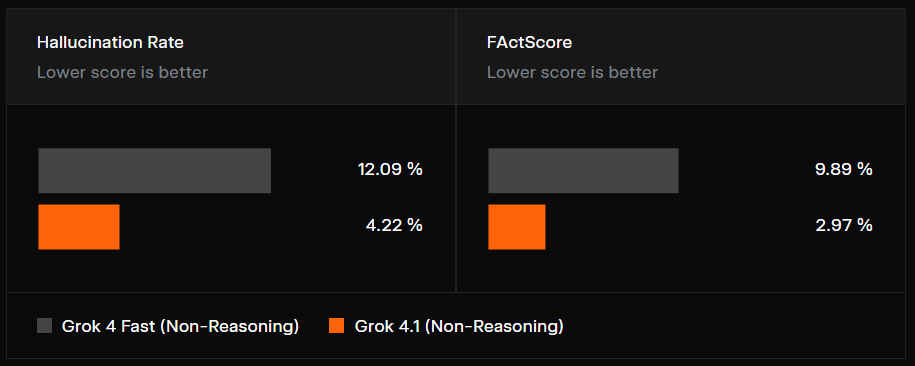
This makes the AI feel more like a teammate – one that remembers the plan, helps refine it, and doesn’t derail when new information appears.
Why Grok 4.1 actually matters for users
All these upgrades add up to one overarching change: Grok 4.1 is easier to trust.
Trust is the real currency of AI adoption. If a model stays consistent, avoids hallucinations, recognises emotional context, and handles complexity without wobbling, people will use it more often and for more meaningful tasks.
xAI’s approach with 4.1 emphasises usefulness over spectacle. Instead of positioning Grok as the biggest or most powerful model, they’re shaping it into a reliable assistant for everyday work: writing, coding, planning, decision-making, and casual conversation.
In a market crowded with increasingly similar LLMs, this focus on human-centric behaviour may be Grok’s strongest differentiator. It signals a shift in AI development, away from raw horsepower and toward models that fit naturally into the rhythm of how people think and work.
For creators, professionals, students, and even casual users, Grok 4.1 isn’t just a technical update. It’s a step closer to an AI that doesn’t just answer but understands, collaborates, and stays grounded.
Also read: Inside ChatGPT: OpenAI’s new LLM reveals secret of AI’s inner working
 Follow Us
Vyom Ramani
A journalist with a soft spot for tech, games, and things that go beep. While waiting for a delayed metro or rebooting his brain, you’ll find him solving Rubik’s Cubes, bingeing F1, or hunting for the next great snack. View Full Profile


