
China’s drones can be charged mid-air using microwave beams, here’s how
 Follow Us

I have been following tech across categories for as long as I can remember and yet China never fails to surprise me. A microwave beam. Charging a drone. In the air. While both the drone and the transmitter are moving. I don’t know who greenlit this at Xidian University, but they clearly skipped the part where someone says “we need to scale this back.”
 Survey
Also read: IIT Madras startup is storing electricity for months with new breakthrough
Here’s what actually happened. A Chinese research team successfully tested a wireless power transfer system that beams microwave energy from the ground directly to a drone mid-flight. The setup uses a mobile ground based emitter which can lock onto a series of antennas mounted beneath the drone to transmit power wirelessly to the drone. During the demonstration, fixed-wing drones flew in mid-air for a total duration of up to 3.1 hours at an average height of about 49 feet above ground level, and the results were published in the peer-reviewed journal Aeronautical Science & Technology.
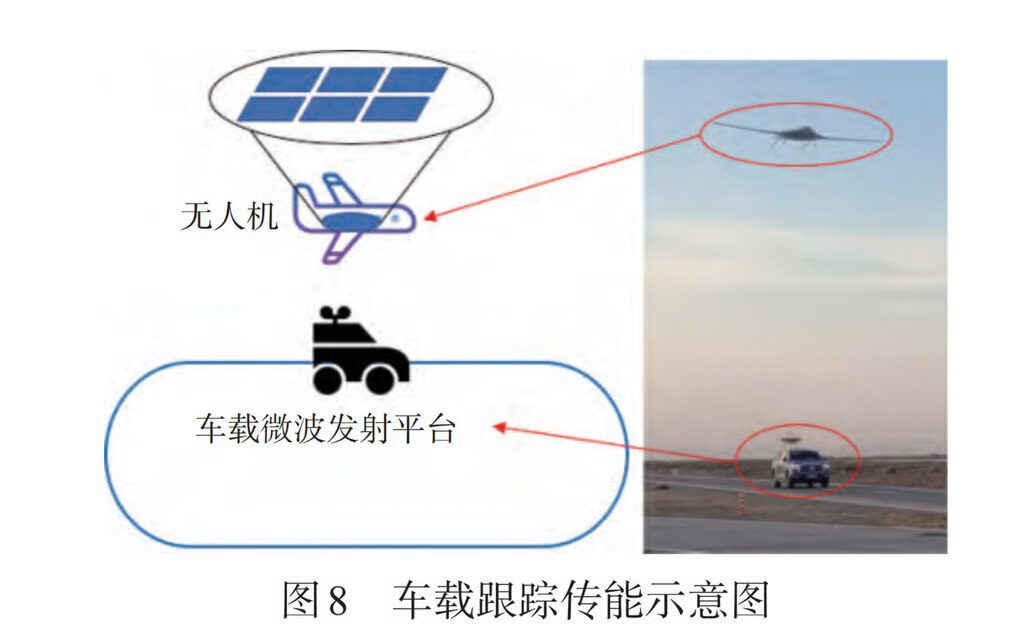
What makes this development interesting and potentially revolutionary is the dynamic nature of the system. In all previous experiments demonstrating wireless energy transmission, stability could only be maintained when there was no relative movement between the transmitter and receiver. That, although still cool, did not have any real world use in warzones. It was here that the team from Xi’an’s Xidian University made their breakthrough; they designed a system in which the drone and the ground-based vehicle can move independently without disturbing the energy transfer process. This was achieved through the integration of GPS guidance and beam steering systems with flight control systems aboard the drones.
Also read: xAI vs ElevenLabs: Are the new Grok speech APIs really better?
This has already been labeled a “land-based aircraft carrier” – an armored platform that does not simply send out drones but continues sustaining their activity similar to a naval carrier that keeps aircraft cycling without ever touching a runway. Military possibilities here should be obvious – permanent reconnaissance, strikes, even electronic warfare without the need to change the battery all become viable without needing the drone to return.
It also changes how drone design philosophies would work. Without having to install batteries for the purposes of long distance flights, additional payload can be added to a drone.
The comparison point is laser-based charging, which the US and several private firms are actively developing. Lasers offer greater precision and longer transmission distances, but they’re disrupted by fog, dust, and atmospheric turbulence, and they emit detectable infrared signatures that give away a drone’s position. Microwave systems don’t have any of those problems.
Whether this works cleanly from a 49-foot test altitude to real operational conditions is still an open question. But China just demonstrated that the hardest part, keeping the beam locked on a moving target, is solvable. The rest is just engineering.
Also read: BITKRAFT’s Jens Hilgers on how the best apps won’t feel like AI at all


