
AI is super capable, but cannot replicate human emotions: Nitin Kumar, Qualcomm
 Follow Us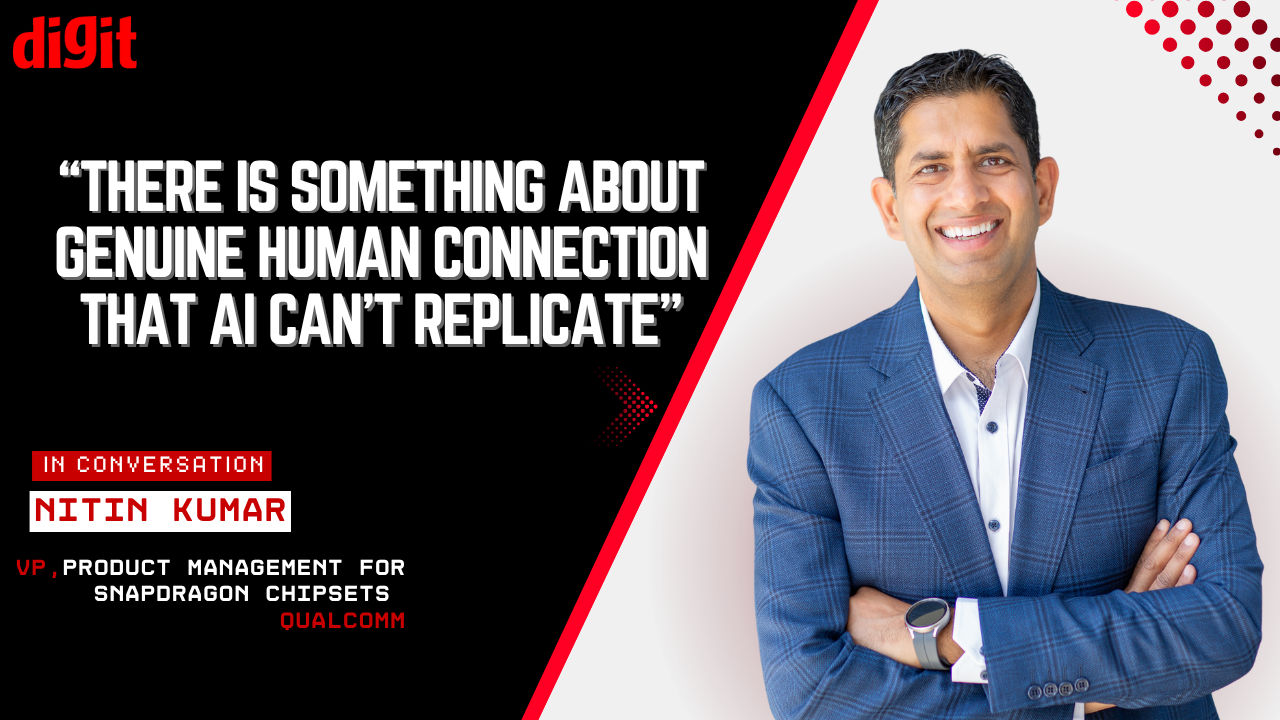

In almost every sci-fi movie, there is a moment where an AI model or a machine becomes intelligent enough to challenge or even compete with human beings. Sometimes it tries to take over the world (The Terminator), sometimes it becomes a friend or emotional companion (Her), or sometimes it becomes a terrorising maniac who wants to rule over the human race (Avengers: Ultron). But no matter the storyline, one question always remains the same: what happens when artificial intelligence (AI) becomes powerful enough to do almost everything we can? In 2026, the answer is right in front of our eyes, and the reality is no longer science fiction. Let me explain.
 Survey
Today, AI can write emails, generate images, summarise meetings, edit videos, and even hold conversations that feel almost natural. The technology is evolving so quickly that it often feels impossible to predict what the next big breakthrough will be.
Yet, amidst all the conversations around what all AI can do, Nitin Kumar, VP, Product Management for Snapdragon Chipsets at Qualcomm, believes there is one thing machines will struggle to replicate: human emotions and empathy. ‘AI can be incredibly capable, but emotional connection and empathy are deeply human traits. And I think that will remain true for a very long time.’ Now this is an interesting perspective from someone helping build the hardware that powers the AI revolution.
During Computex 2026, we got in touch with Nitin Kumar to talk about the rise of AI agents, the idea behind Qualcomm’s new Snapdragon C series processors, and much more. Here are the key excerpts from the conversation:
Qualcomm is calling 2026 the year of agents. What is the one thing that you think an AI agent will be able to do soon that today’s assistants just cannot?
The AI world is changing really, really fast. AI applications, model growth, model evolution in terms of use cases, and the capability of what you would expect an AI model to do are evolving at a very aggressive pace.
From a PC perspective, which is the business that I have, the Snapdragon X Series launched with leading on-device AI capability.
We see that the world is moving toward more AI, and you would want to run more AI locally on the device. Initially, we demonstrated running a 7-billion parameter model, then 13-billion parameter models, and now we can run 20-billion and even 30-billion parameter models locally on the device.
A lot of work has happened, and a lot more is ongoing.
When we launched our X2 product portfolio, we increased on-device AI capability on our NPU from 45 TOPS to 80 TOPS. That number itself is important, but what’s more important is what it enables. Productivity applications, document summarisation, image editing, photo editing, video editing, audio applications, content creation, music generation. All of these use cases leverage AI on the device.
When you look at how the world is changing, tying back to the point that you raised, we strongly believe that as more agents come online, those agents themselves will begin issuing AI commands on their own. That is the true replication of an agentic AI world.
And these agents helping you complete tasks will drive a huge need for AI capability on-device and much better orchestration between local AI and cloud AI.
It is all changing at a very rapid pace.
Qualcomm announced the Snapdragon C chipset during Computex 2026. Tell us more about that. Why did the company decide that now was the right time to launch this chipset?
Snapdragon X stands on three pillars.
The first is that we have to provide the best performance. No matter who you are as a user, a student, an employee, or a casual user, a laptop is ultimately a productivity device. You want the best performance.
The second promise is that we will deliver the best performance, but we will not compromise the battery life. It’s not a trade-off, and users don’t have to choose between the two.
The third promise is that with a device powered by Snapdragon, we will deliver the best on-device AI capability that you can get from a laptop. You will get the best AI. And we have been leading on that for more than a decade in our AI research.
Now, if you look at our journey here with the Snapdragon X series, it began with the Snapdragon X Elite portfolio in June 2024.
We started with Snapdragon X Elite for premium devices priced around $1,000 and above. Then we expanded to Snapdragon X Plus, bringing devices closer to the $800 range. Later, we introduced Snapdragon X, bringing devices closer to the $599 segment. So our goal has always been to bring those three pillars to a broader audience.
But when you look below that segment, around $300, $400, or under $500, there is a very large market of users. That is where Snapdragon C comes in. The idea is to deliver the same three promises in that segment: best performance, exceptional battery life, and AI capabilities.
AI is practically non-existent in that class of devices today, and we want to change that.
Speaking of bringing AI PCs to a larger audience. There are many consumers who still don’t understand why they need an AI laptop. What is Qualcomm’s response to that?
The best use of AI is actually when it works completely behind the scenes. A user doesn’t need to know whether something is AI-powered. They simply need to see the result. For example, when you take a portrait photo on a Snapdragon smartphone, and it automatically blurs the background and applies effects, the user doesn’t manually choose to run an AI model. They simply say, ‘Remove my background.’
The AI works in the background and delivers the result. And the same applies to PCs. There are features like background noise cancellation that run locally on devices using Snapdragon AI.
Here too, the user isn’t consciously running AI. The device understands the context and applies AI automatically.
So users will simply see exciting new features. Behind the scenes, those features are powered by Qualcomm’s NPU and AI capabilities.
Qualcomm has successfully expanded from smartphones into PCs. What do you think is the next major device category where Qualcomm can create a similar disruption?
If you look at consumer electronics broadly, you have earbuds, smartphones, smartwatches, and AR glasses. I’m actually wearing AR glasses powered by Qualcomm’s Snapdragon XR platform right now.
So there are new categories of devices that are just coming along. And most of these devices will be battery-powered. And that means that power consumption is going to be super critical. Also, they’re all mobile. You want to use them and have them with you all the time. Finally, all of these are going to be contextually aware and will need to have the best AI capability because that’s where the magic will happen.
Now, if you look at all these parameters, you can see that Snapdragon is in the best position because we have all those ingredient pieces to make any of these categories of devices successful. Whether it’s smartphones, earbuds, or AR glasses, the core requirements remain largely the same. These devices need to be power-efficient, battery-operated, and capable of delivering advanced AI experiences. And those are exactly the areas where Snapdragon has built its expertise over the years.
Do you believe hardware innovation can keep up with the pace of AI development?
Innovation is happening rapidly on both sides. Hardware is evolving quickly. AI models are evolving quickly. Quantisation techniques are evolving. Accuracy is improving, and new use cases are constantly emerging.
My view is that the pace of innovation today is much faster than it was ten or twenty years ago. Both hardware and software are evolving rapidly, and the entire industry is moving very quickly to adapt.
Speaking of how quickly things are changing, what device do you think people will be carrying five years from now that doesn’t exist today?
I wish I were a futurist who could predict that. But I think it will be some kind of device that can understand your environment contextually and provide value based on that understanding.
Glasses are a good example. When I’m talking to you right now, the glasses can hear what I’m hearing and see what I’m seeing. That gives them a tremendous amount of context.
Future devices may be health devices, wearable devices, or entirely new categories. But one thing will remain consistent: the more a device understands about you, what you see, hear, think, and do, the more useful it becomes. And those devices will be highly personalised.
My AI experience could be very different from yours because the device understands me differently. I believe the world is moving in that direction. And I also believe the smartphone will continue to remain a central device because communication is still its primary purpose.
Everybody talks about AI replacing human tasks. What is the one thing humans will still do better than AI ten years from now?
AI will become an incredible productivity tool. Perhaps the greatest productivity tool humanity has ever created. It will write code, automate tasks, manage schedules and will help people accomplish more.
But I believe there is a fundamental human element that AI will struggle to replace: human-to-human emotional connection. In one word: empathy.
There is something about genuine human connection that cannot easily be replicated.
AI can be incredibly capable, but emotional connection and empathy are deeply human traits. I think that will remain true for a very long time.
Also read: 5 best Windows laptops for freelancers in 2026: Top picks we recommend buying


