

India’s gaming ecosystem has matured, but still has room to grow: Acer APAC president Andrew Hou
 Follow Us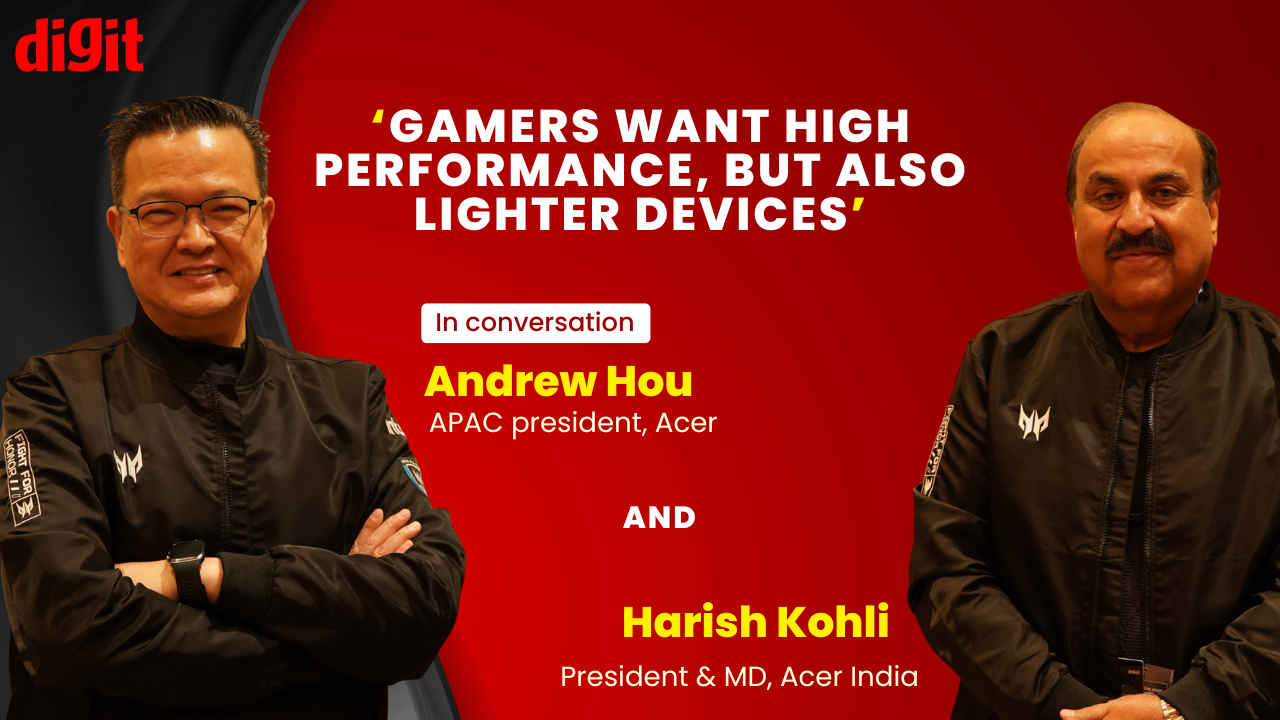

For the longest time, gaming in India lived in the shadows of what were considered “real careers.” It was something squeezed in after homework, played quietly between exams, and often discouraged by parents who saw it as a distraction rather than a discipline. That narrative, however, has shifted decisively over the past few years. Competitive gaming and esports are no longer niche interests reserved for a small set of people. They are organised, aspirational, and increasingly mainstream.
 Survey
That shift was formally acknowledged last year when the Indian government solidified the position of esports in the country through the promotion and regulation of the Online Gaming Act, 2025. With clearer frameworks, growing institutional support, and changing social attitudes, gaming in India has begun to move from living rooms to big stages. And as perceptions continue to change and move forward, global brands are now bringing marquee gaming events to Indian soil.
Also read: India is no longer the underdog in esports: Karan Pathak, Krafton India
Around two months back, Krafton brought the Battlegrounds Mobile India International Cup to New Delhi. And recently, Acer hosted the Predator League 2026 Asia Pacific Finale in the capital on January 10 and January 11, marking a significant moment for India’s place in the global esports ecosystem.
On the sidelines of the tournament, we sat down with Andrew Hou, President of Pan-Asia Pacific Operations at Acer Group, and Harish Kohli, President and Managing Director at Acer India. The conversation revolved around India’s gaming landscape, Acer’s long-term commitment to the market, and what the future holds for gamers. Here are excerpts from the conversation.
India’s gaming ecosystem has moved from casual play to organised esports rather quickly. What has surprised you the most about this evolution compared to other APAC markets?
Andrew: India has a huge population and a young generation. When we talk about esports, it is similar to other South Asian countries like the Philippines and Thailand, which also have young generations and young people like to play games. In that sense, India is similar to other countries.
However, one thing that is different is that around six or seven years ago, I spoke to Harish about selling Predator gaming devices in India since Acer has the Predator brand. The feedback from the team was that most parents in India wanted their kids to focus on studies instead of playing games. At that time, the ecosystem was not ready. The general perception among parents was that playing games would affect their children’s studies.
But over the past several years, the environment has changed. The gaming ecosystem has become more mature, and kids can now study gaming and even become professionals. It has become a different route for kids as well.
So today, I would say that gaming and esports in India have become more mature, but there is still a lot of room to grow. The penetration is not very high yet, but the potential for Acer is very strong.
Is Acer planning any other long term investments here in India with respect to gaming and esports?
Harish: ACD has been an investment we make on a yearly basis at the Asia Pacific level, and we will continue to do that. We have maintained these investments year on year because we have seen their impact on market share and overall growth. As we move forward, there may be one or two additions that we look at introducing in the country. At the Asia Pacific level, we will also continue to evaluate further opportunities.
Laptop gaming remains huge in the APAC region. How does Acer balance portability, thermals, and performance as games become more demanding?
Andrew: That is true. This is why we have our Aeroblade technology, which is now in its fifth generation. It allows us to use thinner fans while delivering better performance in Predator laptops. This helps dissipate more heat compared to other brands. We also use over 20 fan blade pairs, which significantly improves thermal performance.
With AAA games and competitive eSports pushing hardware limits, what kind of innovations can gamers expect from Predator laptops in the future?
Harish: When we talk about gaming products, I will refer back to the earlier question you asked Andrew. Any product we launch must deliver consistent performance. As gaming performance improves, processing power increases, which also leads to higher heat generation. When heat rises, clock frequency drops, even if only for a fraction of a second, and that moment can decide whether a player wins or loses.
We are currently in the fourth stage of development when it comes to cooling technology, and this innovation will continue. Cooling is an area that is fully under our control as a brand. While processors come from partner companies, our cooling technologies are patented by us, and we intend to maintain our leadership in this space.
Beyond raw specifications, what do gamers care about most when choosing a gaming laptop?
Andrew: Gamers want high performance, but also lighter devices. That is why our Aeroblade technology helps with better heat dissipation while allowing us to design lighter yet powerful laptops. If we can offer enough power in a lighter machine, that is exactly what gamers are looking for.
Harish: In addition to what Andrew mentioned, anything that helps me perform better as a gamer matters. This includes keyboard design, key travel, keycaps, and even the lighting and display on the keys. These details directly impact performance.
Gaming products are not a one-time effort. It is an ongoing journey of constant improvement. We cater to casual gaming, mid-level gaming, and true gaming with three different product ranges, and each requires continuous innovation. As a company, we remain committed to supporting eSports and delivering products across all these segments.
What are the biggest shifts you are seeing in how gamers across APAC consume content and engage with brands?
Andrew: Beyond providing powerful machines, gamers want platforms where they can participate in large-scale tournaments and showcase their skills. As a brand, Acer wants to provide that stage and this is one of the reasons we host the Predator League.
We want gamers to stay connected with Acer and Predator, not just by playing but also by understanding our brand and culture. It is about building a deeper relationship with the gaming community.
If you compare Indian gamers with gamers from other regions, do you see any key behavioural differences?
Andrew: They are very similar. They are young and they want to perform better. Overall, gamer behaviour is quite consistent across regions. The main difference may be in game titles, as each country has its own culture and preferences. Other than that, gamers everywhere are very similar.
If you had to sum up Acer’s gaming and tech vision for India in one sentence, what would it be?
Harish: We believe in fresh technology, and we aim to be among the first to turn new innovations into viable, working, and affordable products for customers.
How would you sum up Acer’s gaming and tech vision for the APAC region in one sentence?
Andrew: Acer wants to provide not just stronger and more powerful machines, but also platforms like Predator League where players can perform and showcase their talent.
At CES recently, Acer announced some interesting products, including a 1000Hz monitor. What drove the decision to develop such a high refresh rate display for gamers?
Andrew: Just like with laptops, where we focus on making lighter and more powerful machines using Aeroblade, our goal with monitors is to deliver the fastest refresh rates possible. We always aim to be among the first to bring the latest display technology to gamers, which is why we announced the highest refresh rate monitor this time.
Looking ahead to 2026, what do you see as the biggest challenges and opportunities for Acer in the APAC region?
Andrew:One of the biggest challenges is rising costs, especially for memory, SSDs, and other components. Along with cost increases, there are also supply shortages. Managing supply while delivering sufficient quantities remains a key challenge.
In terms of opportunity, APAC is one of the youngest regions in the world. Markets like India, Indonesia, and the Philippines still have significant room for PC penetration growth, which presents strong opportunities for Acer.
With multiple global PC brands aggressively targeting Indian gamers, what sets Acer Predator apart in such a competitive market?
Harish: Predator is positioned for true gamers. For serious gamers, Predator is often the first brand that comes to mind. The main challenge is affordability, as Predator is not designed for casual or mid-level gaming. It is a performance-focused series, and we do not dilute specifications to meet lower price points.
Predator is built for gamers who aspire to win and perform at the highest level. Competition will always exist, and we are confident in our ability to handle it. We have remained committed to this approach for the past six to seven years and will continue to do so.
As the lights dimmed on the Predator League finale and the cheers inside the arena faded, one thing felt unmistakably clear- gaming in India is no longer asking for validation. It has found its footing, its audience, and its ambition. From global tournaments landing in New Delhi to Indian gamers dreaming bigger than ever, the ecosystem is still young but already confident in its direction. For brands like Acer, the opportunity lies not just in selling powerful machines, but in growing alongside a community that wants to compete, perform, and belong. And for gamers across the country, the journey feels deeply personal. What was once a quiet passion is now a shared pursuit, played out on big stages, watched by millions, and backed by an industry that finally sees them for what they are.
Also read: Handhelds, rollable screens at CES 2026: Cool tech that gamers should not miss


