
AMD FSR Redstone tested: Radeon RX 9070 XT takes on 4K with ray tracing
 Follow Us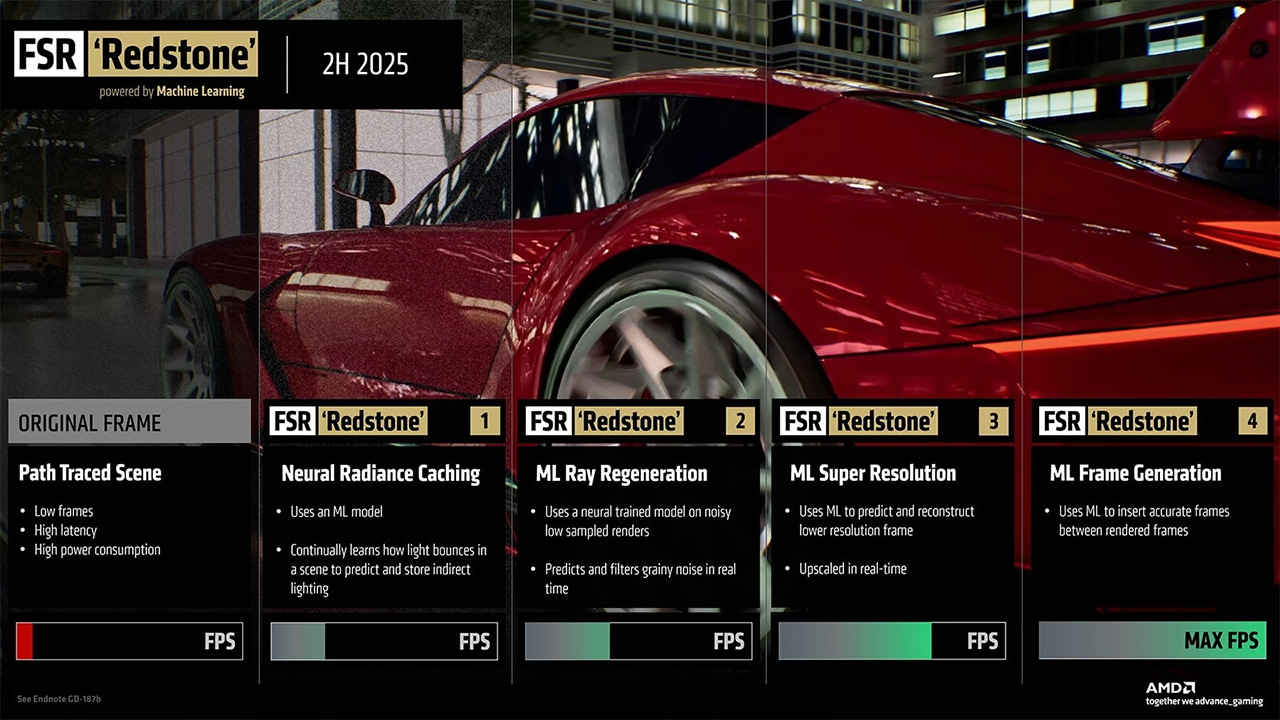

AMD FidelityFX Super Resolution (FSR) has quietly grown from a simple upscaler into a full family of rendering features. With the new FSR Redstone update, that family finally gets a proper name and all the more competitive. Redstone is AMD’s answer to all the machine learning features that NVIDIA has introduced in it’s bouquet of DLSS features. So if you’re wondering what does modern upscaling and ray tracing look like when everything is machine learned, deeply integrated and tuned specifically for Radeon? Then the FSR Redstone update is the answer.
 Survey
We got access to the preview driver for FSR Redstone and we took it out for a spin on an AMD Ryzen 9 9800X3D paired with a Radeon RX 9070 XT, backed by 64 GB of DDR5 at 6000 MT/s, all under Windows 11 with AMD Software Adrenalin Edition 25.12.1. An NVIDIA GeForce RTX 5090 sits in the same system to see how far FSR has come over the years. We’ve recently looked at FSR Ray Regeneration, a neural denoiser that cleans up ray traced data, in a separate article which you can read here.
What FSR Redstone actually is
FSR Redstone is not a single toggle in a graphics menu. It is better understood as a modular pipeline of ML powered components that developers can mix and match. At the front of that pipeline sits FSR Upscaling. Games render at a lower internal resolution, feed motion vectors and depth information into the FSR network, and receive a higher resolution output that aims to look close to native. Quality modes dictate how aggressive this trade-off is, from more conservative Quality and Balanced to the more ambitious Performance setting. This is the bit most players will encounter first, because it is increasingly becoming a standard option in modern titles.
Sitting alongside Upscaling is FSR Frame Generation. Here, a separate network takes the current and previous frames, plus motion data, and predicts an in-between frame. That frame never passes through the game’s logic, but it does show up on the monitor and on the GPU’s utilisation counter. It is essentially free performance from a purely frame rate perspective, with the usual caveats around latency and the potential for visual artefacts.
The most eye-catching newcomer is FSR Ray Regeneration. Traditional ray traced lighting and reflections rely on noisy samples that are then smoothed by analytic denoisers. Redstone swaps that out for a neural network, trained on noisy and clean pairs. The network learns to infer what the fully converged image should look like given a small number of rays, plus buffer inputs such as depth, normals and material properties. The result, in theory, is ray traced output that looks cleaner, stabilises faster and costs fewer rays per pixel for a comparable level of quality.
A fourth feature, Radiance Caching, completes the bouquet of features. This is a neural radiance cache that learns how light moves through a scene and then reuses that knowledge instead of recalculating everything from scratch each frame. It is more of a developer facing technology at this stage, with games expected to adopt it over time. Radiance Caching will be released early next year. For players, the key takeaway is that Redstone is designed as a forward-looking framework, not a single release cycle trick.
Hardware support and game coverage
From a hardware standpoint, Redstone’s most advanced paths are clearly targeted at RDNA 4 class GPUs such as the Radeon RX 9070 XT. FSR Upscaling and the new ML based Frame Generation are tuned for these parts, with fallbacks and analytic variants available for older Radeon cards. Ray Regeneration and Radiance Caching are more tightly coupled to the new architecture, reflecting the extra matrix compute and scheduling changes AMD has baked into RX 9000 series silicon.
On the software side, the update arrives through AMD Software Adrenalin Edition 25.12.1. The driver exposes global controls for FSR Upscaling and Frame Generation, and can upgrade existing FSR 3.1 titles to the new ML path in some cases, although the best experience remains in games that integrate Redstone natively.
Game support is already surprisingly broad on paper. The list of current and upcoming titles spans competitive shooters, open world adventures, racing games and cinematic action RPGs. Marvel Rivals and Black Myth Wukong are positioned as high profile showcases for FSR Upscaling and Frame Generation, while Call of Duty Black Ops 7 is the launch vehicle for Ray Regeneration. Developers can choose to adopt one, several or all of these features, which means the exact Redstone experience will vary title by title.
Test setup and methodology
To understand what all this looks like in practice, the tests focus on two main games for numbers, and treat a third as a supplementary case. Call of Duty Black Ops 7 was benchmarked using the internal performance tool, with the graphics preset set to Extreme. The key Redstone features in use were FSR 4 based Upscaling and Frame Generation on the Radeon RX 9070 XT, with Ray Regeneration enabled when running the game’s ray traced mode. Resolutions tested were 1920 × 1080, 2560 × 1440 and 3840 × 2160.
Marvel Rivals was also measured using its built in Performance Tool. The graphics preset was set to Ultra, at the same three resolutions. Here the emphasis is on FSR Upscaling plus Frame Generation, rather than ray traced effects, because the game’s visual direction is tuned for clarity and quick readability rather than heavy path traced mood lighting.
Black Myth Wukong serves mainly as a qualitative yardstick in this particular piece. The game is visually dense, with abundant foliage, complex lighting and fast moving particles, which makes it a good stress test for upscaling and frame generation.
FSR Upscaling in practice
On its own, FSR Upscaling in Redstone feels like a natural continuation of AMD’s earlier work rather than a dramatic reset. In Marvel Rivals at 1440p with the Ultra preset, the Quality mode delivers an image that, in motion, is very close to native. Character silhouettes, ability effects and UI elements retain their sharpness, which is vital in a competitive shooter where clarity directly translates to performance.
At 4K, stepping down to more aggressive modes starts to reveal the familiar trade-offs. Fine diagonal lines, wire meshes and distant foliage can show a touch of shimmer during fast camera pans. That said, Marvel Rivals is built with clean, stylised visuals and high contrast outlines. This art direction naturally masks some of the heavier lifting the upscaler is doing. The technology largely gets out of the way, which is arguably the best compliment for any reconstruction method in a game that lives or dies by visibility.
In Black Ops 7, the story shifts slightly. Environments are denser, with more grounded lighting and smaller details crammed into reflective surfaces. Here, FSR Upscaling acts as the foundation on which Ray Regeneration and Frame Generation sit. At 1080p, running FSR 4 in a quality oriented mode gives enough headroom for the GPU to keep both RT and FG active without the frame rate collapsing, while still retaining clean enough edges on distant geometry and signage. At higher resolutions, the upscaler has to work much harder, but the overall impression is that of a competent, modern temporal solution rather than a throwback to the blurrier era of early spatial upscalers.
Frame generation impressions
In Marvel Rivals, using the Ultra preset with FSR 4 and Frame Generation on the RX 9070 XT, the internal tool reports around 211 frames per second at 1920 × 1080. Stepping up to 2560 × 1440 drops that to roughly 162 frames per second, while 3840 × 2160 still manages about 97 frames per second. Those are strongly playable numbers across all three resolutions, even at 4K, and they illustrate the key point: with FSR Upscaling doing the heavy lifting and Frame Generation filling in the gaps, the card is no longer struggling to reach high refresh territory in this title.
In Call of Duty Black Ops 7 with the Extreme preset, the pattern is similar but the absolute numbers are naturally lower because of heavier rendering. With FSR 4 and Frame Generation enabled, the RX 9070 XT reaches about 200 frames per second at 1920 × 1080, 155 frames per second at 2560 × 1440, and 82 frames per second at 3840 × 2160.
From a feel perspective, the difference is most noticeable at 1440p and 4K. At 1080p, many players will already be CPU limited in parts of the benchmark, which means Frame Generation has less room to stretch. At higher resolutions, the extra frames act as a buffer against heavy scenes, keeping camera motion smooth and input response consistent when explosions, particles and smoke fill the screen.
Because frame generation always raises the question of latency and artefacts, this testing also cross checks behaviour on the RTX 5090 using its own vendor specific solution. The goal is not to turn this into a strict head to head, especially without identically matched data, but to sanity check whether AMD’s approach feels roughly competitive in fast paced shooters. The short answer is that, when paired with suitable latency mitigation such as the latest Anti Lag implementation on Radeon, Redstone’s Frame Generation lands in a similar ballpark for playability, even if individual artefact patterns differ between vendors.
Ray Regeneration in Call of Duty Black Ops 7
Ray Regeneration is, in many ways, the most visible calling card for Redstone right now, and Black Ops 7 is the flagship showcase. Instead of relying on an analytic denoiser, the game taps into a trained network that reconstructs high quality reflections and lighting from a limited number of ray traced samples.
In practice, the impact is clearest in scenes with mirrors, glass and glossy surfaces. Reflective floors that would normally crawl with noisy samples for a few frames settle much more quickly. Pooling water shows cleaner highlights and better defined reflections of surrounding geometry. Metallic signage and equipment racks pick up subtle environmental bounce that would be easy to miss without side by side comparisons.
Crucially, the effect is not only about static image quality. Temporal stability, the ability of a scene to hold together during camera motion, also improves. With Ray Regeneration enabled, panning across a corridor with bright overhead lights and reflective surfaces produces fewer flickering artefacts. Edges inside reflections stay coherent, and the denoiser is less likely to smear or over blur fine details.
There are still trade offs. In some cases, distant reflections can look a little more smoothed out than a fully converged reference, especially when the underlying sample count is very low. However, in typical gameplay conditions, the balance between cost and quality is favourable. Combined with FSR Upscaling and Frame Generation, it allows the RX 9070 XT to render convincingly ray traced scenes at frame rates that would previously have required aggressive cuts to either resolution or fidelity.
For readers who want a microscope level treatment of image quality artefacts, there is a separate, dedicated feature that zooms into Call of Duty Black Ops 7’s Ray Regeneration implementation, complete with curated screenshots and comparisons against competing denoisers. This article treats that as the companion piece and concentrates on where Ray Regeneration sits in the broader Redstone package.
What does this mean for game devs?
It is impossible to discuss Redstone without touching on its role in the broader rendering landscape. NVIDIA has spent years iterating on DLSS, including its own frame generation and ray reconstruction features. Intel has pushed XeSS as another open, cross vendor option. Redstone is AMD’s attempt to bring its suite up to parity or better, while staying relatively open and accessible for developers.
One of the underlying design goals is modularity. Developers can adopt Upscaling alone, or pair it with Frame Generation, or go deeper with Ray Regeneration and Radiance Caching where their content justifies the extra effort. In practice, this matters because different genres have different tolerances for artefacts and latency. A story driven action RPG can afford more aggressive reconstruction than a competitive shooter. Redstone’s flexibility gives studios room to tune behaviour per title.
On the roadmap side, Radiance Caching is likely to play a larger role in the next wave of ray traced games. By learning lighting behaviour on the fly and reusing it efficiently, it promises to bring higher quality global illumination to more players without requiring future-proof brute force hardware. That is a medium term benefit rather than something that will change the feel of games overnight, but it reinforces the idea that Redstone is designed as a long term platform.
FSR Redstone – Team Red’s time to shine?
Taken as a whole, FSR Redstone finally gives AMD a convincingly modern answer in the upscaling and frame generation race. On a Ryzen 9 9800X3D with a Radeon RX 9070 XT, the combination of FSR 4 Upscaling and Frame Generation delivers frame rates that would have looked improbable at similar settings a couple of years ago, particularly at 1440p and 4K. Ray Regeneration, in particular, feels like an important step. It brings a noticeable bump in reflection and lighting quality without making the performance cost prohibitive, and it points toward a future where neural denoisers become the norm rather than a specialist feature.
There are still caveats. The full experience leans heavily on RDNA 4 hardware, and the quality of Redstone integrations will vary from title to title. Frame Generation remains a feature that should be layered on only once the base frame rate is in a healthy range. And there are occasional artefacts and corner cases that remind players that this is still an evolving technology.
Even so, the direction of travel is clear. For Radeon owners willing to update to the latest drivers and chase games that actively integrate Redstone features, the payoff is tangible. FSR Redstone is a meaningful evolution of AMD’s rendering stack that makes high frame rate, ray traced gaming more accessible on its own hardware, and it lays the groundwork for more ambitious lighting and reconstruction techniques in the years ahead.


